The Parent Engagement Score: How to Measure and Improve It in Your School
In this article
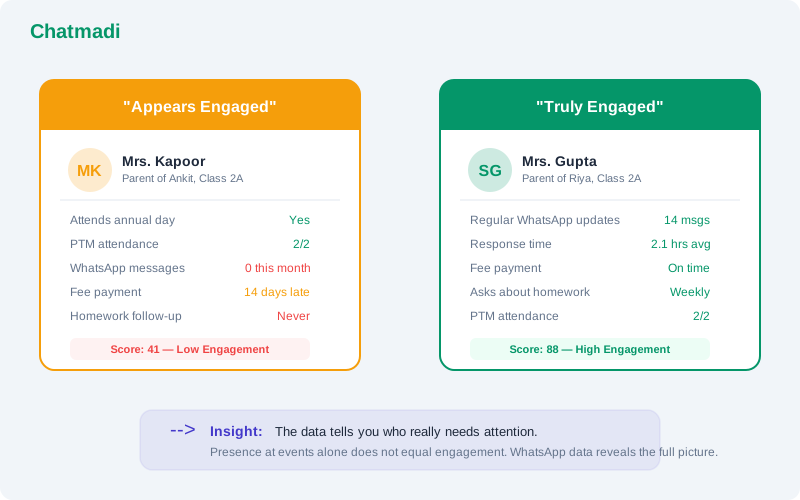
Most Indian schools have an intuitive sense of which parents are engaged and which are not. The class teacher knows that Mrs. Sharma always attends PTMs, responds to homework messages promptly, and pays fees on time. She also knows that Mr. Nair has not attended a single PTM this year, rarely acknowledges homework, and is consistently late on fee payments. What most schools lack is a systematic way to quantify this knowledge, track it over time, and use it to improve outcomes. A parent engagement platform for schools India needs must go beyond messaging and into measurement. Chatmadi computes a Parent Engagement Score for every student's family automatically, using data the school already generates through its daily WhatsApp communication.
What a Parent Engagement Score Is (And What It's Not)
A Parent Engagement Score is a composite metric that measures how actively a family participates in their child's school life across multiple dimensions. It is a number between 0 and 100 that gives teachers and administrators a quick way to understand each family's engagement level. What it is: a diagnostic tool. Like a student's academic score, the engagement score identifies areas of strength and areas that need attention. A parent with a score of 45 is not a bad parent. They are a parent whose school interaction patterns suggest they may need more support or a different communication approach. What it is not: a judgement. The engagement score is never shared with parents. It is an internal tool for school staff to prioritise their outreach and identify families who may be at risk of disengagement. Schools that treat the score as a management tool rather than a rating system get the most value from it. The score is also not static. It updates as new data comes in. A parent whose score drops from 80 to 55 over two months is showing a pattern that deserves attention. A parent whose score rises from 40 to 70 is responding to the school's outreach efforts.
The 4 Factors That Make Up a Parent Engagement Score
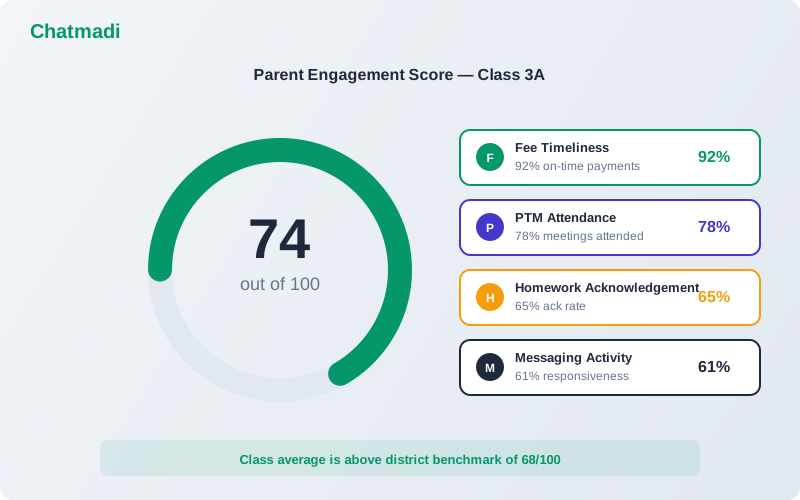
Chatmadi's Parent Engagement Score is built from four equally weighted factors, each contributing 25 points to the 100-point total. Factor one: fee timeliness. This measures whether the family pays school fees on time. A family that has paid all instalments by the due date scores 25 out of 25. A family that is consistently late scores lower. A family with outstanding overdue fees scores lowest in this dimension. Fee behaviour is a strong signal because it reflects the family's prioritisation of the school relationship, though financial difficulty must be considered when interpreting this factor. Factor two: PTM attendance. This measures the family's attendance at parent-teacher meetings. A family that has attended every PTM scores 25 out of 25. Partial attendance scores proportionally. A family that has never attended a PTM scores 0 in this dimension. PTM attendance reflects how much the family values direct interaction with teachers about their child's progress. Factor three: homework acknowledgement rate. This measures how consistently the parent acknowledges homework notifications in WhatsApp. A parent who acknowledges every homework message scores 25 out of 25. The rate is calculated over a rolling 30-day window to capture recent behaviour rather than historical averages. Factor four: conversation frequency. This measures how often the parent communicates with the school via WhatsApp. It counts both proactive messages (the parent initiates) and responsive messages (the parent replies to school communications). Regular communication suggests an engaged, connected family.
How Chatmadi Computes and Displays Engagement Scores
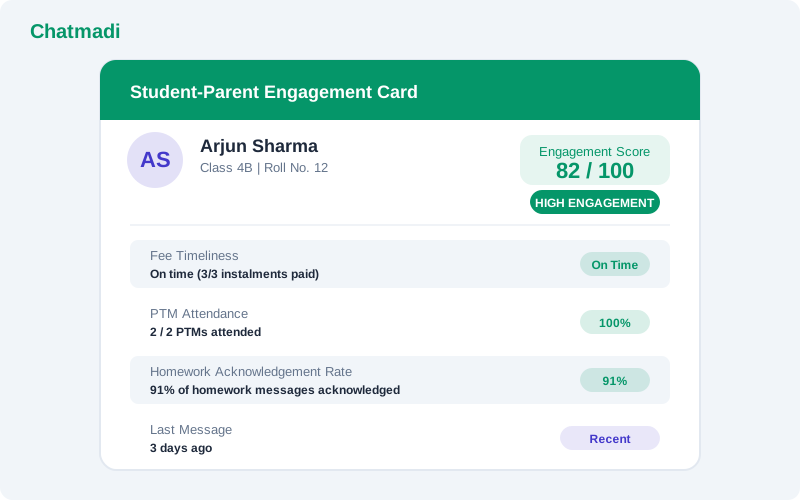
Chatmadi computes engagement scores automatically using data from its existing modules. Fee timeliness data comes from the fee detection and tracking system. PTM attendance data comes from the PTM module. Homework acknowledgement data comes from the assignment tracking system. Conversation frequency data comes from the conversation analysis engine. The score updates each time new data enters the system. When a teacher uploads a fresh WhatsApp conversation, the conversation frequency and homework acknowledgement components update immediately. When a fee payment is detected, the fee timeliness component adjusts. When PTM attendance is recorded, that component updates. Teachers see engagement scores in two places. First, on each student's profile page, where the score is displayed as a prominent badge with a breakdown of all four components. This helps the teacher prepare for parent interactions with full context. Second, on the class dashboard, where all students are listed with their parent engagement scores sorted from lowest to highest. This view makes it easy to identify the families that need the most attention.
Student parent engagement card for Arjun Sharma showing 82 out of 100 score with fee PTM homework and communication metrics
How-To: Using Engagement Scores to Prioritise Parent Outreach
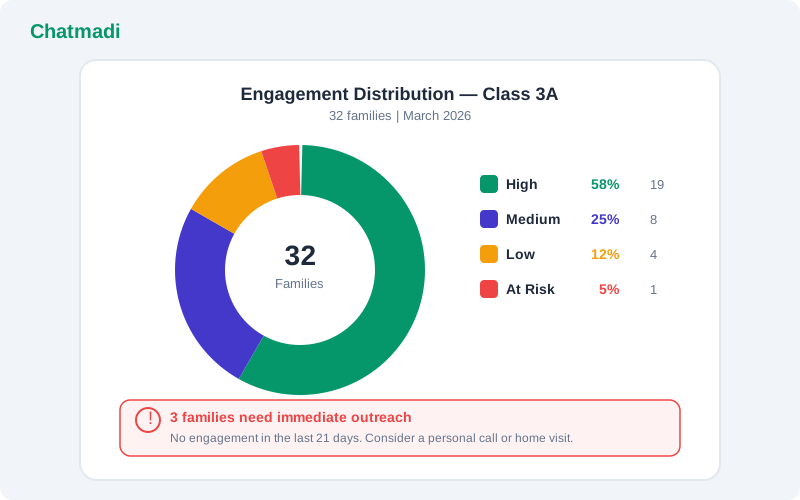
Engagement scores are most valuable when they drive action. Here is a systematic approach to using them. Step one: segment your class into four tiers. High engagement (75 to 100): these families are highly connected. Acknowledge their involvement and maintain the relationship. No special outreach needed. Medium engagement (50 to 74): these families are partially engaged. They may attend PTMs but ignore homework acknowledgements, or they may pay fees on time but never communicate. Identify the specific weak dimension and address it. Low engagement (25 to 49): these families need active outreach. A personal message or phone call from the class teacher can make a significant difference. Understand the barriers and offer support. At risk (0 to 24): these families are essentially disconnected from the school. This requires intervention from the class teacher and possibly the principal or school counsellor. Step two: for each Low and At Risk family, review the score breakdown. If the weak dimension is fee timeliness, the accounts team should reach out to discuss payment arrangements. If the weak dimension is PTM attendance, offer alternative meeting formats. If the weak dimension is homework acknowledgement, check whether the parent is in the correct WhatsApp group and receiving messages. If the weak dimension is conversation frequency, initiate a warm, non-transactional conversation. Step three: track score changes monthly. After outreach, monitor whether the family's score improves. If it does, the outreach is working. If it does not, escalate to a different approach.
Engagement distribution pie chart showing High 58% Medium 25% Low 12% At Risk 5% with outreach alert
The School That Used Engagement Scores to Cut Dropouts by 30%
Parent disengagement is the strongest predictor of student dropout in Indian schools. When a family's engagement score drops consistently over two or more terms, the probability of the student leaving the school increases significantly. One pattern that schools using Chatmadi have identified is the engagement decline curve. A family that scores 80 in Term 1 and 55 in Term 2 is on a trajectory that, if unaddressed, leads to a score of 30 or below by Term 3. By Term 4, the family has withdrawn the child. Schools that intervene during the decline, when the score drops by 20 or more points between terms, can often reverse the trajectory. The intervention is usually simple: a personal phone call from the class teacher expressing concern and asking how the family is doing. In many cases, the decline is caused by a temporary issue such as a parent's job change, a family relocation scare, or dissatisfaction with a specific incident at school. Addressing the issue early, before it compounds into full disengagement, keeps the family connected. Schools using Chatmadi's engagement scoring have reported measurable improvements in retention by systematically identifying and reaching out to families showing declining scores. The earlier the intervention, the higher the probability of retention.
Frequently Asked Questions
Is the Parent Engagement Score shared with parents?
No. The engagement score is an internal management tool visible only to school staff. It is used to prioritise outreach and identify families that need support, not to rate or judge parents.
What if a parent scores low because of financial difficulty rather than disengagement?
The score is a diagnostic tool, not a judgement. A low fee timeliness score may indicate financial difficulty rather than disengagement. Teachers should interpret the score in context and use the component breakdown to understand the full picture before taking action.
How often does the engagement score update?
The score updates in real time as new data enters Chatmadi. Each conversation upload, fee detection, PTM attendance record, or homework acknowledgement triggers a recalculation.
Can schools customise the weighting of the four factors?
The default weighting is equal: 25% each. Schools can adjust the weights based on their priorities. For example, a school that values PTM attendance highly can increase that weight and decrease another.
What is a good average engagement score for a class?
Most classes using Chatmadi achieve an average engagement score between 65 and 80. Scores below 60 at the class level suggest systemic communication issues that need addressing.
---
You cannot improve what you do not measure. Chatmadi measures parent engagement automatically so you can improve it deliberately. Start free at chatmadi.com
Tagsparent engagement platform for schools Indiaschool parent engagement tracking softwareparent school communication tool IndiaAI powered school communication toolChatmadi
C
Chatmadi Team
School Communication Intelligence
The Chatmadi team writes about AI-powered parent communication, school management best practices, and WhatsApp intelligence for Indian schools. Built by Eduloom Technologies OPC Pvt Ltd, Mysore.