How to Automate School Communication Without Losing the Human Touch
In this article
When a school announces that it is adopting an AI-powered communication tool, the first question from teachers is usually not "How does it work?" It is "Will we lose the personal connection with our parents?" This is a legitimate concern. Schools are not factories. The relationship between a teacher and a parent is built on trust, empathy, and genuine care for a child's wellbeing. If automation makes that relationship feel transactional, it has failed regardless of how much time it saves. Automated school management software India schools adopt must understand this distinction. Some school communication should be automated. Some must remain human. The challenge is knowing which is which. Chatmadi is designed around this principle: automate the routine so that humans have more time for what matters.
The Real Fear Behind School Automation: Will We Lose What Makes Us a School?
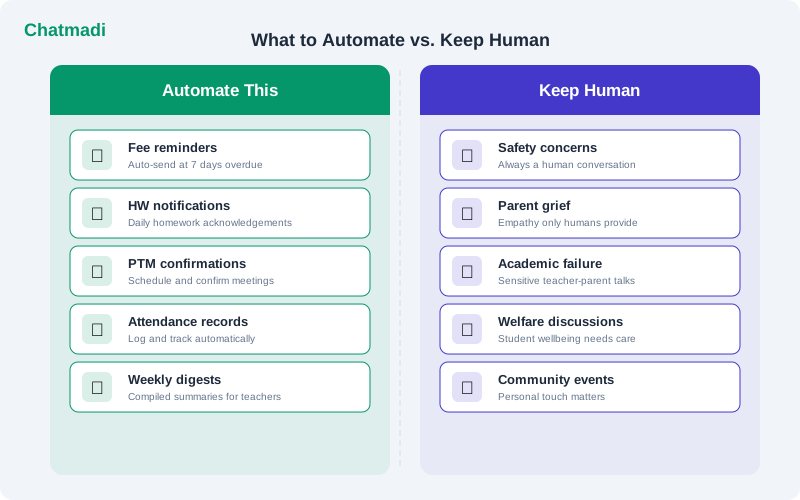
The fear is not irrational. Parents choose schools based on the relationships they build with teachers. A parent whose child is struggling wants to hear from a teacher who cares, not from an automated system that generates alerts. A parent who is going through a difficult time wants empathy from a human, not a perfectly timed fee reminder from an AI. Schools that automate everything risk creating the very problem they are trying to solve: efficient communication that nobody trusts. The solution is not to avoid automation. It is to automate intelligently. There are two categories of school communication: information delivery and relationship management. Information delivery includes fee reminders, homework notifications, PTM scheduling, attendance confirmations, and weekly digests. These are factual, routine, and predictable. They can and should be automated because manual handling of these tasks consumes teacher time without adding personal value. A fee reminder is a fee reminder whether a human types it or an AI drafts it. Relationship management includes responding to a parent's concern about bullying, discussing a child's academic struggles, addressing family difficulties that affect school performance, handling safety escalations, and building community through personal connection. These require empathy, judgement, and the kind of contextual understanding that only humans provide. They should never be automated.
What Should Be Automated and What Must Stay Human
Automate these: fee reminders. Chatmadi drafts personalised fee reminders with the correct parent name, student name, amount, and due date. The teacher reviews and sends. The personalisation makes it feel individual even though the draft is automated. Automate these: homework notifications. The homework assignment is shared in the WhatsApp group by the teacher. Chatmadi tracks which parents acknowledge it. The follow-up reminder to non-acknowledging parents is drafted automatically. Automate these: PTM logistics. The scheduling, RSVP tracking, and confirmation reminders are handled by Chatmadi. The teacher focuses on preparing meaningful discussion points for each parent. Automate these: attendance recording. When a parent sends an absence message, Chatmadi detects it and records it. The teacher does not need to manually enter what the AI already captured. Automate these: weekly digests. A summary of the week's key data points is generated for teachers and optionally for parents. This replaces the manual weekly update that teachers often skip because it takes too long to prepare. Keep human: safety concerns. When a parent raises a welfare concern, the AI detects and escalates it, but the response must come from a real person. A teacher or principal must acknowledge the concern, investigate, and follow up personally. Keep human: academic counselling. When a student is struggling, the conversation with the parent must be human-led. The teacher has context that the AI does not: classroom observations, peer dynamics, and the student's emotional state. Keep human: grief and crisis. When a family faces a loss, illness, or other crisis, the school's response must be genuinely human. An automated message of condolence would be tone-deaf. Keep human: community building. School events, celebrations, and community activities thrive on personal warmth. The invitation can be automated. The warmth cannot.
How Chatmadi Is Designed Around the Human-AI Balance
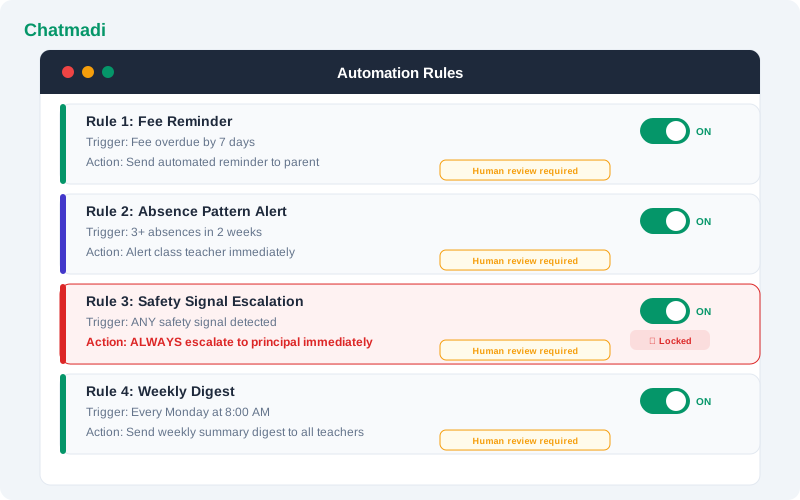
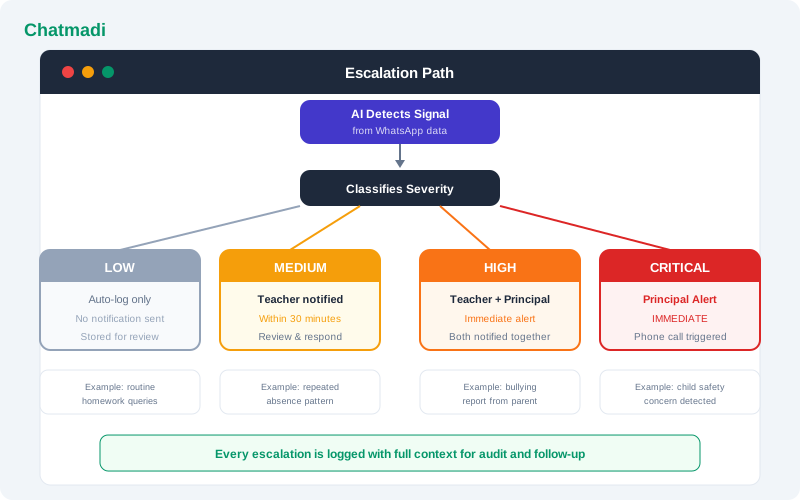
Chatmadi's architecture enforces the human-AI balance through three design decisions. Design decision one: AI drafts, humans approve. Chatmadi never sends a message to a parent without human approval. Fee reminders are drafted by the AI and presented to the teacher for review before sending. This ensures that every parent-facing message has a human checkpoint. Design decision two: severity-based escalation. The AI classifies every detected signal by severity. Low-severity signals (routine attendance confirmations, homework acknowledgements) are logged automatically and presented on the dashboard. Medium-severity signals (declining engagement, emerging absence patterns) generate teacher notifications that recommend action. High-severity signals (safety concerns, POCSO-relevant content) generate immediate alerts to the teacher and principal with the expectation of same-day human response. Critical signals bypass all routing and reach the principal within minutes. Design decision three: the AI provides data, not decisions. Chatmadi tells the teacher "Mrs. Nair's engagement score dropped from 78 to 52 over the last month." It does not tell the teacher what to do about it. The teacher uses their professional judgement, their knowledge of the family, and their relationship with the parent to decide the appropriate response. The AI illuminates. The human decides and acts.
Automation rules settings showing four rules with toggle switches and human review indicators
How-To: Creating Your School's Automation Policy
Every school that adopts AI tools should create a simple automation policy that guides staff on what is automated and what requires human handling. Here is a template. Section one: what we automate. List the specific communication types that are handled by Chatmadi with teacher approval: fee reminders, homework follow-ups, PTM scheduling, attendance recording, weekly digests. For each type, specify the human checkpoint: who reviews before sending. Section two: what we never automate. List the communication types that require personal human response: safety and welfare concerns, academic counselling conversations, responses to parent complaints, family crisis situations, and any communication involving sensitive student information. Section three: escalation paths. Define the routing for different signal types. Low: logged automatically. Medium: teacher notified within 24 hours. High: teacher and principal notified immediately. Critical: principal notified for immediate response. Section four: review cadence. The automation policy should be reviewed quarterly to ensure it still reflects the school's values and the parents' expectations. If parents report feeling disconnected from the school, the automation may need to be pulled back. If teachers report being overwhelmed despite automation, the automation may need to be expanded. Post this policy in the staff room and discuss it during the first staff meeting of each term.
Escalation path diagram showing AI signal detection through severity classification to appropriate human response
The Signs That Your Automation Has Gone Too Far
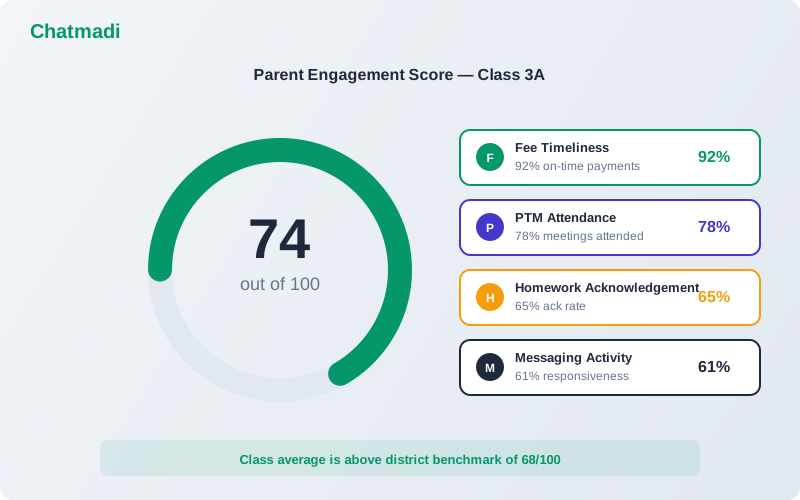
How do you know if your school's automation has crossed the line from helpful to harmful? There are five warning signs. Sign one: parents complain that the school feels "impersonal." If multiple parents independently describe the school's communication as cold, robotic, or transactional, the automation has replaced human warmth rather than supplementing it. Pull back and add more personal touchpoints. Sign two: teachers stop communicating with parents directly. If teachers rely entirely on AI-drafted messages and stop having personal conversations with parents, the relationship layer is eroding. Encourage teachers to make at least one personal phone call per week to a parent. Sign three: safety concerns are responded to with system messages. If a parent raises a safety concern and receives a templated response instead of a personal acknowledgement, the automation is handling something it should not. Review your escalation paths immediately. Sign four: parent engagement scores drop despite more communication volume. If the school is sending more messages than ever but engagement is declining, the messages are noise, not signal. Reduce automation volume and increase personalisation. Sign five: the school feels like a service provider rather than a community. Schools are communities where children grow. If automation makes the school feel like a subscription service, something essential has been lost. The goal of automation is to give teachers and principals more time for human connection, not less.
Frequently Asked Questions
Does Chatmadi ever send messages to parents without teacher approval?
No. All parent-facing messages are drafted by the AI and presented to the teacher or administrator for review and approval before sending. Chatmadi never bypasses the human checkpoint for parent communication.
Can I turn off automation for specific communication types?
Yes. Each automation rule in Chatmadi can be toggled on or off independently. A school that wants to automate homework tracking but handle fee reminders manually can configure this in settings.
How do parents feel about AI-assisted communication from schools?
Parents generally cannot distinguish between an AI-drafted message that a teacher reviewed and a message the teacher wrote from scratch, because the output is personalised and natural. What parents care about is that their message is acknowledged and their concern is addressed. How the acknowledgement is generated matters less than the fact that it happens.
What if a teacher disagrees with the AI's severity classification?
Teachers can override the AI's classification. If the AI classifies a message as low severity but the teacher's professional judgement says it is high severity, the teacher can escalate it manually. The human always has the final say.
Is there a risk that schools become dependent on AI tools?
The risk is real but manageable. Schools should ensure that teachers retain the skills and habits to manage parent communication manually. Chatmadi is a tool that enhances human capability, not a replacement for it.
---
Automate the routine. Humanise the important. Chatmadi helps you do both. Start free at chatmadi.com
Tagsautomated school management software Indiaschool communication automation Indiaparent teacher communication app IndiaAI powered school communication toolChatmadi
C
Chatmadi Team
School Communication Intelligence
The Chatmadi team writes about AI-powered parent communication, school management best practices, and WhatsApp intelligence for Indian schools. Built by Eduloom Technologies OPC Pvt Ltd, Mysore.