Why Indian Parents Don't Need a New App to Communicate with Your School
In this article
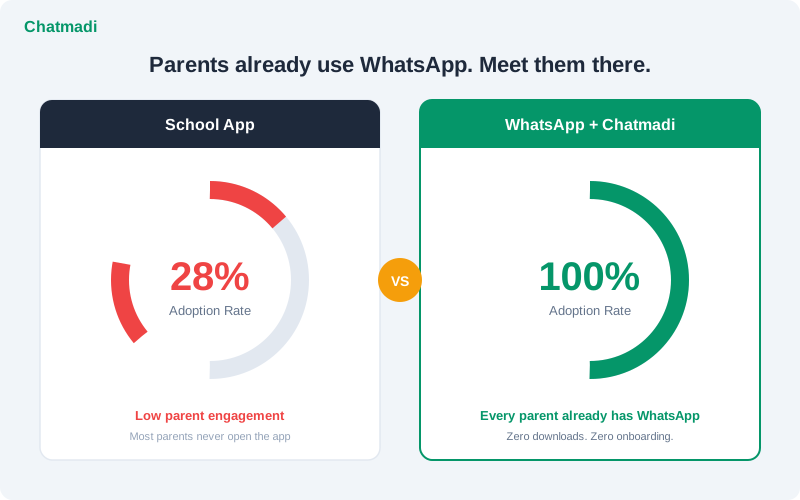
Every year, hundreds of Indian schools invest in dedicated school communication apps. The pitch is compelling: a single platform where parents can see attendance, homework, fee receipts, circulars, and messages from teachers. The reality is different. Within three months of launching a school app, most schools find that fewer than 20% of parents are using it regularly. By month six, the number is closer to 10%. The app becomes another dead channel while teachers and parents continue doing what they have always done: communicating on WhatsApp. The parent school communication app without download that schools actually need is not an app at all. It is an intelligence layer on top of WhatsApp. That is what Chatmadi provides.
Why School Communication Apps Fail Within 6 Months
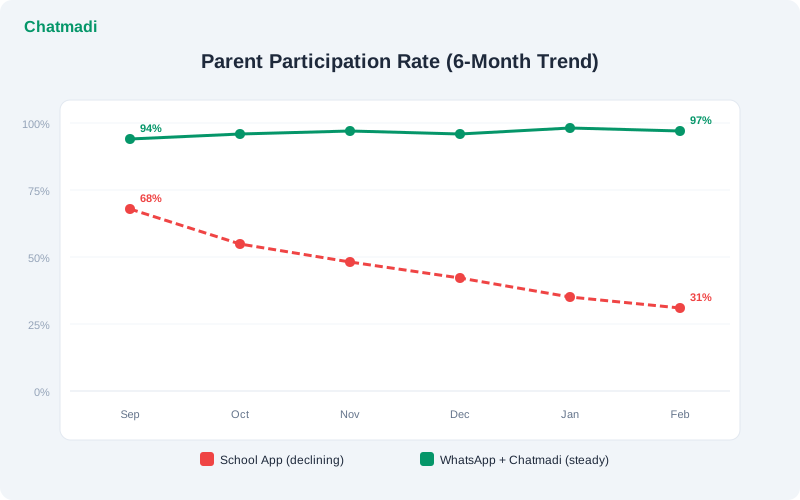
The pattern is remarkably consistent across schools that adopt dedicated communication apps. Month one: the school announces the app during a PTM or via circular. Teachers are trained. Parents are asked to download it. Adoption reaches 60 to 70% because the school actively pushes it. Month two: usage drops to 40 to 50%. Parents who downloaded the app find that it duplicates what they already get on WhatsApp. Teachers still use WhatsApp for quick messages because it is faster. The app becomes a secondary channel. Month three: active usage falls to 25 to 35%. Parents stop checking the app because the important messages still come via WhatsApp. Teachers stop posting on the app because parents do not respond there. Month four to six: the app is effectively abandoned by most parents. Only 10 to 15% of parents use it regularly, and those are typically the already-engaged parents who would respond on any channel. The school has spent money on the app subscription, time on training, and goodwill on pushing adoption, all for a channel that most parents ignore. This is not a technology problem. It is a behaviour problem. Parents already have a communication channel that works. Asking them to adopt a new one adds friction they will not accept.
The Adoption Problem: Why Parents Don't Download School Apps
Understanding why parents resist school apps requires understanding how Indian parents use their phones. For many parents, especially in tier 2 and tier 3 cities, the smartphone is primarily a communication and entertainment device. WhatsApp is the primary communication tool. YouTube is the primary entertainment tool. Beyond these two apps and perhaps a UPI payment app, phone storage is limited and app fatigue is real. When a school asks a parent to download a dedicated app, several barriers immediately appear. Storage space is the first barrier. Many parents use phones with 16 to 32 GB of storage, much of it consumed by WhatsApp media, photos, and a few essential apps. A school app competing for space against WhatsApp, GPay, and YouTube is not going to win. Notification fatigue is the second barrier. Parents already receive notifications from WhatsApp, SMS, and several other apps. Adding another notification source for school updates creates noise, not clarity. Most parents disable notifications for non-essential apps within the first week. Learning curve is the third barrier. Every new app requires learning a new interface: where to find messages, how to respond, where homework is posted, how to check fees. WhatsApp has no learning curve because parents have used it daily for years. Language and accessibility is the fourth barrier. WhatsApp supports the parent's preferred language and keyboard. A school app may not. WhatsApp works reliably on low-end phones and slow connections. A school app may not. The fundamental insight is this: the parent school communication app without download that achieves 100% adoption already exists on every parent's phone. It is WhatsApp.
WhatsApp-Native Communication: The Only Model That Works for Indian Schools
WhatsApp-native communication means that parents continue using WhatsApp exactly as they do today. They send messages, confirm homework, report absences, ask questions, and confirm fee payments in their regular WhatsApp conversations with teachers. Nothing changes for the parent. What changes is what happens on the school's side. Chatmadi sits behind the teacher's workflow and reads every WhatsApp conversation using AI. When a parent confirms homework, the AI detects it. When a parent reports an absence, the AI logs it. When a parent mentions a fee payment, the AI flags it for the accounts team. When a parent raises a concern about their child's safety or wellbeing, the AI alerts the teacher and principal. The parent never knows that AI is processing their messages. They never need to download an app, create an account, or learn a new interface. They simply continue using WhatsApp. The school, meanwhile, gets structured intelligence from unstructured conversations. This is fundamentally different from a school app model. A school app asks parents to change their behaviour. WhatsApp-native communication meets parents where they already are. The adoption rate is not 30% or 50% or even 80%. It is effectively 100% because every parent who uses WhatsApp is already on the platform.
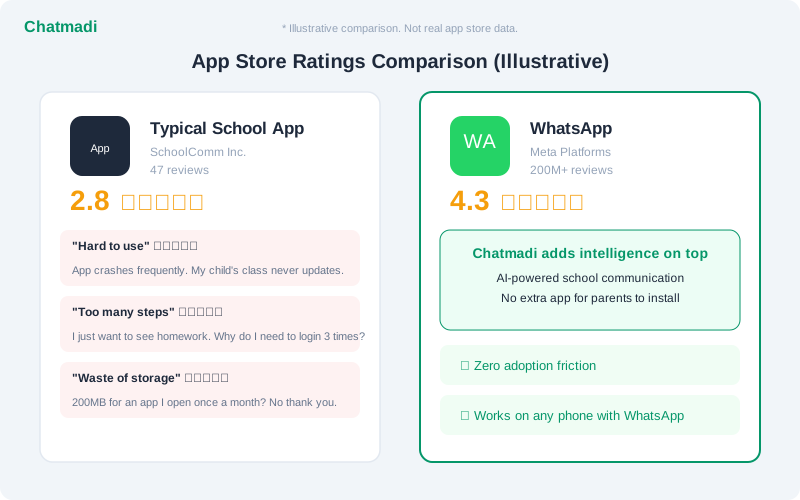
Illustrative app comparison showing typical school app with low ratings versus WhatsApp with Chatmadi intelligence layer
How-To: Migrating Your School from a School App to WhatsApp + Chatmadi
If your school is currently using a dedicated school app and considering a switch to WhatsApp-native communication with Chatmadi, here is the migration path. Step one: audit your current app usage. Check how many parents actively use the school app each week, not how many downloaded it, but how many actually open it and engage. If the number is below 30%, the app is already effectively dead. Step two: identify what the app does that WhatsApp cannot. Make a list. Typically, the list includes structured homework posting, attendance viewing, fee receipt downloads, and circular distribution. Chatmadi handles all of these through WhatsApp conversation analysis and dashboard presentation. Step three: set up Chatmadi alongside the existing app. Run both systems for one month. Teachers continue uploading WhatsApp conversations to Chatmadi while the school app remains active. Compare the data captured by each system. In most cases, Chatmadi captures more parent interactions because it reads the WhatsApp conversations where parents are actually communicating. Step four: communicate the transition to parents. Send a simple message: "We are simplifying school communication. You no longer need to use the school app. Continue communicating with your class teacher on WhatsApp as you normally do. We will handle the rest." Parents will welcome this message because it removes a burden rather than adding one. Step five: deactivate the school app after the transition month. Redirect any remaining app features to the Chatmadi dashboard for teachers and administrators.
Parent participation rate chart showing school app adoption declining from 68% to 31% while WhatsApp engagement stays at 94-98%
What Schools Gain When 100% of Parents Are Already on the Platform
When every parent is on the communication platform by default, several things change. First, data completeness improves dramatically. A school app with 30% adoption captures data from 30% of parents. WhatsApp with Chatmadi captures data from every parent who communicates, which is effectively all of them. Fee payment mentions from every parent are detected. Absence notifications from every parent are logged. Homework acknowledgements from every parent are tracked. Second, teacher workload decreases. Teachers no longer maintain two communication channels. They do not post homework on the app and then repeat it on WhatsApp. They do not check the app for responses and then check WhatsApp for the same. Everything flows through one channel. Third, parent satisfaction increases. Parents are not asked to do anything differently. No downloads, no logins, no new interfaces. The school becomes easier to interact with rather than harder. Fourth, equity improves. School apps create a digital divide between parents who can navigate the app and those who cannot. WhatsApp-native communication levels the playing field because WhatsApp works on every phone, in every language, for every parent. Fifth, the school's data quality improves over time. With 100% of parents contributing data through their natural WhatsApp conversations, the AI's insights become more accurate, the engagement scores more meaningful, and the dashboards more representative of actual school health. This is the core argument for WhatsApp-native school communication: it is not about technology preference. It is about reaching every parent, not just the digitally comfortable ones.
Frequently Asked Questions
Does Chatmadi replace WhatsApp for parent communication?
No. Chatmadi does not replace WhatsApp. Parents continue using WhatsApp exactly as they do today. Chatmadi is an intelligence layer that reads WhatsApp conversations and extracts structured data for the school's dashboards and tracking systems.
What if our school has already invested in a school app?
Many schools run Chatmadi alongside their existing app during a transition period. Within a month, most schools find that Chatmadi captures more parent interaction data than the app because it reads the conversations where parents are actually communicating.
Do parents need to know about Chatmadi?
Schools typically inform parents that conversations may be reviewed for school administration purposes. Parents do not need to install anything or change their communication behaviour in any way.
What about parents who do not use WhatsApp?
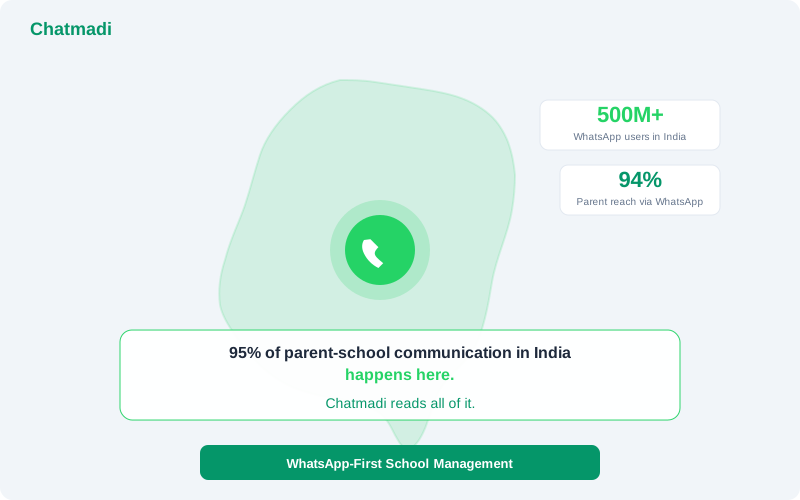
In India, WhatsApp penetration among smartphone users is over 95%. For the rare parent without WhatsApp, schools can continue using phone calls or SMS. These parents represent a tiny fraction compared to the 70% who would not use a school app.
Is WhatsApp-native communication less secure than a dedicated app?
WhatsApp provides end-to-end encryption for all messages. Chatmadi processes conversation exports with the same security standards as any school data system. The security model is comparable to or better than most school apps.
---
Stop asking parents to download another app. They are already communicating with your school on WhatsApp. Chatmadi makes that communication intelligent. Start free at chatmadi.com
Tagsparent school communication app without downloadWhatsApp parent communication platformschool parent WhatsApp communicationbest WhatsApp tool for schools IndiaChatmadi
C
Chatmadi Team
School Communication Intelligence
The Chatmadi team writes about AI-powered parent communication, school management best practices, and WhatsApp intelligence for Indian schools. Built by Eduloom Technologies OPC Pvt Ltd, Mysore.