Why WhatsApp-First School Management Is the Only Approach That Works in India
In this article
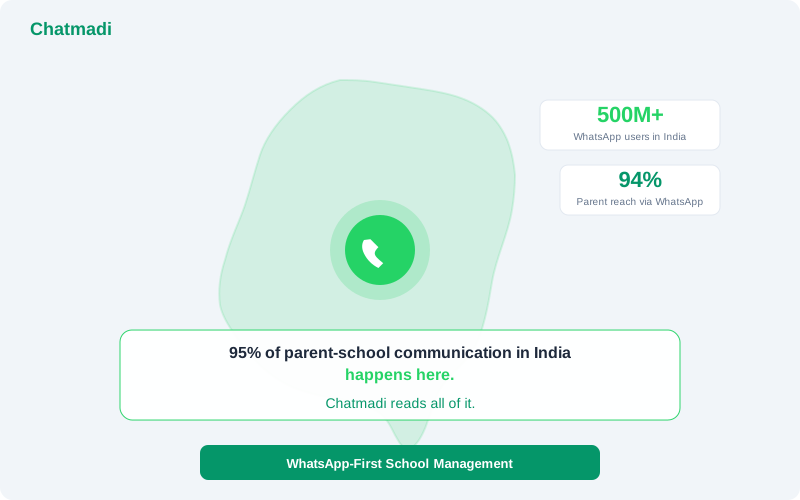
In the United States, schools use apps like ClassDojo and Remind. In the UK, schools use ParentMail and ClassCharts. In Australia, schools use Compass and Sentral. These platforms work in their respective countries because parents in those countries are accustomed to downloading and using purpose-built school communication apps. India is different. In India, WhatsApp is not just a messaging app. It is the communication infrastructure. Over 500 million Indians use WhatsApp daily. Among parents with school-age children, the penetration rate is estimated at 95% or higher. When an Indian parent needs to communicate with their child's school, they open WhatsApp. They do not download an app, log into a portal, or check email. This reality has a profound implication for school management: the only approach that achieves near-universal parent adoption is one that meets parents where they already are. WhatsApp for parent teacher communication India schools rely on is not a workaround. It is the optimal channel. Chatmadi is built on this understanding.
India's WhatsApp Reality: 95% of Parent-School Communication Is Already There
The numbers tell the story. India has approximately 500 million WhatsApp users, making it the largest WhatsApp market in the world. Among smartphone users in urban India, WhatsApp penetration exceeds 97%. Among smartphone users in semi-urban and rural India, it exceeds 90%. WhatsApp is the first app installed on a new phone and the last app deleted when storage runs low. For school parents specifically, WhatsApp is not just present on their phone. It is how they communicate with virtually everyone: family, friends, colleagues, service providers, and their children's teachers. A parent who communicates with their class teacher on WhatsApp is not making a deliberate choice to use WhatsApp for school communication. They are doing the only thing that feels natural. This means that any school management approach that requires parents to use a different tool is asking them to change a deeply ingrained behaviour. History has shown that this does not work at scale in India. School apps that require downloads achieve 30 to 40% adoption in the first month and decline to under 15% within a year. Email-based communication reaches fewer than 20% of parents in most Indian schools. SMS achieves delivery but not engagement since it is a one-way channel. WhatsApp achieves both delivery and engagement because parents are already there.
Why Every Other School Communication Tool Fails in India
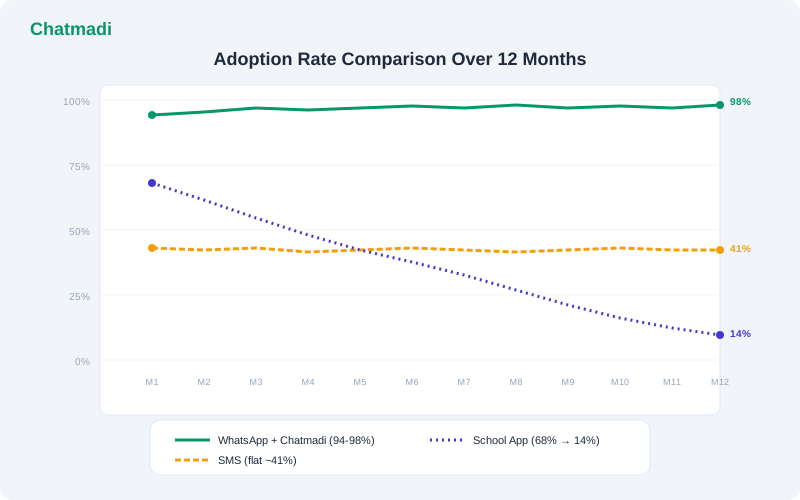
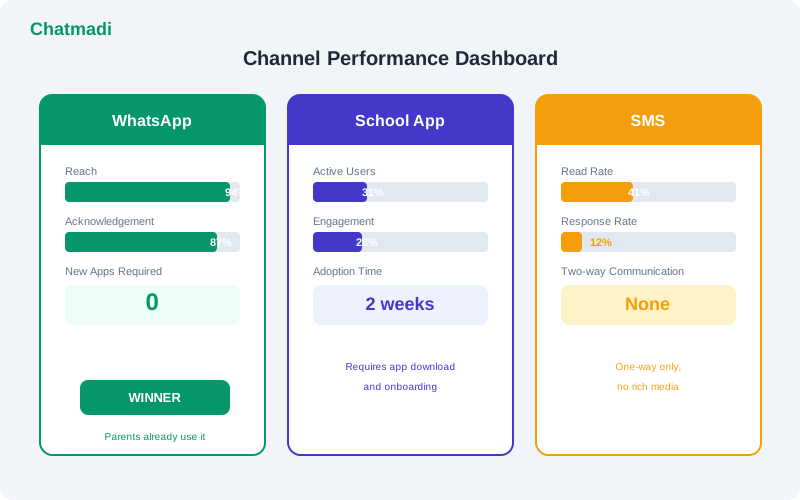
The failure of non-WhatsApp school communication tools in India follows a predictable pattern. School communication apps: the school purchases a dedicated app. Parents are asked to download it. Month one adoption reaches 60 to 70% because the school actively promotes it. By month three, active usage drops to 30 to 40%. By month six, fewer than 15% of parents check the app regularly. The teachers, meanwhile, continue using WhatsApp for urgent communication because they know parents will see it there. The app becomes a secondary channel that duplicates effort without replacing WhatsApp. Parent portals: web-based portals where parents can check attendance, fees, and exam results. These require login credentials, internet access, and the motivation to check regularly. Adoption in Indian schools rarely exceeds 20% for regular use. Parents who can get the same information by messaging the teacher on WhatsApp see no reason to log into a portal. Email communication: works for formal communication like fee receipts and official notices. Does not work for daily communication because Indian parents check email far less frequently than WhatsApp. Response rates for email-based school communication are typically below 10%. SMS-based systems: deliver messages reliably but do not support two-way communication. A parent cannot reply to an SMS fee reminder with a question about the due date. SMS also lacks the richness of WhatsApp: no images, no voice notes, no document sharing. Each of these alternatives fails for the same reason: they ask parents to change their behaviour. WhatsApp-first school management does not ask parents to change anything. It reads the communication they are already having and extracts intelligence from it.
WhatsApp-First School Management: The Philosophy Behind Chatmadi
WhatsApp-first school management is a design philosophy, not just a product feature. It means that WhatsApp is treated as the primary data source and communication channel for the entire school management system. Everything else builds on top of it. The philosophy has three principles. Principle one: zero behaviour change for parents. Parents continue using WhatsApp exactly as they do today. They send messages, confirm homework, report absences, ask questions, and discuss their child's progress in their natural communication style. They never need to download an app, create an account, or learn a new interface. Principle two: intelligence extraction, not data entry. Instead of asking teachers and administrators to enter data into forms, the system reads the conversations where data already exists and extracts it automatically. A parent's message confirming a fee payment becomes a fee record. A parent's absence notification becomes an attendance record. A parent's homework acknowledgement becomes an engagement data point. Principle three: school-specific AI. The AI is trained specifically for the Indian school context. It understands the way Indian parents communicate about school matters in English, Hindi, and Hinglish. It recognises school-specific concepts like PTMs, unit tests, CBSE chapters, fee instalments, and absence reasons. It classifies messages into school-relevant categories and routes them to the right people. Chatmadi is the implementation of this philosophy. Every feature, every AI model, and every dashboard is built on the assumption that WhatsApp is where school life happens in India.
Adoption rate comparison showing school app declining from 68 to 14 percent versus WhatsApp plus Chatmadi steady at 94 to 98 percent
How-To: Making WhatsApp Your School's Primary Intelligence Channel
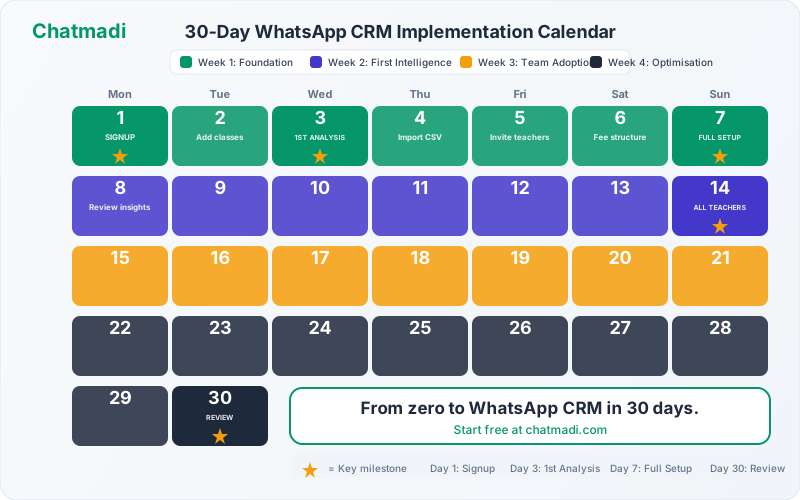
Transitioning to WhatsApp-first school management with Chatmadi involves four stages. Stage one: acknowledge the reality. Accept that WhatsApp is already your school's primary communication channel. Your teachers already use it. Your parents already use it. The data is already flowing through it. The only question is whether you are extracting value from that data or letting it scroll past. Stage two: set up Chatmadi. Create your school account, add classes and students, and link parent contacts. This takes under 30 minutes. Stage three: start uploading conversations. Ask each class teacher to export their class WhatsApp group conversation and upload it to Chatmadi. The AI immediately begins analysing the messages and extracting signals: fee payments, absences, homework acknowledgements, safety concerns, and engagement metrics. The first upload typically produces immediate insights that surprise teachers. Stage four: build the daily routine. Each morning, teachers check their Chatmadi dashboard for today's attendance, pending actions, and active alerts. Each week, they upload the latest conversations. Each month, the principal reviews school-wide analytics. Over time, the system builds a comprehensive picture of every student, every family, and every class.
Channel performance dashboard comparing WhatsApp school app and SMS across reach engagement and adoption friction
What Schools Achieve When They Stop Fighting WhatsApp and Start Using It
Schools that embrace WhatsApp-first management with Chatmadi report consistent improvements across multiple dimensions. Parent reach goes to near 100%. When the communication channel is WhatsApp, every parent with a smartphone is reachable. There is no adoption campaign, no download requirement, and no training needed. Fee collection visibility improves. Teachers and accounts staff stop manually tracking which parents have confirmed payments in WhatsApp. The AI detects confirmations automatically, reducing the time spent on fee follow-up by 50 to 60%. Attendance tracking becomes automatic. Instead of calling parents to ask why a student is absent, the system detects absence notifications from WhatsApp messages and records them. Teachers save 15 to 20 minutes per day on attendance-related tasks. Safety response time drops. A parent's safety concern that might have been buried in a WhatsApp scroll for hours or days is now detected and escalated within minutes. The school's response time for welfare issues improves dramatically. Teacher workload decreases. Teachers who spend less time on manual data collection and tracking have more time for teaching, mentoring, and meaningful parent interaction. The administrative burden that comes with managing 30 to 40 students becomes manageable. Data completeness improves. When data is extracted from conversations that 95% of parents participate in, the school's data represents the reality of the entire student body, not just the families who use a specific app or portal.
Frequently Asked Questions
Does WhatsApp-first mean the school uses only WhatsApp?
No. WhatsApp-first means that WhatsApp is the primary data source and communication channel. Schools can still use other tools for specific purposes: ERPs for administrative records, email for formal communication, and phone calls for sensitive conversations. WhatsApp-first means starting with WhatsApp, not ending with it.
What about parents who do not use WhatsApp?
In India, WhatsApp penetration among smartphone users is over 95%. For the rare parent without WhatsApp, schools can continue using phone calls or SMS. These parents represent a tiny fraction compared to the 70% or more who would not use a dedicated school app.
Is WhatsApp-first school management only relevant for Indian schools?
WhatsApp-first is most relevant in markets where WhatsApp is the dominant communication channel, which includes India, Brazil, parts of Africa, and Southeast Asia. In markets where other platforms dominate, different approaches may be more appropriate.
Does Chatmadi work without WhatsApp Business API?
Yes. Chatmadi works with manual conversation uploads from the standard WhatsApp app. Schools that want real-time integration can connect the WhatsApp Business API for automated message processing.
How does Chatmadi handle WhatsApp groups with both parents and non-parents?
Chatmadi's AI identifies messages from parents by matching sender names and numbers against the student database. Messages from non-parents in mixed groups are processed but not attributed to student profiles.
---
India does not need a school app. It needs WhatsApp that works smarter. Chatmadi makes it happen. Start free at chatmadi.com
TagsWhatsApp for parent teacher communication IndiaWhatsApp CRM for schoolsschool WhatsApp management software Indiaparent school communication app without downloadChatmadi
C
Chatmadi Team
School Communication Intelligence
The Chatmadi team writes about AI-powered parent communication, school management best practices, and WhatsApp intelligence for Indian schools. Built by Eduloom Technologies OPC Pvt Ltd, Mysore.