How to Run a Parent-Teacher Meeting That Parents Actually Attend: The Data-Backed Guide
In this article
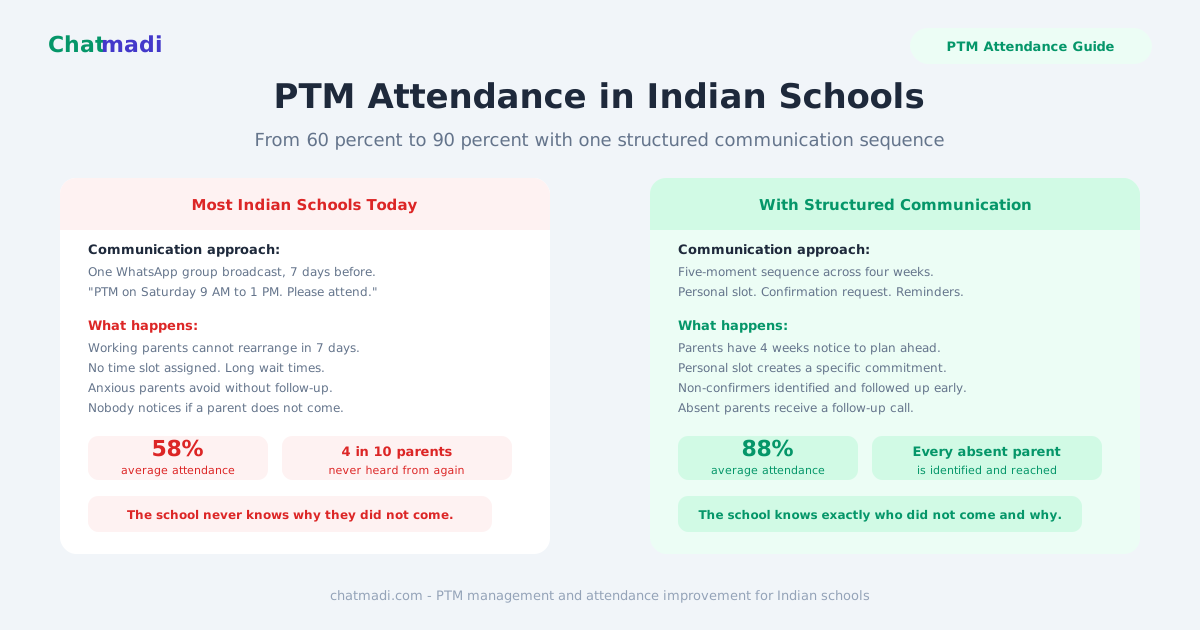
The average PTM attendance rate at Indian private schools sits somewhere between 55 and 70 percent. This means that on a typical PTM day, between three and four parents in every ten are not in the building. Some of those absences are unavoidable: genuine work conflicts, travel, illness, or family emergencies. But a significant portion of every school's PTM no-shows represent parents who received the communication about the PTM and chose not to come, or parents who intended to come and forgot, or parents whose child is struggling academically and who avoided the meeting precisely because they did not want to hear what the teacher had to say.
Table of Contents
- [Reason 1: They Did Not Know About It](#reason-1-they-did-not-know-about-it)
- [Reason 2: The Timing Does Not Work for Working Parents](#reason-2-the-timing-does-not-work-for-working-parents)
- [Reason 3: They Forgot](#reason-3-they-forgot)
- [Reason 4: They Are Avoiding Difficult News](#reason-4-they-are-avoiding-difficult-news)
- [Reason 5: The Previous PTM Was a Waste of Time](#reason-5-the-previous-ptm-was-a-waste-of-time)
- [Reason 6: They Do Not Know Their Specific Time Slot](#reason-6-they-do-not-know-their-specific-time-slot)
- [Reason 7: Nobody Will Miss Them If They Do Not Come](#reason-7-nobody-will-miss-them-if-they-do-not-come)
- [Week 4 Before: Save the Date](#week-4-before-save-the-date)
- [Week 3 Before: Personal Slot Confirmation](#week-3-before-personal-slot-confirmation)
- [Week 2 Before: Follow-Up for Non-Confirmers](#week-2-before-follow-up-for-non-confirmers)
- [48 Hours Before: Reminder Broadcast](#48-hours-before-reminder-broadcast)
- [Morning of PTM: Final Nudge](#morning-of-ptm-final-nudge)
Understanding which type of absence each parent represents is the beginning of building a PTM attendance strategy that actually works. A school that treats every absence as a scheduling problem will send more reminders. A school that treats every absence as a disengagement signal will try to rebuild the parent relationship before the next PTM. A school that treats every absence as avoidance behaviour will reach out personally to the parents of its most academically at-risk students before the meeting happens.
All three of these approaches are correct for the parents they are aimed at. The mistake most Indian schools make is applying the same approach to all absent parents: sending one reminder via WhatsApp and hoping the attendance improves.
This guide is for school principals and class teachers who want to move their PTM attendance from the 55 to 70 percent range into the 85 to 95 percent range, consistently, across academic terms.
Why PTM Attendance Matters More Than Schools Realise
Low PTM attendance is treated by most Indian schools as an inconvenience: an operational metric that is lower than it should be but that does not have a measurable impact on student outcomes. This is incorrect.
The research on parent-teacher meeting attendance and student outcomes is consistent across educational contexts. Students whose parents attend PTMs regularly have better attendance, better academic performance, and better social-emotional outcomes than students whose parents do not attend, even after controlling for socioeconomic factors that might independently predict both parental engagement and student performance.
The mechanism is not mysterious. When a parent attends a PTM, they receive specific, personal information about their child from the teacher. This information, even when it is positive, creates a heightened awareness of the child's school experience that typically persists for weeks after the meeting. Parents who attended PTMs ask different questions at home, provide different support for homework, and notice different signals in their child's behaviour than parents who received the same information in a written report card.
For students who are struggling, the difference is even more significant. A parent who attends a PTM and hears directly from the teacher about their child's academic difficulties has a fundamentally different experience from one who reads the same information in a report card. The direct conversation creates emotional accountability and a sense of shared responsibility that a written report does not.
The parent engagement measurement guide identifies PTM quality score as one of the six key metrics that predicts student outcomes. PTM attendance is the prerequisite for PTM quality: a meeting that does not happen has a quality score of zero.
Seven Reasons Parents Skip PTMs in Indian Schools
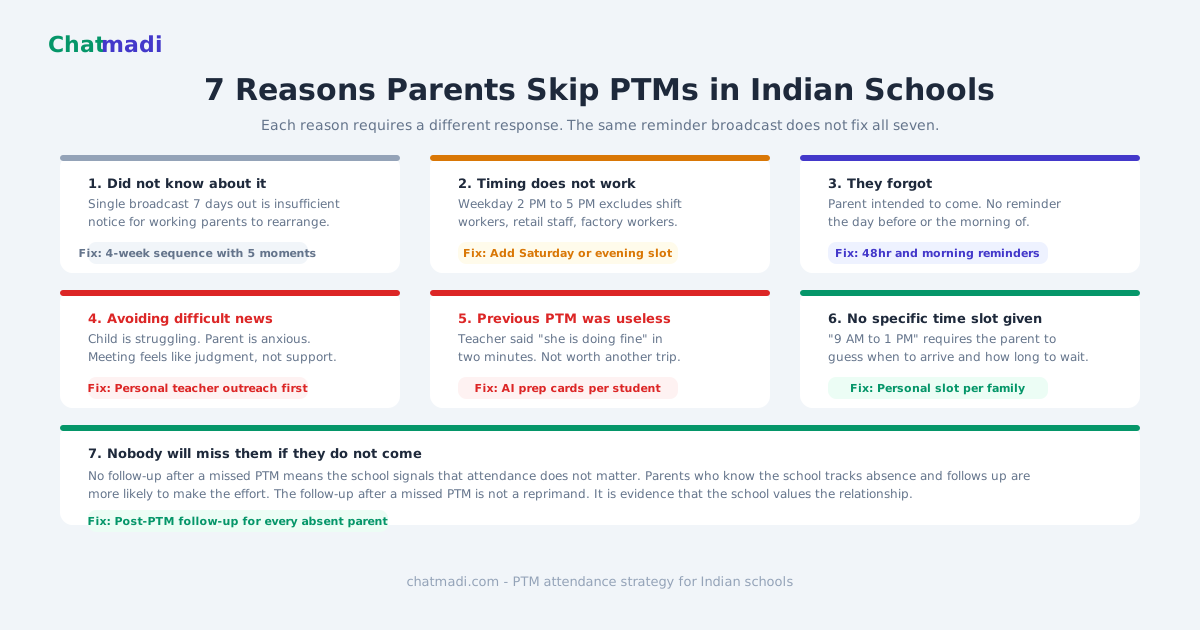
Understanding why parents do not come is essential for designing communication that actually changes behaviour. The seven most common reasons for PTM absence in Indian schools are distinct enough that each requires a different response.
Reason 1: They Did Not Know About It
A PTM announcement sent once via WhatsApp group, seven days before the meeting, is insufficient notice for a working parent to rearrange their schedule. Announcement timing and frequency are the most straightforward PTM attendance problem to fix. Most schools that move from a single announcement to a structured three-reminder sequence see meaningful attendance improvement with no other changes.
Reason 2: The Timing Does Not Work for Working Parents
PTMs scheduled on weekday afternoons between 2 PM and 5 PM exclude a significant proportion of the working parent community. Both parents may be employed. A parent who works in a technology company with a flexible schedule can rearrange their afternoon. A parent who works a shift in manufacturing, retail, or service cannot.
Schools that add a Saturday morning slot or an evening slot (5:30 PM to 7:30 PM) to their PTM schedule consistently see attendance from working parents who were absent from every previous weekday afternoon PTM. The question is not whether parents want to come. It is whether the school has scheduled the meeting at a time when working parents can actually attend.
Reason 3: They Forgot
A parent who intends to come and forgets is a communication failure, not a disengagement signal. The solution is a reminder 24 hours before the PTM and another on the morning of the PTM. WhatsApp reminders for events with personal relevance have high open and response rates. A reminder that includes the specific time slot reserved for this parent and the name of the teacher they will meet is significantly more effective than a generic group broadcast.
The PTM RSVP and reminder system covers how automated reminder sequences can be structured to cover all three pre-meeting communication moments without requiring significant additional teacher time.
Reason 4: They Are Avoiding Difficult News
Parents whose children are struggling academically sometimes avoid PTMs because they do not want to hear what the teacher has to say. This avoidance is not disengagement. It is anxiety. These are often the parents who are most distressed about their child's performance and who most need the conversation that the PTM provides.
The most effective approach for this group is a personal outreach from the class teacher before the PTM, not another broadcast reminder. A brief private message from the teacher saying "I am looking forward to talking about how we can support Rohan together at the PTM" reframes the meeting from an occasion of judgment to an occasion of collaboration. This framing change consistently improves attendance from anxious parents.
Reason 5: The Previous PTM Was a Waste of Time
Parents who attended previous PTMs and found them brief, generic, or uninformative are less likely to prioritise the next one. If the class teacher spent two minutes with each parent saying "she is doing fine, no concerns," the parent walks away having learned nothing new and having disrupted their workday for no reason they could identify.
This is a PTM quality problem, not a PTM attendance problem. But the quality problem directly causes the attendance problem. Schools that invest in improving PTM preparation, so that teachers have specific, data-informed things to say to each parent, see repeat attendance improve significantly after the first well-prepared PTM.
The AI preparation card feature generates per-student preparation notes before each PTM, giving teachers specific talking points grounded in attendance data, academic performance, welfare signals, and communication patterns. A teacher who is well-prepared has a substantive conversation. A teacher who has a substantive conversation gets a parent who comes back next time.
Reason 6: They Do Not Know Their Specific Time Slot
A PTM announcement that says "PTM on Saturday from 9 AM to 1 PM" is different from one that says "Your appointment with Mrs. Sunitha is at 10:15 AM on Saturday." The first announcement requires the parent to figure out when to arrive and how long to wait. The second tells them exactly when they are expected. Schools that assign specific time slots and communicate them personally see shorter wait times and higher attendance, because the personal appointment creates a specific commitment rather than a general intention.
Reason 7: Nobody Will Miss Them If They Do Not Come
A parent who knows that the school tracks PTM attendance and follows up with absent parents is more likely to make the effort to attend than one who suspects their absence will go unnoticed. This is not a manipulation of parent behaviour. It is the natural consequence of the school demonstrating that it cares about the parent relationship enough to notice when it is absent.
The follow-up communication after a missed PTM, handled well, strengthens the parent relationship rather than straining it. "We missed you at the PTM and want to make sure you have an opportunity to connect with Mrs. Sunitha. Can we schedule a brief call this week?" is not a reprimand. It is a demonstration that the school values the parent's involvement enough to pursue it.
The Four-Week PTM Communication Sequence
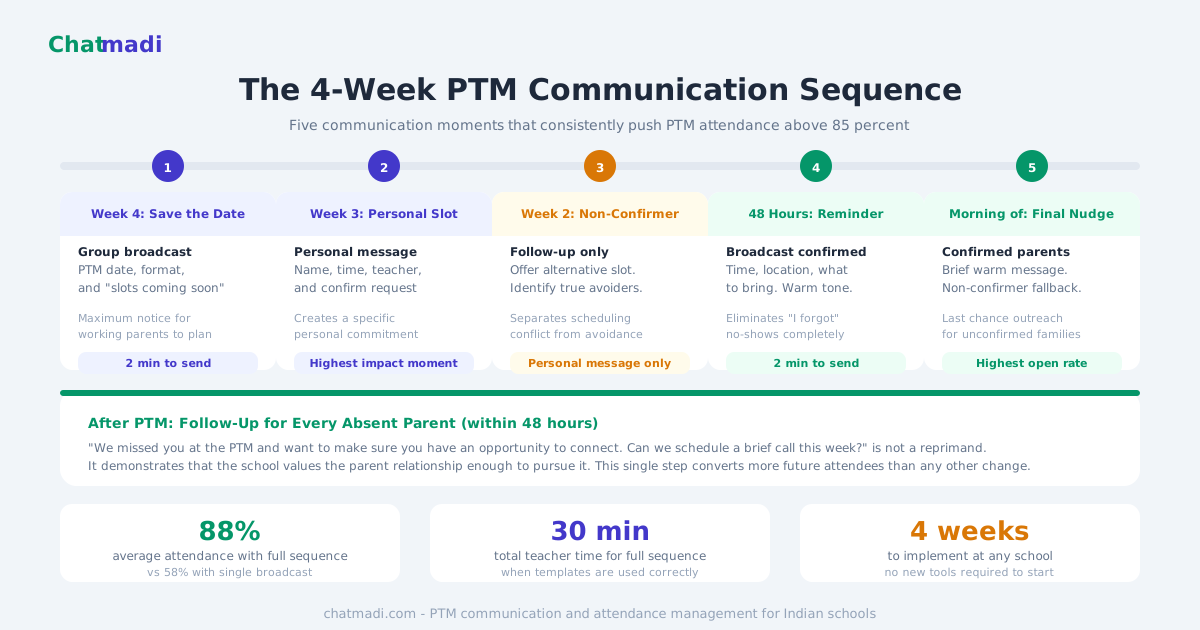
The single most reliable way to improve PTM attendance is to implement a structured communication sequence in the four weeks before each PTM. The sequence has five moments, each serving a distinct purpose.
Week 4 Before: Save the Date
A brief broadcast to all parents announcing the PTM date, the format (in-person or hybrid), and the fact that individual time slots will be sent shortly. This gives parents maximum notice to plan around the date. The message should be warm and specific: "Our next PTM for Class 6A is on Saturday, March 14. We have a lot to share about the term and we are looking forward to connecting with each family."
Week 3 Before: Personal Slot Confirmation
Each parent receives a personal message (not a group broadcast) with their specific time slot, the teacher's name, and a confirmation request. This message should come from the class teacher or from the school's central WhatsApp contact and should be addressed to the parent personally. "Mr. Mehta, your appointment with Mrs. Sunitha for Rohan is at 10:15 AM on Saturday, March 14. Please confirm if this works for you."
The confirmation request serves two purposes: it secures the appointment and it identifies parents who are not responding, which flags potential no-shows early enough to follow up.
Week 2 Before: Follow-Up for Non-Confirmers
Parents who have not confirmed their appointment within five days receive a follow-up message. This message should acknowledge that scheduling can be difficult and offer an alternative: "We noticed you have not confirmed your appointment yet. If the 10:15 AM slot does not work, we can offer a different time. Please let us know how we can make this convenient for you."
This follow-up separates parents who have a genuine scheduling conflict (who will request an alternative) from parents who are avoiding the meeting (who will continue to not respond). Each group then receives a different approach in the final week.
48 Hours Before: Reminder Broadcast
All confirmed parents receive a reminder with their specific time, the location, any documents they should bring, and a warm note about what the teacher is looking forward to discussing. This reminder dramatically reduces the "I forgot" category of no-shows.
Morning of PTM: Final Nudge
A brief morning message to all confirmed parents: "Good morning, we are looking forward to seeing you today at [time]. Please arrive a few minutes early so we can make the most of your slot." This message has a high open rate because it is sent on the day of the event and because it is personal rather than broadcast.
For parents who never confirmed and did not request an alternative, the morning of the PTM is the last opportunity for personal outreach: "Mr. Nair, we have not heard from you about Aditya's PTM slot today. If you are able to come, please arrive between 11 AM and 12 PM and we will fit you in. If not, can we arrange a brief call this week?"
What to Do With PTM Attendance Data
Tracking PTM attendance is useful only if the school acts on what the data reveals. Two specific uses of attendance data improve both the current PTM and future ones.
Identifying at-risk families before the next PTM. Parents who missed two consecutive PTMs without explanation are signalling disengagement that should trigger a welfare review of their child, not just a more persistent reminder next time. The parent engagement score captures PTM attendance as one of its six signals, and families with declining scores across multiple dimensions should receive proactive outreach between PTMs rather than waiting for the next scheduled meeting. Improving PTM quality for the parents who did come. After each PTM, the class teacher should record a brief rating of the quality of each meeting: Was the parent engaged? Did the conversation cover meaningful topics? Was a follow-up action agreed? This data, accumulated over multiple PTMs, reveals which parents are attending but not genuinely engaging, which is a different problem requiring a different response from simple non-attendance.The PTM meeting notes system captures meeting notes, concern categories, school and parent actions, and follow-up requirements for each parent meeting. This data feeds directly into the AI preparation for the next PTM, creating a cumulative record of each family's PTM history that the class teacher can review before each subsequent meeting.
Making the System Sustainable
The risk with structured PTM communication sequences is that they add significant work to already stretched class teachers. A four-week sequence with five communication moments, multiplied across 30 to 40 families per class, is a substantial communication workload.
The solution is to automate the broadcast elements and personalise only the elements that genuinely require personalisation. The save-the-date broadcast and the 48-hour reminder broadcast can be generated in seconds. The personal slot confirmation and the follow-up for non-confirmers require personal messages but can be templated with student name, parent name, and time slot filled in automatically from the school's data.
The morning-of message and the post-PTM follow-up for absent parents are the moments where personalisation matters most and where teacher judgment cannot be replaced by a template. These are also the shortest messages in the sequence, taking less than two minutes each to send.
The PTM management feature in Chatmadi automates the broadcast elements of the PTM communication sequence and generates template messages for the personal elements, reducing the total teacher time required for the five-moment sequence to under 30 minutes per PTM.
Start free at chatmadi.com. PTM management including RSVP tracking, meeting notes, and AI preparation cards is available on the Growth plan and above. Schools on the Starter plan can use the PTM scheduling features and track attendance manually before upgrading for the full automation suite.
Frequently Asked Questions
What is a realistic PTM attendance target for an Indian school?For urban private schools with working parent communities, a realistic and achievable target is 80 to 85 percent attendance. Schools with predominantly dual-income professional parent communities, where scheduling flexibility is higher, can target 85 to 90 percent. Schools that offer both a weekday and a Saturday slot consistently achieve higher attendance than those that offer only one option. Attendance above 90 percent typically requires significant personal outreach to every at-risk family before the PTM, which is achievable but resource-intensive.
Should PTMs be in-person or can they be conducted via video call?In-person PTMs consistently produce better outcomes than video call PTMs for the families that attend. The face-to-face environment creates a different quality of conversation, makes emotional signals more visible to both parties, and signals a level of commitment from the school that video calls do not. However, offering video call as an option for parents who genuinely cannot attend in person is better than not reaching those parents at all. Hybrid PTM scheduling, where in-person is the default and video call is the fallback for confirmed non-attendees, maximises both attendance rates and meeting quality.
How long should each PTM slot be?Fifteen minutes per family is the minimum for a substantive conversation. Ten-minute slots create rushed meetings where the teacher cannot say everything meaningful and the parent cannot ask all their questions. Twenty-minute slots are better for classes where complex student situations are common, such as senior classes approaching board examinations or classes with a high proportion of students on welfare monitoring. Longer slots mean fewer families can be seen per PTM day, so some schools run PTMs across two half-days to accommodate twenty-minute slots for all families.
What should the class teacher prepare for each PTM?For each family, the class teacher should prepare: a specific academic performance summary with reference to the most recent assessment, a brief attendance overview (percentage and any pattern of concern), a note on the student's social-emotional wellbeing and classroom engagement, one or two specific things the school is going to do to support the student, and one or two specific requests for what the parent can do at home. This preparation takes approximately five minutes per student when the data is readily available in a dashboard. Without a data system, it can take twenty to thirty minutes per student, which is why most teachers skip preparation and conduct generic PTMs.
How should the school handle parents who refuse to attend PTMs despite repeated outreach?Persistent non-attendance at PTMs, combined with low engagement across other communication channels, is a welfare signal about the student. When a family does not attend two consecutive PTMs and does not respond to alternative meeting offers, the class teacher and principal should conduct a welfare review of the student to assess whether home circumstances are affecting the child's school experience. The non-attendance is not the problem to be solved. It is the signal pointing to what may be a more significant underlying situation.
Chatmadi Team
School Communication Intelligence
The Chatmadi team writes about AI-powered parent communication, school management best practices, and WhatsApp intelligence for Indian schools. Built by Eduloom Technologies OPC Pvt Ltd, Mysore.
Ready to Try Chatmadi at Your School?
Free to start. Setup in 15 minutes. No new apps for parents.
Set Up My School Free →