How to Measure Parent Engagement in Your School: Beyond Open Rates and Read Receipts
In this article
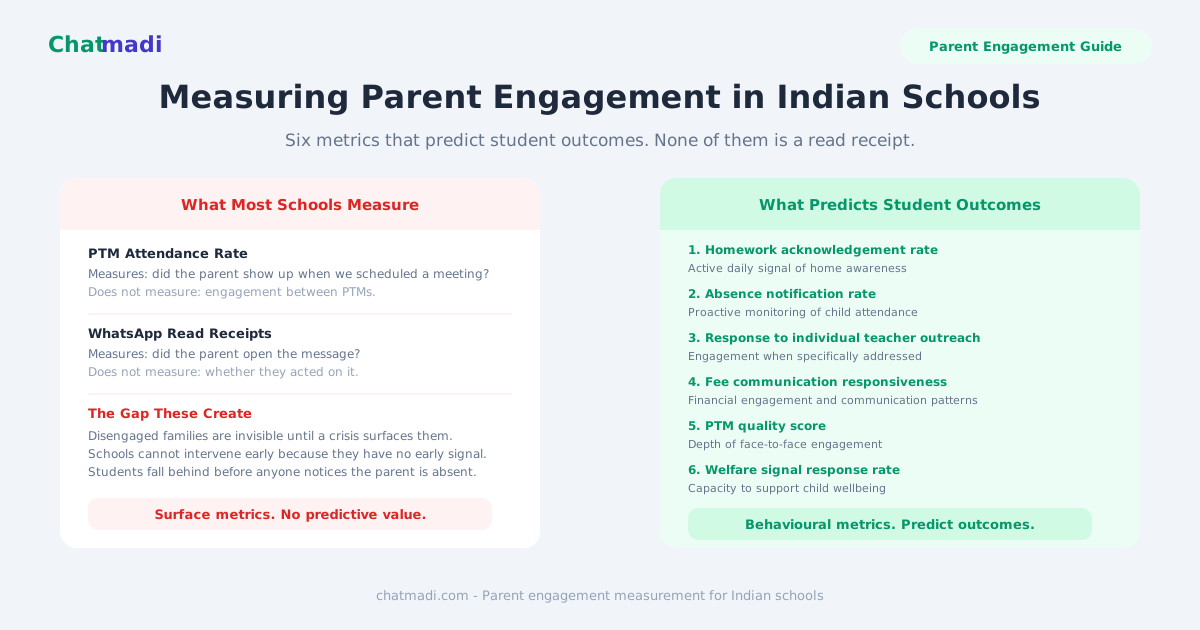
Ask a school principal in India how engaged their parents are and you will almost always get the same answer: the principal will mention PTM attendance rates and whether parents respond to WhatsApp messages. These are the two metrics most Indian schools use to assess how involved their parent community is in school life.
Table of Contents
- [Metric 1: Homework Acknowledgement Rate](#metric-1-homework-acknowledgement-rate)
- [Metric 2: Response Rate to Teacher Outreach](#metric-2-response-rate-to-teacher-outreach)
- [Metric 3: Absence Notification Rate](#metric-3-absence-notification-rate)
- [Metric 4: Fee Communication Responsiveness](#metric-4-fee-communication-responsiveness)
- [Metric 5: PTM Quality Score](#metric-5-ptm-quality-score)
- [Metric 6: Welfare Signal Response Rate](#metric-6-welfare-signal-response-rate)
Both metrics are real. Both are worth tracking. Neither one tells the school anything useful about which individual families are disengaged, why they are disengaged, or what the school can do about it. And neither one reliably predicts the student outcomes that parent engagement is supposed to improve.
This guide is for school principals and administrators who want to move beyond these surface-level measures and build a genuine understanding of parent engagement that is specific to individual families, predictive of student outcomes, and actionable when a family's engagement drops.
Why the Metrics Most Schools Use Are Not Enough
The two most common parent engagement metrics in Indian schools share a fundamental limitation: they measure school-initiated events, not genuine parent involvement.
PTM attendance measures whether parents showed up when the school scheduled a meeting. It says nothing about whether those parents are engaged between PTMs. A parent who attends every PTM but never responds to a homework acknowledgement request, never follows up on a teacher's concern about their child, and never initiates contact with the school is technically a PTM attender but is operationally disengaged.
WhatsApp read receipts measure whether a parent opened a message. They say nothing about whether the parent understood it, acted on it, or cared about it. A parent who reads every school WhatsApp message but whose child is chronically absent, consistently behind on fees, and never completes homework acknowledged might have a high read receipt rate and low actual engagement.
According to NCERT's research on parent involvement in Indian schools, genuine parent engagement that improves student outcomes has three components: academic support at home, active participation in school events and decisions, and responsive communication with teachers. None of these three components is captured by PTM attendance rates or WhatsApp read receipts alone.
The gap between what schools measure and what actually matters creates a specific problem: schools cannot identify disengaged families until a crisis makes the disengagement visible. By the time a student's poor performance or attendance forces a conversation with a disengaged family, weeks or months of opportunity for early intervention have already passed.
Six Metrics That Actually Predict Student Outcomes
Metric 1: Homework Acknowledgement Rate
When a class teacher sends homework to parents via WhatsApp, the percentage of parents in that class who acknowledge receipt is a meaningful engagement signal. A parent who consistently acknowledges homework is almost certainly aware of what their child is expected to do at home. A parent who never acknowledges homework may not know what the homework is, may not feel the acknowledgement is necessary, or may not be reading the messages at all.
Homework acknowledgement rate differs from read receipts in one critical way: it requires an active response from the parent, not just a passive opening of the message. It is a behavioural measure, not a technical one.
The homework tracking guide explains how schools can systematically track which parents acknowledge homework and which do not, and how this data can be used to identify families who need a different communication approach before the child's academic performance suffers.
Metric 2: Response Rate to Teacher Outreach
When a class teacher sends a message specifically directed at an individual parent, how often does that parent respond? This metric distinguishes between parents who engage with broadcast communication (relevant to all parents) and parents who engage with individual communication (directed specifically at them).
A parent who responds promptly to individual teacher outreach is engaged in a qualitatively different way from a parent who reads group messages but does not respond when specifically addressed. For schools trying to identify which families need more proactive engagement, this distinction is important.
Response rate to individual outreach can be tracked systematically when schools use an institutional communication platform rather than teachers' personal WhatsApp accounts. The WhatsApp CRM for schools guide explains why institutional communication tracking makes this kind of metric possible when personal phone communication makes it invisible.
Metric 3: Absence Notification Rate
When a child is absent, does the parent proactively notify the school? This is one of the clearest signals of a parent's active engagement with their child's school attendance. A parent who messages the class teacher to notify absence before the school day begins is actively monitoring their child's school attendance and taking responsibility for communication with the school.
A parent who never notifies absence, leaving the teacher to discover the absence through roll call and then chase for an explanation, is either unaware of the expectation, unable to meet it, or unwilling to. Each of these explanations suggests a different kind of engagement gap that requires a different response from the school.
Absence notification rate is directly measurable from WhatsApp conversation data. When teachers upload class group exports, the AI identifies which absences were proactively notified by parents and which were discovered by the school. The attendance tracking guide shows how this data is used in practice to identify patterns across a class.
Metric 4: Fee Communication Responsiveness
How a family communicates about fees is a strong proxy for their overall engagement with school communication. Families who pay on time, proactively confirm payment, and respond quickly to fee queries are consistently more engaged across other dimensions of school communication as well.
Families who never communicate about fees, pay late without explanation, and do not respond to fee reminders are frequently disengaged in other areas too: higher absence rates, lower homework acknowledgement, and lower PTM attendance are all correlated with fee communication avoidance.
This does not mean that families who struggle with fee payment are disengaged parents. It means that communication patterns around fees are a useful early signal. A family that was previously responsive on fees and has suddenly gone quiet may be experiencing a difficulty that affects their child's school experience in other ways. The fee recovery guide shows how fee communication data can identify families who need support rather than just reminders.
Metric 5: PTM Quality Score
PTM attendance, as discussed, is a weak engagement signal. PTM quality is a stronger one. A parent who attends PTMs and engages in substantive conversation with the teacher, asks specific questions about their child's learning, and follows up on action items agreed at the meeting is engaged in a meaningfully different way from a parent who attends PTMs but sits silently for three minutes and leaves.
PTM quality cannot be measured automatically. It requires the class teacher to record a brief assessment of the meeting's substance. But the PTM planning guide shows how schools that systematically record meeting notes, follow-up actions, and meeting quality ratings build a longitudinal picture of each family's engagement with PTMs that is far more useful than simple attendance data.
Metric 6: Welfare Signal Response Rate
When the school reaches out to a family about a welfare concern, how quickly and how substantively does the family respond? This metric is the most sensitive indicator of a family's actual capacity to support their child's wellbeing.
A parent who responds to a welfare concern within hours, engages with the teacher's observations, and agrees to specific next steps is demonstrating a qualitatively different level of engagement from a parent who does not respond, deflects, or minimises a concern the school has raised.
Welfare signal response rate should be tracked not as a judgment on families but as a diagnostic tool. Families who consistently do not respond to welfare outreach may be experiencing difficulties at home that are directly affecting their child. Early identification of these families allows the school to provide support rather than simply escalating concerns that nobody at home can act on.
The child safety alert system generates alerts that require follow-up. Tracking which families respond to these alerts and which do not creates a welfare engagement record that informs how the school prioritises its outreach.
Building a Parent Engagement Score
The six metrics described above can be combined into a single parent engagement score for each family. This score is not a grade or a judgment. It is an operational tool that helps the class teacher and the principal identify which families are at risk of disengagement before that disengagement affects the student.
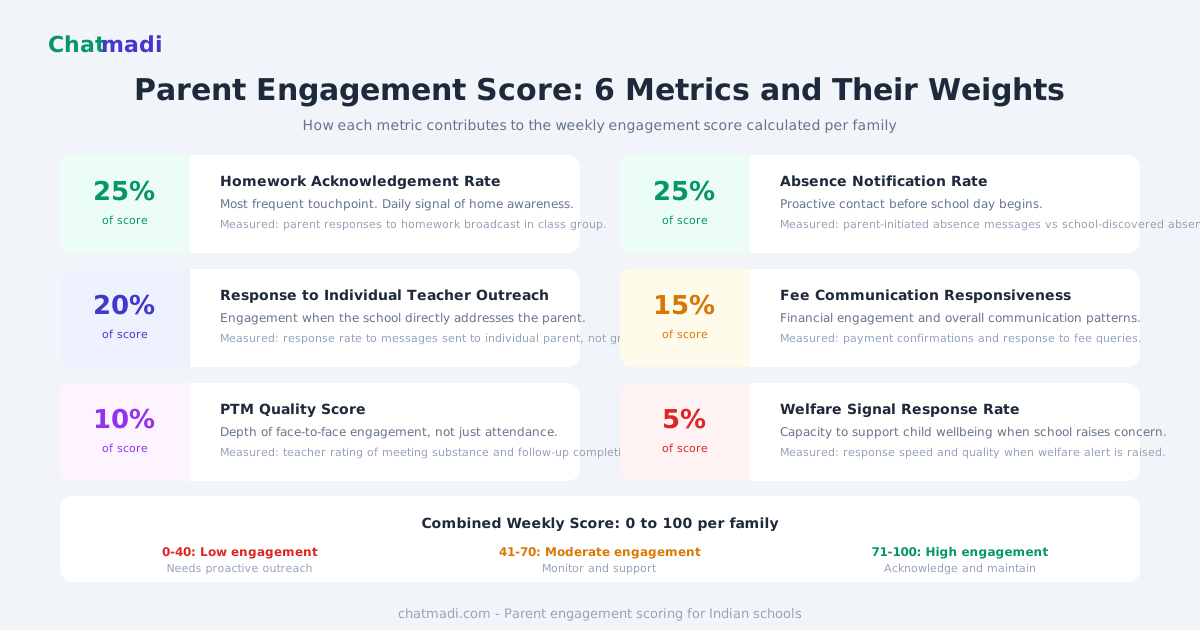
A practical parent engagement score for Indian schools might weight the six metrics as follows:
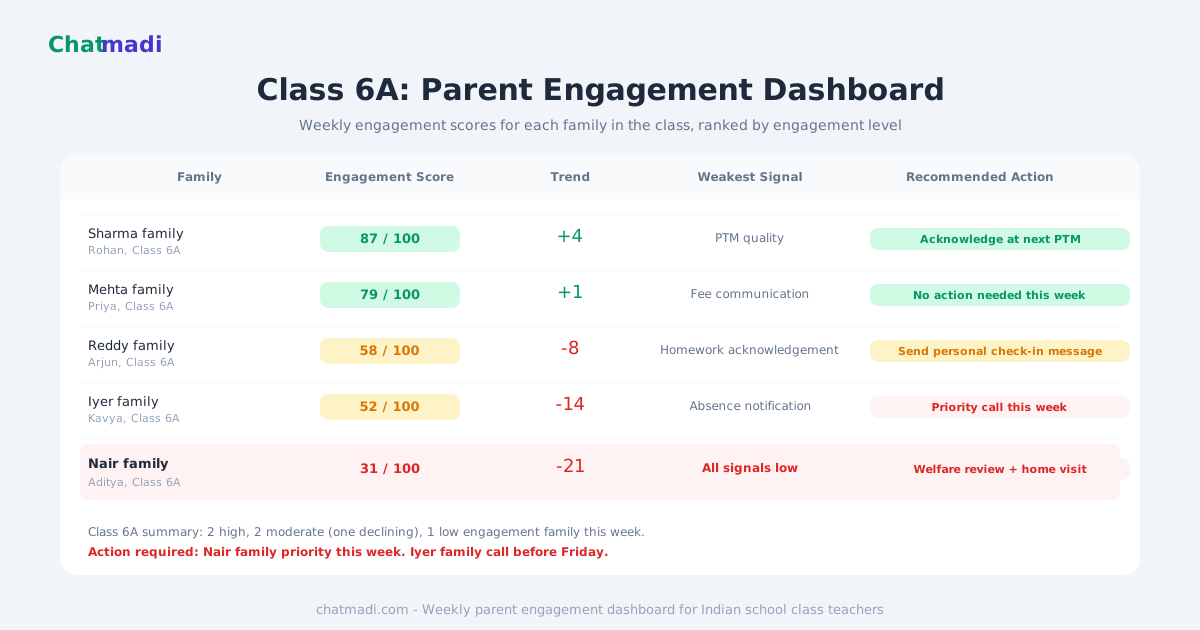
Homework acknowledgement rate: 25 percent. This is the most frequent touchpoint between home and school, so it carries the highest weight. A parent who consistently acknowledges homework is engaged on a daily basis. Absence notification rate: 25 percent. Proactive absence notification requires the parent to think about school before the school day begins. It is a strong signal of active awareness of the child's school life. Response rate to individual teacher outreach: 20 percent. This measures whether parents respond when the school specifically needs them. Fee communication responsiveness: 15 percent. This measures financial engagement and, by extension, overall communication patterns. PTM quality score: 10 percent. This captures the depth of face-to-face engagement. Welfare signal response rate: 5 percent. This metric is infrequent for most families but carries high weight when it occurs, which is why it is given separate tracking even at a low overall weight.A parent engagement score calculated weekly from these metrics allows the class teacher to see at a glance which families in their class are trending toward disengagement, which are consistently highly engaged, and which need a different communication approach to improve their participation.
What to Do When Engagement Drops
A declining parent engagement score is an early warning signal, not a conclusion. When a family's score drops, the first response should be curiosity, not concern: what has changed, and does the school know about it?
Common reasons for sudden drops in parent engagement include family difficulties (financial stress, health issues, relationship changes), dissatisfaction with the school that the parent has not expressed directly, a change in the parent's work situation that has reduced their availability during school hours, or a communication channel issue (the parent changed their phone number and the school does not have the updated contact).
Each of these requires a different response from the school. A family experiencing financial stress needs empathy and flexibility, not escalating fee reminders. A parent who is dissatisfied needs a conversation, not more broadcasts. A parent who changed their phone number needs a contact update, not an assumption of disengagement.
The class teacher is typically best placed to make the initial outreach when a family's engagement drops. A brief personal message from the teacher, not from the school's admin contact, asking if everything is alright, is often enough to surface whatever has changed. The improve parent engagement guide covers specific outreach strategies for different engagement gap scenarios.
Using Engagement Data at the Class and School Level
Individual family engagement scores are useful for class teachers managing their class's parent community. Aggregated engagement data is useful for principals managing their school's overall parent relationship health.
At the class level, the class teacher should review the engagement distribution once a fortnight. Which families are in the low-engagement band? Have any families that were previously highly engaged dropped significantly? Is there a pattern of low engagement among families of students who are also showing academic difficulty?
At the school level, the principal should review class-level engagement data monthly. Are there classes where average parent engagement is significantly lower than the school average? This might reflect a class teacher communication style that is not working for that parent community. Are there academic years (Standard 6, for example) where engagement consistently drops? This might reflect a transition point that needs more school support.
The school analytics guide for principals explains how principals who use data to manage class-level performance, including engagement data, achieve better outcomes across attendance, academic performance, and welfare than principals who manage primarily through direct observation and anecdote.
The parent engagement score feature in Chatmadi calculates each family's engagement score weekly from the data that flows through the school's WhatsApp communication. No additional data entry is required: the score is derived from signals that the school is already generating through its normal communication with parents.
Getting Started with Engagement Measurement
The transition from informal engagement assessment to systematic engagement measurement does not require a complete overhaul of how the school communicates with parents. It requires three changes.
Change 1: Define what each metric means for your school. Homework acknowledgement looks different in a school that sends homework via WhatsApp group broadcast and a school where individual teachers send homework directly to each parent. Define, per class, what constitutes a measurable engagement signal for each of the six metrics. Change 2: Begin tracking systematically from one class. Choose one class to begin engagement measurement, ideally with a class teacher who is enthusiastic about data-informed communication. Run the tracking for one term, review the results, and use the learning to refine the approach before rolling it out across the school. Change 3: Connect engagement data to student outcomes. At the end of the term, compare the class's engagement data with student outcomes: attendance, academic performance, welfare flags, and homework completion rates. The correlation between low engagement and poor outcomes will almost always be visible and will make the case for expanding the measurement across the school.Start free at chatmadi.com. Parent engagement tracking using WhatsApp conversation data is included in the Growth plan. Schools on the Starter plan can begin with manual engagement tracking for a single class using the metrics described in this guide before investing in automated measurement.
Frequently Asked Questions
How does Chatmadi calculate parent engagement scores from WhatsApp data?Chatmadi analyses uploaded WhatsApp conversation exports and tracks six engagement signals per family: homework acknowledgement responses, absence notifications sent proactively, responses to individual teacher messages, fee payment communications, PTM confirmation and follow-up, and welfare concern responses. Each signal is weighted and combined into a weekly engagement score per family. The score is visible to the class teacher and the principal. No manual data entry is required beyond the WhatsApp conversation uploads that teachers are already doing.
Can engagement scores be compared across classes?Yes. The principal dashboard shows class-average engagement scores alongside individual family scores. This allows the principal to identify classes where the average engagement is significantly below the school average and investigate whether this reflects a communication approach issue, a specific demographic challenge in that class's parent community, or another systemic factor.
What should a school do if a family has a consistently low engagement score despite repeated outreach?Persistent low engagement despite school outreach should trigger a welfare review of the student, not just a communication review of the family. When a family is consistently unable or unwilling to engage with school communication, the school should assess whether there are home circumstances affecting the child that require welfare intervention rather than simply communication improvement. The class teacher and principal should be involved in this assessment together.
Does tracking parent engagement create a surveillance concern for families?Engagement tracking measures the school's own communication interactions, not parents' private behaviour. Every signal tracked is a signal in a communication that involved the school directly: a homework acknowledgement to the class group, a response to a teacher's message, a confirmation for a PTM. Schools should disclose their engagement tracking approach in their data processing notice to parents as part of DPDPA compliance, which the DPDPA compliance guide covers in detail.
How long does it take to see a meaningful engagement score for each family?A reliable engagement score requires approximately four to six weeks of communication data. Families with low interaction frequency may take longer to produce a stable score. Schools that begin engagement tracking at the start of a term have a reliable score for each family within the first six weeks of the term, leaving the remaining weeks to act on the insights the scores reveal.
Chatmadi Team
School Communication Intelligence
The Chatmadi team writes about AI-powered parent communication, school management best practices, and WhatsApp intelligence for Indian schools. Built by Eduloom Technologies OPC Pvt Ltd, Mysore.
Ready to Try Chatmadi at Your School?
Free to start. Setup in 15 minutes. No new apps for parents.
Set Up My School Free →