How to Reduce Teacher Workload by 3 Hours a Day Using AI
In this article
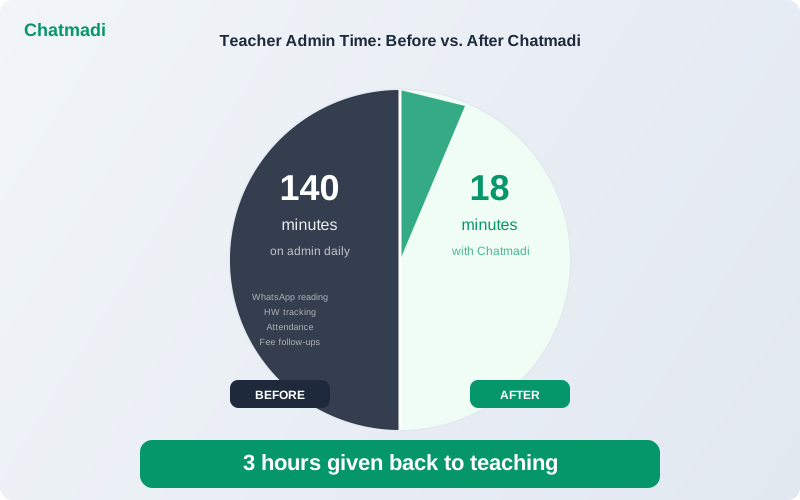
An Indian class teacher arrives at school at 8 AM. Before the first class at 9 AM, she has already spent 25 minutes scrolling through the class WhatsApp group: checking which parents sent absence messages, who acknowledged last night's homework, whether anyone mentioned a fee payment, and if any messages need immediate response. During lunch break, she spends another 20 minutes updating the attendance register with information from WhatsApp messages she collected in the morning. After school, she spends 30 minutes drafting and sending homework notifications, counting acknowledgements from yesterday's assignment, and following up with two parents about overdue fees. Before leaving at 4 PM, she spends another 15 minutes writing a brief weekly update for her class and checking if any action items from the last PTM are pending. Total administrative time: 140 minutes per day. That is 2 hours and 20 minutes spent on tasks that do not involve teaching, mentoring, or developing as a professional. Software that can reduce teacher workload school software India educators need must target these specific 140 minutes. Chatmadi reduces them to approximately 18 minutes.
The 140-Minute Daily Admin Burden Every Class Teacher Carries
The 140-minute figure is not an exaggeration. It is the sum of six specific tasks that every Indian class teacher performs daily, each of which consumes measurable time. Task one: reading and processing WhatsApp messages. Time: 45 minutes per day. The class teacher reads every message in the class WhatsApp group and individual parent conversations. Most messages are routine, but the teacher must read all of them to find the ones that require action. This includes absence notifications, homework questions, fee confirmations, event queries, and general communication. Task two: tracking homework acknowledgements. Time: 25 minutes per day. After posting a homework notification, the teacher scrolls through responses to count which parents acknowledged. For a class of 30 students, this involves scanning 30 or more messages, matching each response to a parent, and mentally noting who did not respond. Task three: updating attendance records. Time: 20 minutes per day. The teacher cross-references WhatsApp absence messages with the physical register, enters the data, notes the reasons, and follows up with parents who did not send a message for their absent child. Task four: fee-related follow-up. Time: 20 minutes per day. The accounts team asks class teachers to follow up with parents about overdue fees. The teacher checks which parents have mentioned payments in WhatsApp, relays this to accounts, and sends reminders to those who have not paid. Task five: writing summaries and updates. Time: 15 minutes per day. The teacher prepares brief updates for the principal, drafts weekly parent summaries, and documents any notable incidents or observations. Task six: PTM and action item tracking. Time: 15 minutes per day (averaged across the term). Preparing for PTMs, following up on action items, and checking on previously flagged student issues. These six tasks add up to 140 minutes. None of them involve teaching.
The 6 Tasks Eating Your Teachers' Most Valuable Hours
Each of these tasks is necessary. The problem is not that they should not be done. It is that they should not be done manually. Reading and processing WhatsApp messages is necessary because the messages contain important school data. But a teacher should not have to read 50 messages to find the 5 that require action. An AI should read all 50 and present the 5 that matter. Tracking homework acknowledgements is necessary because it measures parent engagement. But a teacher should not have to scroll through a group chat counting thumbs-up emojis. An AI should count them and present the acknowledgement rate as a single number. Updating attendance records is necessary because the school needs accurate attendance data. But a teacher should not have to manually transfer information from WhatsApp messages to a register. An AI should detect the absence notification and record it automatically. Fee follow-up is necessary because fee collection funds the school's operations. But a teacher should not have to act as a messenger between the accounts team and parents. An AI should detect which parents have already confirmed payments and draft reminders for those who have not. Writing summaries is necessary because principals and boards need information. But a teacher should not have to manually compile data that already exists in their daily conversations. A dashboard should present it automatically. PTM tracking is necessary because follow-through is what makes PTMs valuable. But a teacher should not have to remember action items in their head. A system should track them with due dates and reminders.
How Chatmadi Reduces or Eliminates Each Time-Consuming Task
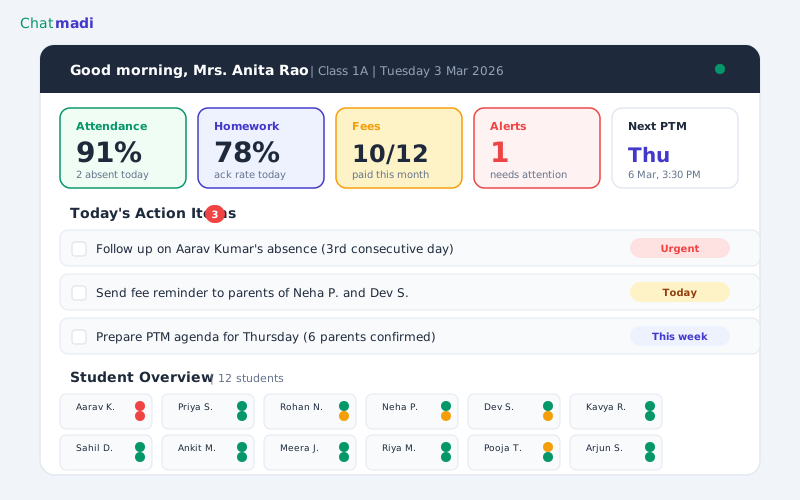
For task one (reading WhatsApp messages, 45 minutes): Chatmadi's AI reads every message and classifies it by type. Instead of scrolling through 50 messages, the teacher opens the dashboard and sees: 2 absences detected, 1 fee payment mentioned, 3 homework acknowledgements received, 1 safety concern flagged. The teacher reviews only the actionable items. Time with Chatmadi: 5 minutes. For task two (homework acknowledgement tracking, 25 minutes): Chatmadi automatically detects which parents acknowledged the homework notification. The dashboard shows the acknowledgement rate and lists acknowledged and pending parents. The teacher can send a reminder to pending parents with one click. Time with Chatmadi: 3 minutes. For task three (attendance recording, 20 minutes): Chatmadi detects absence notifications from parent messages and records them automatically. The teacher confirms the AI's detections and manually adds any absences not reported on WhatsApp. Time with Chatmadi: 3 minutes. For task four (fee follow-up, 20 minutes): Chatmadi's fee detection queue shows which parents have mentioned payments. The AI drafts reminders for parents who have not paid. The teacher reviews and sends. Time with Chatmadi: 3 minutes. For task five (summaries, 15 minutes): Chatmadi's dashboard and weekly digest feature provide the data that summaries typically contain. The teacher reviews the auto-generated summary and adds any personal observations. Time with Chatmadi: 2 minutes. For task six (PTM tracking, 15 minutes): Chatmadi tracks action items with due dates and sends reminders when items are approaching their deadline. The teacher checks the action item list as part of their daily dashboard review. Time with Chatmadi: 2 minutes. Total time with Chatmadi: 18 minutes per day. Time saved: 122 minutes per day. That is more than 2 hours given back to every class teacher, every day.
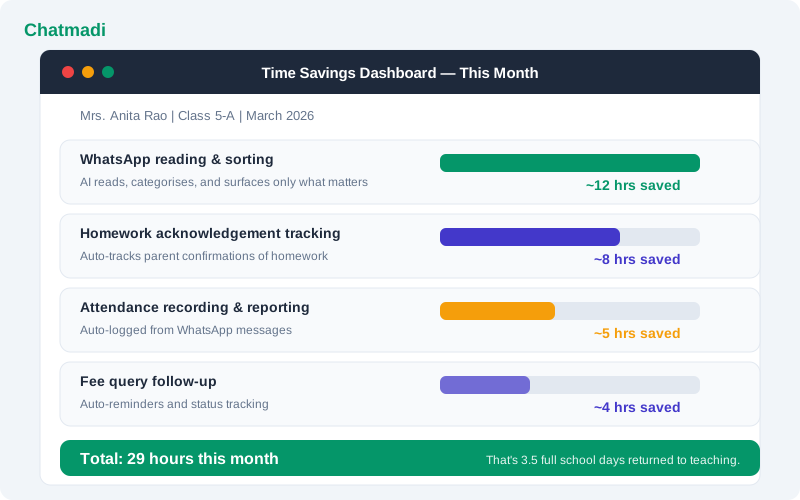
Time savings dashboard showing monthly hours saved across WhatsApp reading homework attendance and fee tasks
How-To: Measuring Your School's Teacher Time Savings After Adopting Chatmadi
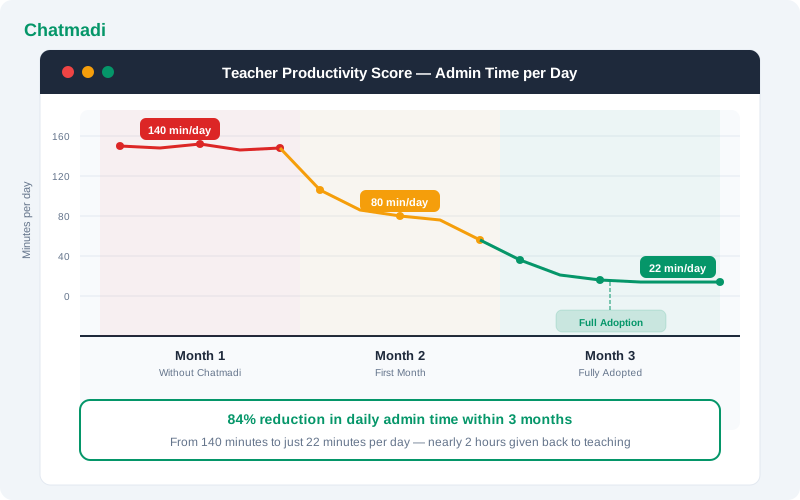
To measure the actual time savings in your school, follow this framework. Before adoption: ask each class teacher to track their daily admin time for one week. Use a simple log: "WhatsApp reading: 40 mins. Homework tracking: 30 mins. Attendance: 20 mins. Fee follow-up: 15 mins. Summaries: 10 mins. PTM tasks: 10 mins. Total: 125 mins." Average across the week and across teachers. This is your baseline. After two weeks of Chatmadi use: repeat the time tracking exercise. Teachers now log how long they spend on each task using Chatmadi. Typical results show a 50 to 60% reduction in the first two weeks as teachers learn the system. After one month of Chatmadi use: repeat once more. By this point, teachers are fully comfortable with the dashboard routine and the time savings stabilise. Typical results show an 80 to 90% reduction from baseline. Calculate the school-wide savings by multiplying the per-teacher daily savings by the number of class teachers and the number of school days per month. For a school with 8 class teachers saving 2 hours each per day over 22 school days, the total is 352 hours of recovered teacher time per month. At a conservative valuation, this represents significant operational efficiency that far exceeds the cost of the software.
Teacher productivity score over 3 months showing admin time dropping from 140 to 22 minutes per day
What Teachers Do With Their 3 Recovered Hours Per Day
The 2 or more hours that Chatmadi gives back to teachers are not idle time. They are reinvested into the work that teachers are trained for and passionate about. More time for lesson preparation. Teachers who are not exhausted by admin have more energy and time to prepare engaging lessons, create teaching materials, and differentiate instruction for diverse learners. More time for individual student attention. In a class of 30 students, each child deserves individual attention. Teachers who are freed from admin can spend time with struggling students, challenge advanced students, and notice the quiet ones who need support. More time for professional development. Teachers who have breathing room can read, learn new teaching methods, attend workshops, and collaborate with colleagues. Professional growth requires time that admin-heavy schedules do not allow. More time for meaningful parent interaction. When the routine communication is handled by the system, the conversations teachers do have with parents are about the student's growth, challenges, and potential, not about whether the fee was paid or the homework was received. Better work-life balance. Teachers who leave school at 4 PM without a backlog of admin tasks are less likely to burn out. Teacher retention improves when the job feels sustainable.
Frequently Asked Questions
Is the 3-hour savings realistic for every teacher?
The 140-minute baseline is typical for a class teacher responsible for 25 to 35 students. Teachers with fewer students or less WhatsApp communication may save less. Teachers with larger classes or more active parent groups may save more. The 80 to 90% reduction is consistent across schools that adopt Chatmadi fully.
Does using Chatmadi add any new time to the teacher's day?
Yes, but minimally. The daily Chatmadi routine (uploading conversations and reviewing the dashboard) takes approximately 10 to 18 minutes. This is significantly less than the 140 minutes of manual work it replaces.
What if my teachers are not currently spending 140 minutes on admin?
Some teachers may have already developed shortcuts or may not track all admin tasks. Even if a teacher's baseline is 60 minutes instead of 140, a reduction to 18 minutes still saves 42 minutes per day, which is meaningful.
Can Chatmadi help with non-communication admin tasks like report writing?
Chatmadi automates communication-related admin tasks. Non-communication tasks like lesson planning, grading, and report writing are not directly addressed, though the time saved on communication tasks frees up time for these other responsibilities.
How do I convince sceptical teachers that AI will actually reduce their workload?
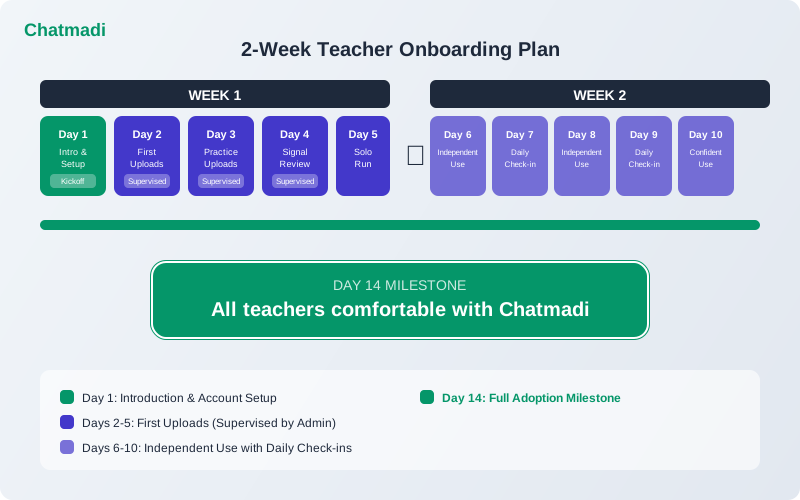
The most effective approach is a pilot. Have one willing teacher use Chatmadi for two weeks and track their time savings. When that teacher reports saving 2 hours per day, the sceptical colleagues will want to try it.
---
Your teachers became teachers to teach, not to count WhatsApp messages. Give them their time back with Chatmadi. Start free at chatmadi.com
Tagsreduce teacher workload school software Indiaclass teacher dashboard software Indiaschool productivity tools India 2025AI school management software IndiaChatmadi
C
Chatmadi Team
School Communication Intelligence
The Chatmadi team writes about AI-powered parent communication, school management best practices, and WhatsApp intelligence for Indian schools. Built by Eduloom Technologies OPC Pvt Ltd, Mysore.