The 7 Things School ERPs Get Wrong That WhatsApp CRMs Get Right
In this article
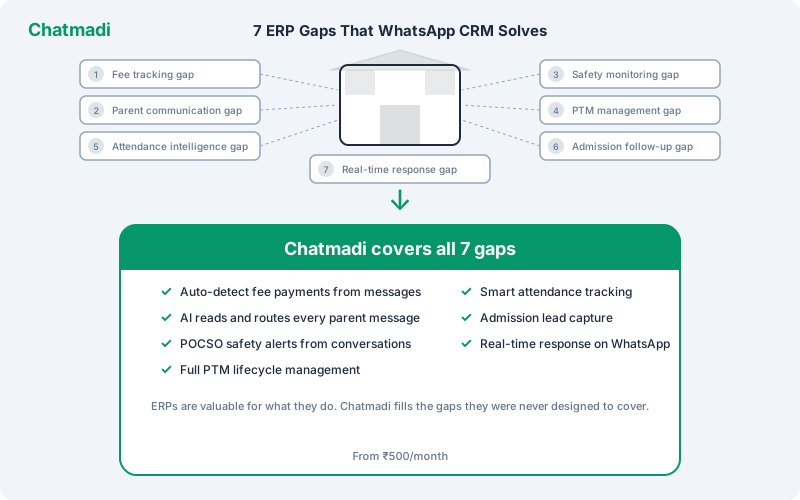
School ERPs were revolutionary when they first appeared in Indian schools in the early 2010s. For the first time, schools could digitise student records, generate fee receipts, print report cards, and manage staff payroll without paper registers and manual calculations. Products like Fedena, Entab, and MyClassboard brought genuine efficiency to school administration. That contribution deserves acknowledgement. But 2025 is not 2010. The way parents communicate with schools has fundamentally changed. WhatsApp has become the primary channel for daily school-parent interaction. Parents send homework queries, absence notifications, fee payment confirmations, and concerns about their children through WhatsApp messages. This communication generates enormous amounts of valuable data that traditional ERPs cannot access. School admin software India free or paid must evolve to address this new reality. Chatmadi's WhatsApp CRM closes seven specific gaps that traditional ERPs leave open.
Why School ERPs Were Revolutionary in 2010 (And Why 2025 Is Different)
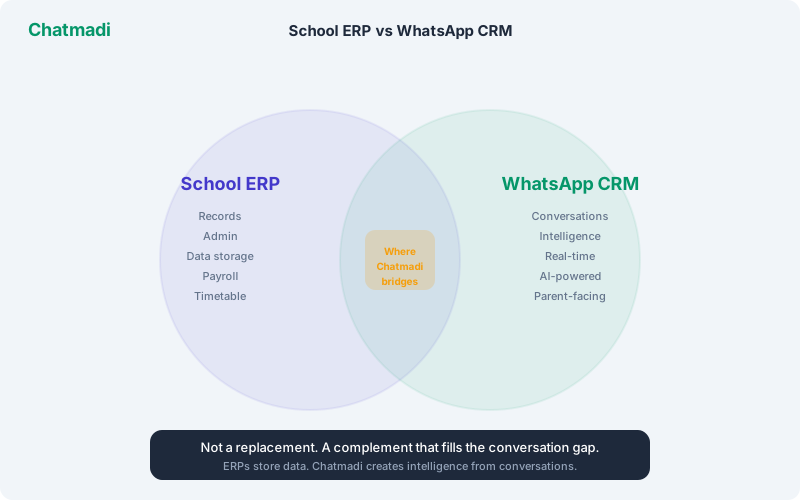
In 2010, the typical Indian school ran on paper. Student records were in physical files. Fee receipts were carbon-copied by hand. Report cards were handwritten. Attendance was tracked in bound registers. When school ERPs arrived, they digitised these processes. Data that was previously locked in paper registers became searchable, sortable, and reportable. This was genuinely transformative. But the ERP model was designed for a pre-WhatsApp world. It assumed that all school data would be entered into the system by school staff through structured forms and interfaces. In 2010, this was a reasonable assumption. In 2025, it is no longer true. Today, a significant portion of school-relevant data flows through WhatsApp conversations that the ERP has no visibility into. A parent confirms a fee payment on WhatsApp. The ERP does not know until someone manually enters it. A parent reports a child's absence on WhatsApp. The ERP does not know until the teacher manually marks the register. A parent raises a safety concern on WhatsApp. The ERP has no safety module to record it. The gap is not that ERPs are bad. It is that the world has changed and ERPs have not changed with it. Chatmadi bridges this gap by reading the WhatsApp conversations that ERPs cannot see.
The 7 Gaps Traditional ERPs Leave That Schools Feel Every Day
Gap one: manual data entry requirement. Every data point in an ERP must be entered by a human. Fee payments, attendance, exam scores, parent contact updates, and communication records all require manual entry. This is time-consuming, error-prone, and creates a persistent lag between real-world events and system records. Gap two: no WhatsApp integration. ERPs operate as standalone systems. They have no connection to the WhatsApp conversations where most daily school-parent communication happens. A parent who confirms a payment, reports an absence, or raises a concern on WhatsApp is invisible to the ERP until someone manually transfers the information. Gap three: no parent engagement tracking. ERPs store parent contact details but do not measure how engaged each parent is with the school. There is no metric for communication frequency, homework acknowledgement rates, or composite engagement scores. Schools cannot identify disengaging families using ERP data alone. Gap four: no real-time intelligence. ERPs produce periodic reports: monthly attendance summaries, term-end academic reports, annual fee collection statements. These are backward-looking. They tell you what happened, not what is happening now. Schools need real-time dashboards that show today's attendance, this week's homework engagement, and current fee collection status. Gap five: no AI analysis layer. ERPs do not read or analyse text. They cannot detect that a parent's message about their child "not wanting to come to school" may be a bullying signal. They cannot detect that a message saying "transferred the amount" is a fee payment confirmation. They process structured data that humans enter, not unstructured text from conversations. Gap six: complex adoption requiring staff training. ERP implementations are notoriously difficult. They require weeks of setup, data migration, staff training, and ongoing IT support. Many Indian schools, especially smaller ones, abandon ERP implementations midway because the complexity exceeds their capacity. Gap seven: no safety or welfare monitoring. ERPs do not have modules for detecting child welfare concerns, generating safety alerts, or tracking welfare signals across student profiles. POCSO compliance, bullying detection, and at-risk student identification are not part of the ERP feature set.
How Chatmadi Closes Each of the 7 Gaps
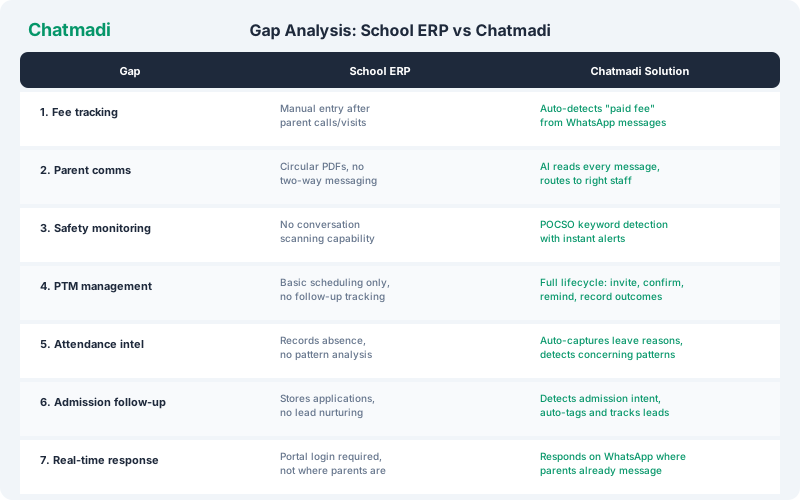
For gap one (manual data entry): Chatmadi extracts data automatically from WhatsApp conversations. Fee payments are detected from parent messages. Absences are detected from parent notifications. Homework acknowledgements are detected from parent responses. The AI does the data entry that humans currently do manually. For gap two (no WhatsApp integration): Chatmadi is built on WhatsApp from the ground up. Every feature reads from and writes to WhatsApp conversations. The school's primary communication channel is the system's primary data source. For gap three (no parent engagement tracking): Chatmadi computes a Parent Engagement Score for every family based on four dimensions: fee timeliness, PTM attendance, homework acknowledgement rate, and communication frequency. Schools can identify disengaging families weeks before the disengagement becomes a crisis. For gap four (no real-time intelligence): Chatmadi's dashboards update each time new conversation data enters the system. Teachers see today's attendance, this week's homework engagement, and current alerts in real time. Principals see school-wide metrics that are current, not months old. For gap five (no AI analysis layer): Chatmadi's AI reads every parent message and classifies it by type: fee payment, absence notification, homework acknowledgement, safety concern, general communication, and more. This classification turns unstructured WhatsApp text into structured, actionable school data. For gap six (complex adoption): Chatmadi can be set up in hours, not weeks. Teachers upload WhatsApp conversations and the AI begins producing insights immediately. There is no complex data migration, no IT infrastructure requirement, and no extensive staff training. For gap seven (no safety monitoring): Chatmadi scans every conversation for welfare signals, classifies them by severity, and generates alerts for teachers and principals. POCSO-relevant signals trigger immediate escalation to the designated child protection officer.
Gap analysis table showing 7 ERP gaps and Chatmadi specific solutions for each
How-To: Identifying Which Gaps Are Costing Your School the Most
Not every school feels all seven gaps equally. Here is how to identify which ones are causing the most pain in your school. Ask your accounts team: "How many hours per week do you spend entering fee payment data into the system?" If the answer is more than 5 hours, gap one (manual data entry) is a major cost. Ask your class teachers: "How much time do you spend each day scrolling through WhatsApp to track attendance and homework acknowledgements?" If the answer is more than 20 minutes, gap two (no WhatsApp integration) is a major cost. Ask your principal: "Can you tell me right now which 5 parents are least engaged with the school?" If the answer requires checking with individual teachers, gap three (no engagement tracking) is a major cost. Ask yourself: "When was the last time we were surprised by a student's poor exam performance and realised the warning signs were there months earlier?" If this has happened even once, gap four (no real-time intelligence) and gap five (no AI layer) are costing you student outcomes. Ask your designated child protection officer: "Do we have a systematic way to detect welfare concerns from parent communications?" If the answer is no, gap seven (no safety monitoring) is a compliance and child welfare risk. Start with the gaps that cost you the most. Chatmadi closes all seven, but knowing which ones matter most to your school helps you prioritise what to implement first.
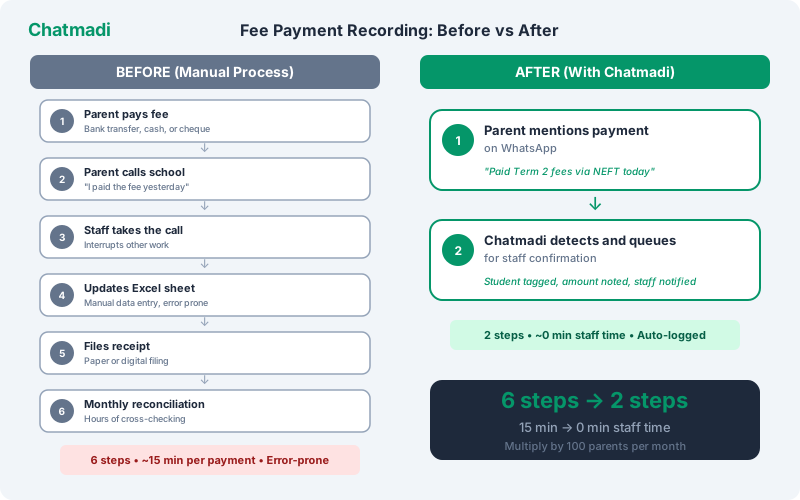
Before versus after workflow comparison for fee payment recording showing 6 manual steps reduced to 2 automated steps
The Hybrid Approach: Using ERP + Chatmadi Together
The most effective technology setup for Indian schools is a hybrid approach that uses each tool for what it does best. The ERP handles structured administration: student enrollment records, staff payroll, timetable management, official report card generation, and fee receipt issuance. These are tasks that require structured data entry and produce formal documents. The ERP excels here. Chatmadi handles communication intelligence: WhatsApp conversation analysis, fee payment detection, absence tracking, homework engagement, safety alerts, parent engagement scoring, PTM management, and real-time dashboards. These are tasks that require understanding unstructured conversation data and producing actionable insights. Chatmadi excels here. In the hybrid model, Chatmadi acts as the real-time intelligence layer that feeds into the ERP's record-keeping layer. The AI detects a fee payment in a WhatsApp conversation. The accounts staff verifies it and enters the confirmed payment into the ERP. The AI detects an absence. The teacher confirms it and the attendance record is updated in the ERP. The AI detects a safety concern. The teacher investigates and documents the outcome in both Chatmadi's safety log and the school's official records. This hybrid approach gives schools the best of both worlds: the structured record-keeping of an ERP and the real-time intelligence of a WhatsApp CRM.
Frequently Asked Questions
Are you saying schools should stop using ERPs?
No. ERPs provide valuable administrative capabilities that Chatmadi does not replace: payroll, timetabling, transport management, and official report card generation. The argument is that ERPs alone are insufficient for modern school management because they cannot access WhatsApp communication data.
Is Chatmadi available for free?
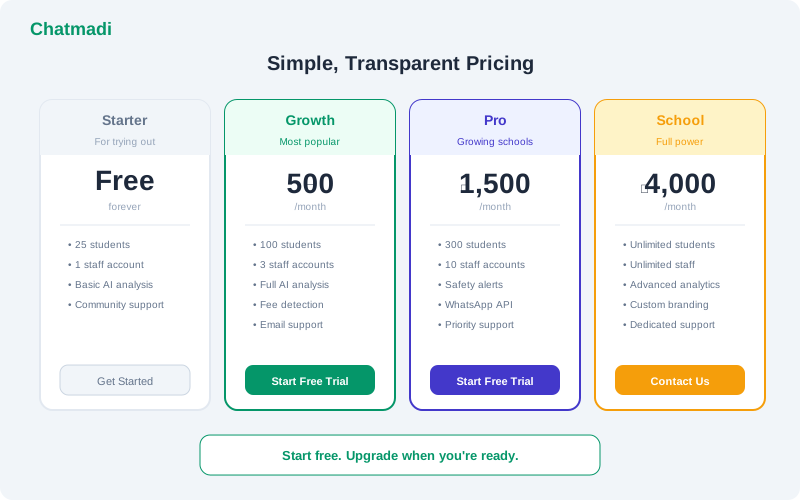
Chatmadi offers a free tier for schools to experience the platform. Paid plans with additional features are priced affordably for the Indian school market.
Can a small school with 50 students benefit from Chatmadi?
Yes. Small schools often benefit the most because they have the least administrative staff. A school with 50 students and one administrator cannot afford to spend hours on manual data entry. Chatmadi's automatic data extraction saves time that small schools can least afford to waste.
What if our school does not have an ERP and we want one system for everything?
Chatmadi covers many of the functions that a school ERP provides for day-to-day operations: student profiles, attendance tracking, fee tracking, academic analytics, and parent communication. For schools that do not need payroll or timetable management, Chatmadi may be sufficient as a standalone system.
How does Chatmadi handle data security compared to ERPs?
Chatmadi stores data in secure cloud infrastructure with encryption. Access is role-based, with teachers seeing only their class data and principals seeing school-wide data. The security standards are comparable to leading school ERPs.
---
ERPs store records. Chatmadi extracts intelligence. Together, they give your school the tools it needs for 2025. Start free at chatmadi.com
Tagsschool admin software India freeschool management software vs WhatsApp CRMaffordable school CRM Indiadigital transformation school IndiaChatmadi
C
Chatmadi Team
School Communication Intelligence
The Chatmadi team writes about AI-powered parent communication, school management best practices, and WhatsApp intelligence for Indian schools. Built by Eduloom Technologies OPC Pvt Ltd, Mysore.