School Fee Structure Setup: How Indian Schools Should Design Term Fees, Instalments, and Concessions
In this article
Most Indian school fee structures were designed when the school first opened, usually by the founder or the first principal, based on what nearby schools were charging at the time. They have been adjusted incrementally since then: a percentage increase each year, a new component added when a new facility was built, a concession policy introduced when a donor family asked for one. Over a decade or more, the structure has accumulated layers that nobody has reviewed holistically, that parents find confusing, and that the accounts team finds difficult to explain and enforce consistently.
Table of Contents
- [Mistake 1: Too Few Payment Frequency Options](#mistake-1-too-few-payment-frequency-options)
- [Mistake 2: Too Many Optional Components With Unclear Necessity](#mistake-2-too-many-optional-components-with-unclear-necessity)
- [Mistake 3: Concession Policy That Is Ad Hoc Rather Than Systematic](#mistake-3-concession-policy-that-is-ad-hoc-rather-than-systematic)
- [Mistake 4: No Late Payment Policy That Is Consistently Enforced](#mistake-4-no-late-payment-policy-that-is-consistently-enforced)
- [Mistake 5: Fee Structure That Does Not Reflect Class-Level Costs](#mistake-5-fee-structure-that-does-not-reflect-class-level-costs)
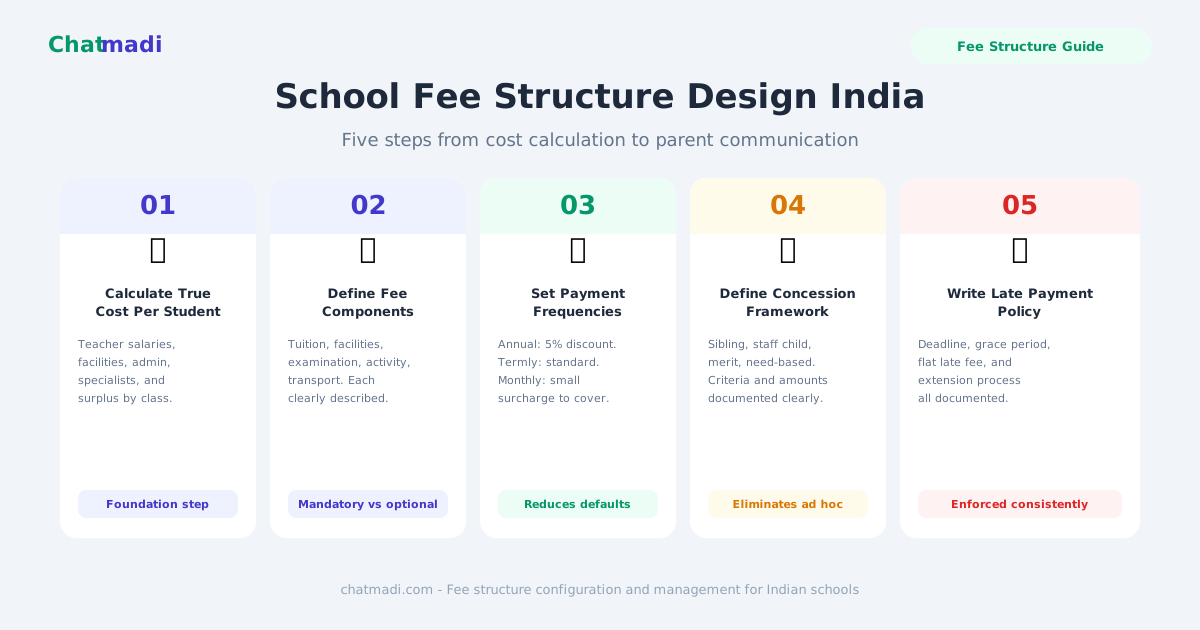
- [Step 1: Calculate the True Cost of Education Per Student Per Class](#step-1-calculate-the-true-cost-of-education-per-student-per-class)
- [Step 2: Define the Fee Components](#step-2-define-the-fee-components)
- [Step 3: Set Payment Frequency Options and Pricing](#step-3-set-payment-frequency-options-and-pricing)
- [Step 4: Define the Concession Framework](#step-4-define-the-concession-framework)
- [Step 5: Write the Late Payment Policy](#step-5-write-the-late-payment-policy)
A fee structure that was designed reactively, adjusted incrementally, and never reviewed as a complete system is almost always producing more defaults, more disputes, and more collection effort than a structure that was designed with the school's parent community and operational realities in mind.
This guide is for school administrators and principals who want to review and redesign their fee structure in a way that reduces defaults, simplifies collection, and serves the diverse financial situations of their parent community without compromising the school's revenue.
Why Fee Structure Design Matters More Than Fee Collection Tactics
The most common approach to improving fee collection in Indian schools is to improve collection tactics: send more reminders, call defaulters more frequently, escalate to the principal faster, and threaten consequences for persistent non-payment more firmly. These tactics have limited effectiveness because they treat the symptom (late or missing payments) rather than the cause (a fee structure that does not match how families can actually pay).
A family that defaults on fees is not always a family that cannot afford the school. Often it is a family that could afford the total annual fee but cannot produce the full amount at the moment the school demands it. India's salaried workforce is paid monthly. India's self-employed and business-owning population has irregular income. A fee structure that demands large lump-sum payments at the beginning of each term creates genuine cash flow difficulties for families whose income does not arrive in those same lump sums.
The schools with the lowest default rates in India are not the ones with the most aggressive collection tactics. They are the ones with fee structures that align payment timing with how their parent community actually receives money. This is a design problem, not a communication problem.
The fee recovery guide covers what to do when payments are missed. This guide covers how to design the structure to minimise the number of payments that are missed in the first place.
The Five Fee Structure Mistakes Indian Schools Make
Mistake 1: Too Few Payment Frequency Options
A school that offers only annual or termly payment forces every family into one of two modes. Families who can pay annually benefit from any annual payment discount. Families who cannot pay a full term at once have no option except to miss the deadline and become defaulters.
The most effective fee structures for Indian schools offer at least three payment frequency options: annual (typically with a discount of 5 to 10 percent), termly (the default), and monthly (sometimes with a small surcharge to cover the administrative cost of processing twelve payments instead of three). Monthly payment options do not reduce the school's revenue if they are priced correctly. They reduce the school's default rate significantly because they match the payment cycle of salaried employees.
Mistake 2: Too Many Optional Components With Unclear Necessity
A fee structure with twelve components, where six are optional and parents must choose which optional components to pay for, creates confusion that directly causes disputes. A parent who paid the base fee but not the activity fee, and whose child participated in activities, becomes hostile when the school retroactively charges for activities they assumed were included.
Every component in a school fee structure should be clearly categorised as mandatory (required for enrolment and not optional regardless of circumstances) or optional (genuinely available only to families who choose the associated service). The descriptions should be specific enough that parents understand exactly what each component covers. Vague component names like "miscellaneous fees" or "development charges" generate the most disputes and the most payment resistance.
Mistake 3: Concession Policy That Is Ad Hoc Rather Than Systematic
Most Indian schools have a concession policy that exists largely in the principal's head. Concessions are granted based on who asks, how persuasively they ask, and the principal's assessment of the family's need at that moment. This approach creates inconsistency (two families with identical financial circumstances receive different concessions), resentment (families who did not ask do not receive concessions they might have been entitled to), and the perception of favouritism.
A systematic concession policy has defined categories (sibling discount, staff child discount, merit-based concession, need-based concession, community trust scholarship), defined criteria for each category, defined percentage or amount of concession per category, and a defined application and approval process. The policy should be documented and communicated to all families at admission, not discovered by families who happen to ask.
Mistake 4: No Late Payment Policy That Is Consistently Enforced
The absence of a clear, consistently enforced late payment policy is one of the most significant drivers of defaults in Indian schools. When families know that missing a payment deadline has no meaningful consequence, missing the deadline becomes a default strategy for managing cash flow. "The school will chase us eventually" is a rational financial decision when there is no financial penalty for late payment.
A late payment policy should specify: the deadline, the grace period (typically 5 to 10 days), the late payment fee or interest rate that applies after the grace period, the process for families who need an extension before the deadline (which should be available and clearly communicated), and the consequences for persistent non-payment after the policy has been applied. The policy should be communicated at admission, included in the fee structure documentation, and applied consistently to every family.
Mistake 5: Fee Structure That Does Not Reflect Class-Level Costs
Many Indian schools charge the same fee for every class from Class 1 to Class 10, despite the fact that the cost of delivering education changes significantly across these classes. Laboratory equipment, specialist teachers for sciences and mathematics, examination registration fees for board examinations, and career counselling services for senior classes all represent costs that apply to senior classes and not to junior classes.
A fee structure that does not differentiate by class either undercharges senior classes (reducing revenue) or overcharges junior classes (creating value perception problems with parents of younger students who feel they are subsidising older students). Class-differentiated fee structures are more complex to administer but more accurate in their alignment of charges with costs.
Designing a Fee Structure From First Principles
Step 1: Calculate the True Cost of Education Per Student Per Class
Before setting fees, understand what it costs to educate a student in each class. This calculation should include: teacher salaries allocated per class based on teaching time, facilities costs allocated per student, administrative costs per student, specialist services (laboratory, library, sports, arts), examination and board registration costs, and a surplus percentage for capital expenditure and reserves.
This calculation reveals the true cost floor below which the school cannot operate sustainably. It also reveals which classes are genuinely more expensive to run and should therefore be charged at higher rates.
Step 2: Define the Fee Components
Based on the cost calculation, define the components that will make up the total fee. Components should map to identifiable cost categories and should be described in language that parents can understand.
Common component categories for Indian schools: tuition fee (the core academic service), facilities fee (buildings, utilities, equipment), examination fee (internal examinations, board registration), activity fee (sports, arts, co-curricular, if included), transport fee (if the school provides transport), caution deposit (refundable at end of enrolment), and any genuinely optional components like uniform, books, or special programmes.
The fee component configuration in Chatmadi supports all standard component types and allows schools to mark each component as mandatory or optional, with descriptions that appear in parent-facing communication.
Step 3: Set Payment Frequency Options and Pricing
For each payment frequency option, set the pricing correctly. Annual payment should offer a genuine discount relative to the cost of processing multiple payments. Monthly payment may carry a small surcharge that covers the administrative cost of twelve transactions, or it may be offered at the same effective annual rate if the school values the cash flow certainty of monthly collection.
The table below illustrates how a school might price different payment frequencies for a total annual tuition fee of 60,000 rupees:
This structure gives families with cash flow flexibility an incentive to pay annually. It gives families with monthly income a viable monthly option. It does not force any family into a payment mode that does not match their income cycle.
Step 4: Define the Concession Framework
A well-designed concession framework has four categories that cover the most common legitimate concession scenarios in Indian schools.
Sibling concession: A percentage reduction (typically 5 to 15 percent) on the second and subsequent siblings enrolled simultaneously. This acknowledges the loyalty of families who enrol multiple children and reduces the financial barrier to keeping all children in the same school. Staff child concession: A significant reduction (typically 25 to 50 percent) for children of full-time school employees. This is a staff benefit that contributes to teacher retention and should be treated as a compensation element, not a favour. Merit concession: A defined reduction (typically 10 to 25 percent) awarded to students who meet specific academic criteria, such as consistent top ranking in their class or a specific score threshold. Merit concessions should be applied for a defined period (one academic year) and renewed based on continued performance. Need-based concession: A means-tested reduction for families with genuine financial difficulty, awarded through an application process with defined income criteria. This category requires the most careful administration to be fair and consistent.The concession framework should specify whether concessions are stackable (can a staff child who also qualifies for merit concession receive both?) and whether they apply to all fee components or only to the tuition component.
Step 5: Write the Late Payment Policy
A clear late payment policy has four elements: the deadline, the grace period, the consequence, and the extension process.
Deadline: The date by which each payment is due. For termly payment, this is typically the first day of the new term or a specific date within the first two weeks of term. Grace period: The number of days after the deadline during which the payment can be made without penalty. Five to ten days is standard. The grace period should be explicitly communicated so families understand they have a buffer. Consequence: The specific financial penalty that applies after the grace period. A flat late payment fee (500 to 1,000 rupees) is simpler to administer than a percentage interest rate. The consequence should be meaningful enough to incentivise timely payment without being punitive enough to create hardship for families who are making genuine efforts to pay. Extension process: A defined route for families who know in advance that they cannot make the deadline. Families who request an extension before the deadline, with a specific payment commitment date, should receive a brief, formal extension that defers the late payment fee. This route must be genuinely available and not require the family to navigate excessive bureaucracy to use it.Communicating the Fee Structure to Parents
A fee structure that is well-designed but poorly communicated produces almost as many disputes as a poorly designed one. Three communication practices make the largest difference in parent understanding and payment behaviour.
Communicate the complete fee structure at admission, not piecemeal. Every family should receive a complete fee structure document at the time of admission, covering all components, all payment frequency options with their prices, the concession framework with application criteria, and the late payment policy. This document should be signed by the parent as evidence of receipt and understanding. Send fee reminders that include a breakdown, not just a total. A WhatsApp reminder that says "Your fee of 20,000 rupees is due on March 1" produces more queries than one that says "Your Term 2 fee of 20,000 rupees is due on March 1. This covers tuition (15,000), facilities (3,000), and examination (2,000)." The breakdown answers the question before it is asked. Use WhatsApp fee detection to reconcile payments promptly. The most damaging fee communication failure in Indian schools is sending a reminder to a family that has already paid but whose payment was not detected and recorded. The fee payment detection guide explains how AI analysis of WhatsApp conversations can identify payment confirmations and route them to the accounts team for recording, preventing the trust erosion that comes from chasing fees that have already been paid.Setting Up Fee Structures in Chatmadi
Chatmadi's fee structure configuration allows schools to set up their complete fee framework per class, including all components (mandatory and optional), payment frequencies with their prices, concession categories, and due dates.
Once configured, the fee structure feeds directly into the fee collection workflow: generating fee records per student, flagging overdue payments, detecting payment confirmations from WhatsApp conversations, and providing the accounts team with a real-time view of collection status across the school.
The complete school setup guide covers fee structure configuration in detail, including how to set up different structures for different classes and how to apply concessions systematically across the student body.
Start free at chatmadi.com. Fee structure configuration and basic fee tracking are available on the Growth plan. Full fee management including WhatsApp payment detection, bulk payment recording, and fee reminder broadcasting via WABA is available on the Pro and School plans.
Frequently Asked Questions
How often should a school review and update its fee structure?A full review of the fee structure should happen every two to three years, or whenever there is a significant change in the school's cost base (a new building, a significant salary revision, a new programme). Annual fee increases can be applied without a full review. A full review means examining every component, every payment frequency option, every concession category, and the late payment policy to ensure they still reflect the school's actual costs and the parent community's needs.
Should the fee structure be the same across all classes?No, for the reasons described in the guide. The cost of educating a student in Class 10 with laboratory equipment, board examination registration, and specialist science teachers is genuinely higher than the cost of educating a student in Class 1. A differentiated fee structure is more accurate and more defensible to parents than a flat structure that charges every class the same amount.
How should schools handle families who simply cannot afford the fees despite accessing all available concessions?Schools should have a hardship fund or a bursary arrangement for genuine cases of financial difficulty that fall outside the standard concession framework. This fund should be separate from the concession framework (which is systematic and rule-based) and should be discretionary (awarded by the principal based on individual circumstances). Maintaining such a fund, even at a modest level, allows the school to support genuinely needy families without compromising the integrity of the systematic concession framework.
What is the right late payment fee amount for Indian schools?The late payment fee should be high enough to incentivise timely payment but not so high that it creates hardship for families making genuine efforts. A flat fee of 500 to 1,000 rupees is appropriate for most urban private schools. Schools with significantly higher fee levels may set late payment fees up to 2,000 rupees. Schools should avoid percentage-based late fees (which can create large charges for high-fee families) unless they have the administrative systems to calculate and communicate them accurately.
Can Chatmadi support different fee structures for different classes in the same school?Yes. Fee structures in Chatmadi are configured at the class level. A school can have a different fee structure for Class 1, a different one for Class 6, and a different one for Class 10, all within the same school workspace. The accounts team sees the correct fee structure for each student based on their class, and fee records are generated with the correct component breakdown for each student automatically.
Chatmadi Team
School Communication Intelligence
The Chatmadi team writes about AI-powered parent communication, school management best practices, and WhatsApp intelligence for Indian schools. Built by Eduloom Technologies OPC Pvt Ltd, Mysore.
Ready to Try Chatmadi at Your School?
Free to start. Setup in 15 minutes. No new apps for parents.
Set Up My School Free →