How to Score Your Teachers' Performance Without Subjectivity or Bias
In this article
Teacher performance reviews in Indian schools are typically conducted once a year, last 15 minutes, and are based almost entirely on the principal's subjective impression. "Mrs. Nair is doing well." "Mr. Patel needs to improve his class management." These are gut feelings, not measurements. They are vulnerable to recency bias (what happened last week overshadows what happened for ten months), halo effects (a teacher who is well-liked is rated higher regardless of outcomes), and simple information gaps (the principal cannot observe every classroom every day). Teacher performance scoring school software like Chatmadi replaces this guesswork with objective, data-driven metrics computed from actual student outcomes, parent engagement, and classroom activity.
Why Teacher Performance Reviews in Indian Schools Fail
Three structural problems undermine teacher performance reviews at most Indian schools. First, the data does not exist. When a principal sits down to review a teacher's performance, what data do they have? Student exam results (available only at exam time), attendance registers (which track students, not teacher effectiveness), and personal observation (which covers maybe 5% of the teacher's actual classroom time). The remaining 95% of a teacher's work is invisible to the reviewer. Second, the review is infrequent. An annual review means that an underperforming teacher continues for 12 months before receiving structured feedback. A high-performing teacher goes unrecognised for the same period. Third, the conversation is uncomfortable because it is subjective. When a principal tells a teacher "you need to improve parent communication," the teacher can legitimately ask "based on what data?" Without objective metrics, the conversation becomes a negotiation of perceptions rather than a collaborative review of evidence.
The 5 Dimensions That Actually Predict Teacher Effectiveness
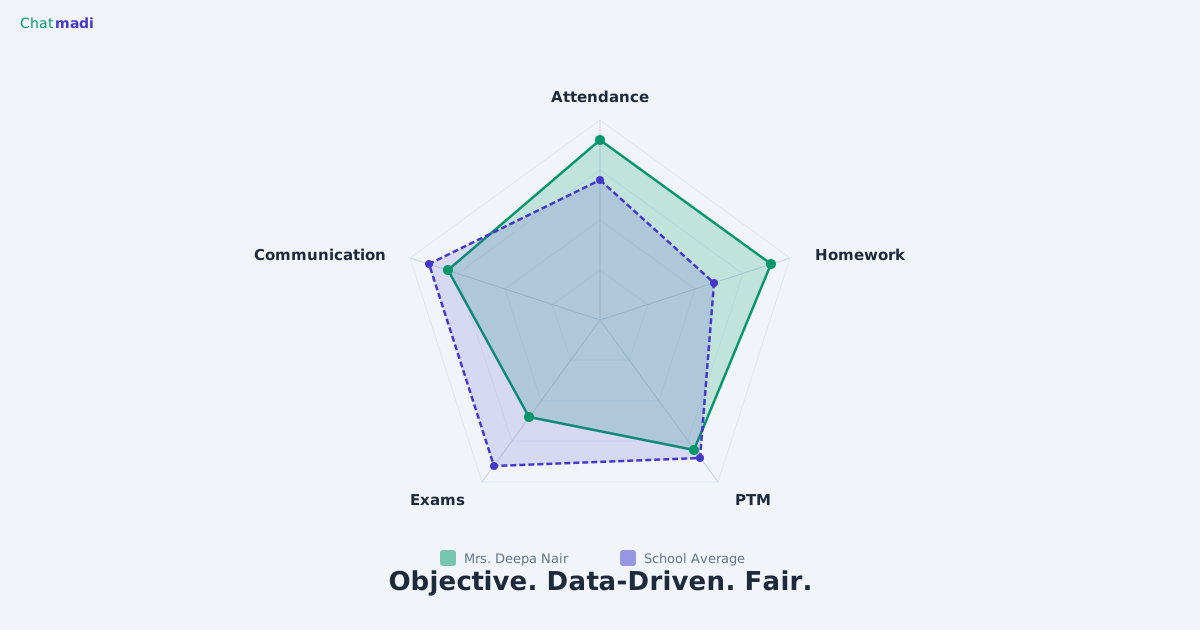
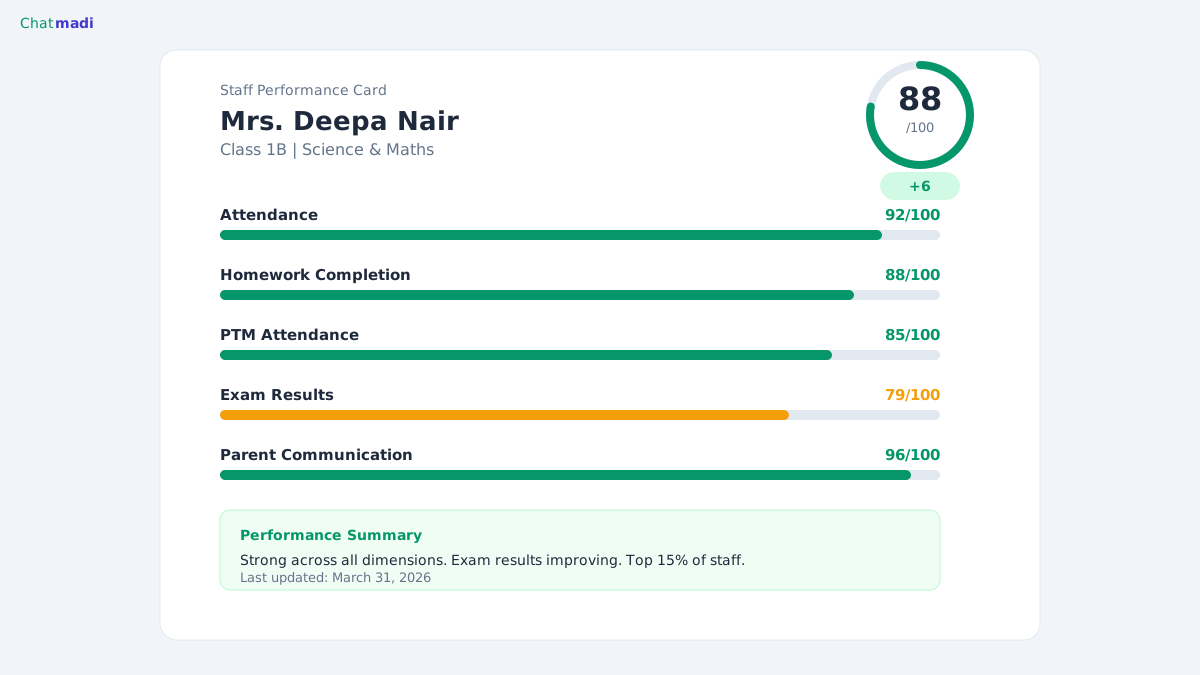
Chatmadi scores each teacher across five dimensions, each computed from real data flowing through the platform. Attendance Quality measures how effectively the teacher tracks and responds to student absences. A teacher whose students have low chronic absence rates and whose absence notifications are confirmed promptly scores higher. Homework Engagement measures the parent acknowledgement rate for assignments shared by the teacher. A class where 85% of parents acknowledge homework has a more engaged teacher than a class where 45% acknowledge. PTM Completion measures PTM scheduling consistency, RSVP response rates, and follow-up completion. A teacher who schedules PTMs regularly, achieves high parent attendance, and documents action items scores higher. Exam Performance measures the academic outcomes of students in the teacher's class, including pass rates, improvement trends, and the proportion of students in each performance band. Communication Frequency measures how regularly the teacher uploads WhatsApp conversations to Chatmadi, which is a direct indicator of how actively they monitor parent communication. Each dimension is scored from 0 to 100. The composite score is a weighted average across all five dimensions.
How Chatmadi Computes Each Dimension Score from Real Data
The scoring computation for teacher performance scoring school software in Chatmadi is transparent and reproducible. For Attendance Quality, the score is based on the percentage of students in the teacher's class with attendance above 85%, the average response time for absence confirmations, and the rate of chronic absence detection and intervention. For Homework Engagement, the score uses the average parent acknowledgement rate across all assignments shared by the teacher during the scoring period. For PTM Completion, the score combines the number of PTMs scheduled relative to the school calendar, the RSVP confirmation rate achieved, the actual parent attendance rate, and the percentage of post-PTM action items that were completed within the specified follow-up period. For Exam Performance, the score uses the class pass rate, the proportion of students improving between consecutive exams, and the average percentage score relative to the school average. For Communication Frequency, the score measures the regularity of WhatsApp conversation uploads, the total number of conversations analysed, and the recency of the last upload. All scores are computed weekly and displayed on the principal dashboard. Historical scores are stored, enabling trend analysis over multiple terms.
Chatmadi staff performance card showing 5 dimension scores for a class teacher
How-To: Introducing Data-Driven Performance Reviews in Your School
Introducing objective performance scoring requires a communication approach that emphasises support, not surveillance. Step one: announce the system transparently. In a staff meeting, explain that the school is implementing data-driven performance tracking to support teacher development. Show the five dimensions and explain how each is computed. Emphasise that scores are tools for improvement, not punishment. Step two: give teachers access to their own scores. Each teacher can see their own performance card in Chatmadi, including all five dimension scores and their trend over time. This transparency builds trust. Step three: run the system for one full term before conducting formal reviews based on the data. This gives teachers time to understand the metrics and adjust their practices. Step four: conduct term-end reviews using the performance data as a foundation. The conversation shifts from "I think you need to improve" to "Your homework engagement score dropped from 78 to 62 this term. Let us look at what changed and how we can support you."
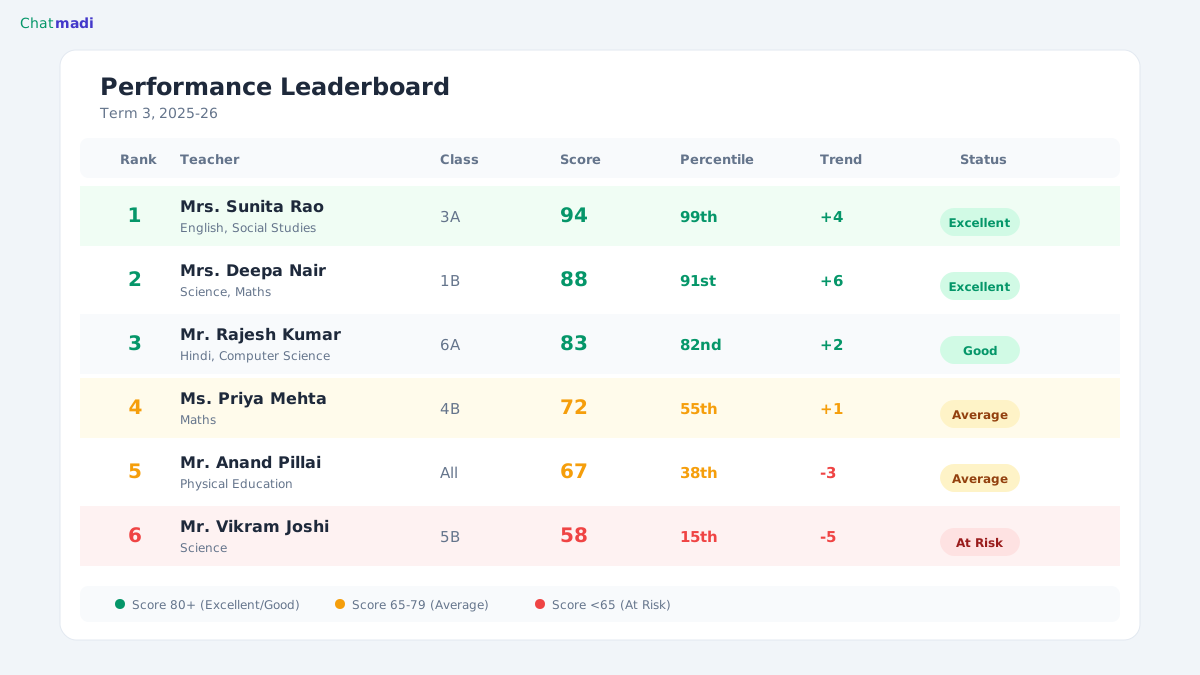
Chatmadi performance leaderboard showing 6 teachers ranked by composite score
Using Performance Scores to Support, Not Punish, Teachers
This is the most important section of this article. Performance scoring is not a surveillance tool. It is a support tool. When a teacher's Communication Frequency score drops, the correct response is not "Why are you not uploading conversations?" but "Is something making it difficult for you to monitor parent communication this term? How can we help?" When a teacher's Homework Engagement score is low, the correct response is not "Your class is underperforming" but "Let us look at which assignments had low acknowledgement rates and discuss whether the format, timing, or communication method could be adjusted." Chatmadi's teacher performance scoring school software provides the data. The principal provides the empathy and the action plan. Schools that use performance scores punitively will create resistance and gaming behaviour. Schools that use them supportively will create a culture of continuous improvement where teachers actively engage with their own data and seek to improve their practice.
Frequently Asked Questions
Can teachers see their own performance scores?
Yes. Each teacher has access to their own performance card showing all five dimension scores, their composite score, and their trend over time. They cannot see other teachers' scores. Only the principal and admin can see the school-wide leaderboard.
How often are performance scores updated?
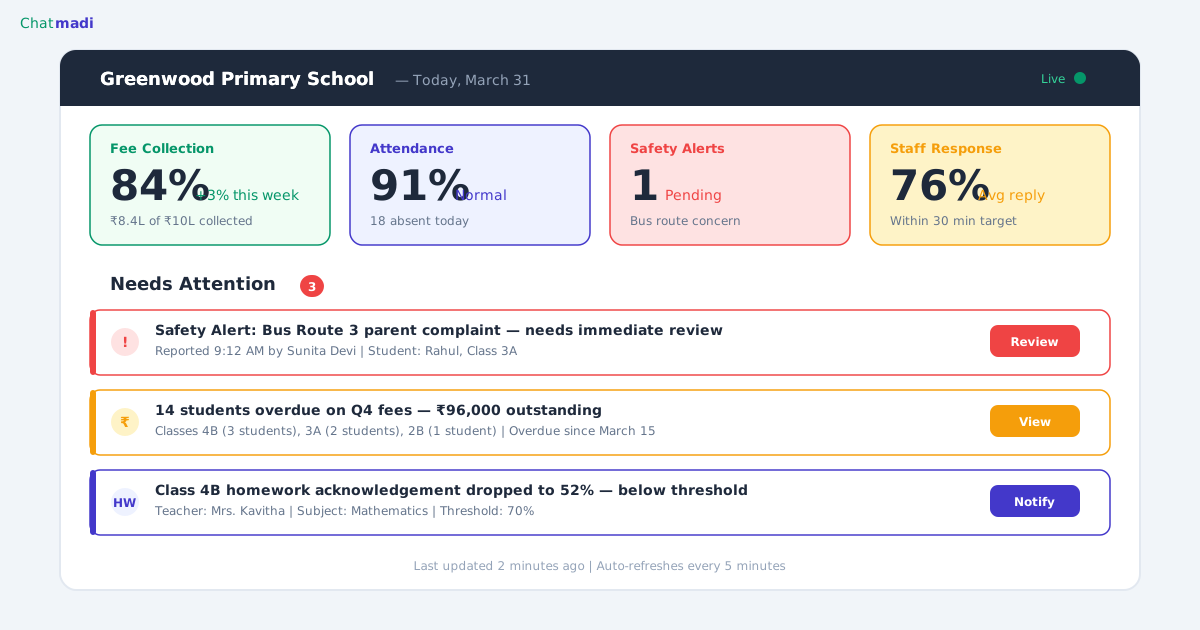
Scores are computed weekly using data from the preceding period. The principal dashboard shows the latest scores with trend indicators (improving, stable, declining) compared to the previous period.
What if a teacher's low score is caused by factors outside their control?
The five dimensions are designed to measure factors largely within the teacher's influence. However, context matters. A teacher whose class has a high proportion of students from financially stressed families may have lower fee collection rates. The principal should interpret scores with appropriate context during reviews.
Is the performance scoring available on all plans?
The full staff performance scoring module with 5-dimension analysis is available on the School plan. The Pro plan includes basic performance indicators. Growth and Starter plans do not include staff performance scoring.
---
Your teachers deserve fair, objective, data-driven performance feedback. Chatmadi provides it. Start free at chatmadi.com
The Chatmadi team writes about AI-powered parent communication, school management best practices, and WhatsApp intelligence for Indian schools. Built by Eduloom Technologies OPC Pvt Ltd, Mysore.