How AI Can Flag At-Risk Students Before the Exam Results Come In
In this article
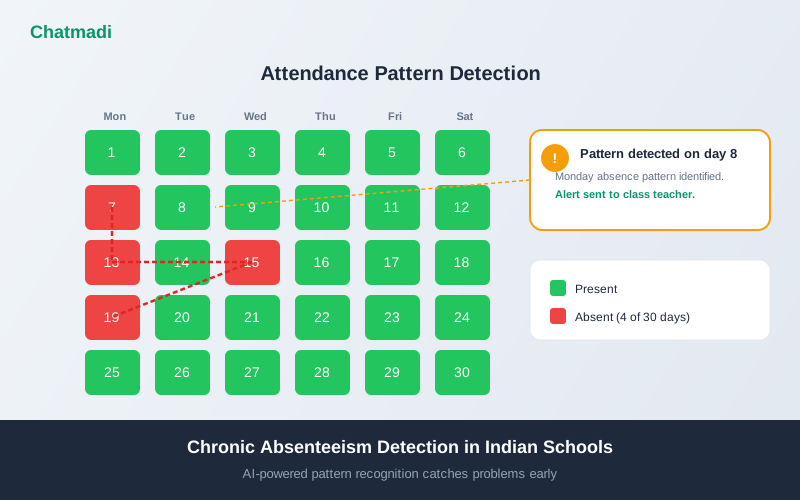
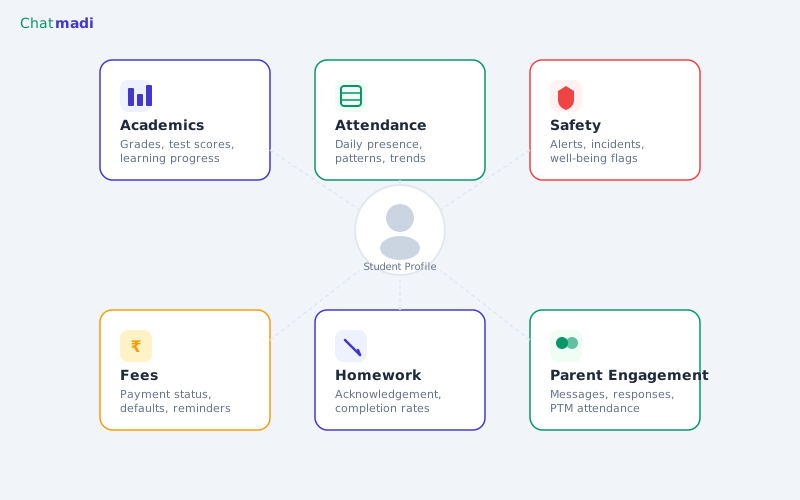
Every exam season, Indian schools discover students who failed or performed far below expectations. The teachers are surprised. The parents are upset. The principal asks what happened. And when the school looks back, the warning signs were there all along. The student's attendance had dropped from 90% to 72% over two months. The parent had stopped acknowledging homework three weeks before the exam. The parent engagement score had declined from 80 to 45. Each of these signals was visible in the data, but nobody connected them. Nobody saw the pattern until the exam results made it undeniable. AI attendance tracking school India educators need is not just about counting present and absent days. It is about connecting attendance data with homework engagement, parent communication, and welfare signals to create a composite risk picture that identifies struggling students six to eight weeks before exam results reveal the problem. Chatmadi does this automatically. NCERT research on student assessment consistently identifies early identification of at-risk students as the highest-impact intervention available to class teachers, with the greatest outcomes when identification happens before the end of the first academic term.
Table of Contents
[The At-Risk Student the School Missed (And How to Prevent It)](#the-at-risk-student-the-school-missed-and-how-to-prevent-it)
[The 3 Predictive Signals That Appear Before Academic Failure](#the-3-predictive-signals-that-appear-before-academic-failure)
[How Chatmadi's AI Combines Signals to Score Student Risk](#how-chatmadis-ai-combines-signals-to-score-student-risk)
[How-To: Acting on At-Risk Student Alerts in Chatmadi](#how-to-acting-on-at-risk-student-alerts-in-chatmadi)
[The Intervention Protocol: What Works and What Doesn't](#the-intervention-protocol-what-works-and-what-doesnt)
The At-Risk Student the School Missed (And How to Prevent It)
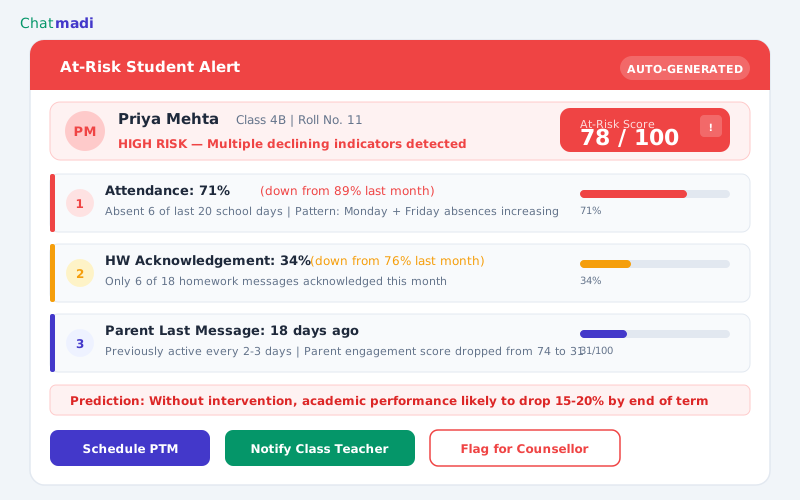
Consider Priya, a Class 4 student at a well-run school. In Term 1, she scored 78% average, attended 92% of school days, and her parents acknowledged 85% of homework notifications. She was a solidly performing student that no teacher would flag for concern. In the first month of Term 2, three things changed simultaneously. Her attendance dropped to 82%. Her homework acknowledgement rate fell to 55%. Her mother, who previously messaged the teacher two to three times per week, had not sent a single message in 18 days. Each of these changes, taken individually, might not trigger alarm. An attendance rate of 82% is still acceptable. A homework acknowledgement rate of 55% is below average but not critical. A parent not messaging for 18 days is unusual but not unprecedented. But when all three signals decline simultaneously for the same student, the probability of academic underperformance increases dramatically. Research on student risk factors consistently shows that the combination of declining attendance, declining parental engagement, and declining homework participation is the strongest predictor of academic failure, stronger than any single factor alone. Six weeks later, Priya scored 52% on her Term 2 exam. The decline was predictable. It was predicted, in fact, by the data that was already in the system. The school just did not have a way to connect the signals. Chatmadi connects them automatically.
The 3 Predictive Signals That Appear Before Academic Failure
Academic failure is rarely sudden. It is preceded by a gradual decline across three observable dimensions. Dimension one: attendance decline. A student whose attendance drops by 10 or more percentage points between terms is showing a behavioural change. They are physically disengaging from school. The reasons vary: illness, family problems, bullying, loss of motivation, or a combination. Regardless of the reason, the attendance decline reduces the student's exposure to teaching and increases the probability of poor exam performance. Dimension two: homework engagement decline. When a parent stops acknowledging homework notifications, it usually means one of three things: the parent is no longer monitoring the child's homework, the child is no longer doing the homework, or the parent-school communication channel has broken down. All three lead to the same outcome: the student is doing less academic work outside school hours, which directly affects exam performance. Dimension three: parent communication decline. A parent who was previously communicating regularly with the school and then goes silent is showing a disengagement pattern. This may be caused by dissatisfaction with the school, personal or family difficulties, or a gradual loss of connection with the school community. Whatever the cause, the silence means the school has lost a feedback channel that would otherwise help them understand and support the student. Chatmadi tracks all three dimensions for every student and computes a composite at-risk score. A student with significant decline across all three dimensions receives the highest risk score and the most urgent alert.
How Chatmadi's AI Combines Signals to Score Student Risk
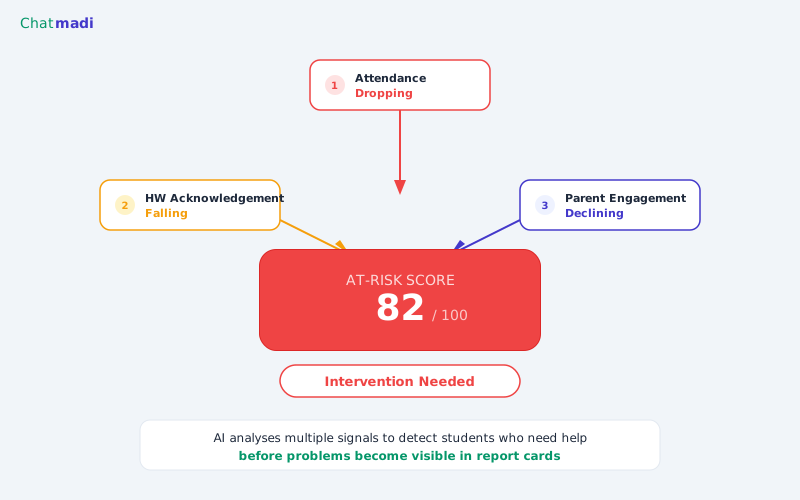
Chatmadi's at-risk scoring system uses a weighted model that considers both the current state and the rate of change of each signal. Current state matters because a student with 70% attendance is objectively at more risk than a student with 90% attendance, regardless of trend. Rate of change matters because a student whose attendance dropped from 95% to 85% in one month is at more risk than a student who has consistently been at 85% all year. The scoring model assigns points based on both dimensions. Attendance component: current attendance below 85% adds risk points. A decline of 10 or more percentage points from the previous month adds additional risk points. Homework engagement component: current acknowledgement rate below 60% adds risk points. A decline of 20 or more percentage points from the rolling average adds additional risk points. Parent communication component: no parent messages in 14 or more days adds risk points. A decline in message frequency of 50% or more from the rolling average adds additional risk points. The composite score ranges from 0 to 100, where higher scores indicate higher risk. Students scoring above 60 are flagged as At Risk on the teacher's and principal's dashboards. Students scoring above 80 are flagged as High Risk with an urgent intervention recommendation. The beauty of the composite model is that it catches patterns that individual metrics miss. A student at 83% attendance, 58% homework acknowledgement, and 16 days since last parent message would not be flagged by any single metric. But the composite score of these three moderately concerning signals produces a risk score that correctly identifies the student as needing attention.
At risk student alert for Priya Mehta showing score 78 out of 100 with three declining signals and action buttons
How-To: Acting on At-Risk Student Alerts in Chatmadi
When an at-risk alert appears on the dashboard, the response should follow a structured protocol. Step one: review the alert details. Click into the student's at-risk card to see which signals are contributing to the score and how they have changed over time. Understand the specific pattern before taking action. Step two: check for additional context. Review the student's full welfare profile. Are there safety alerts in the history? Has the student's academic performance already started declining? Is there a pattern explanation that is already known, such as a family relocation or a parent's illness? Step three: reach out to the parent. A warm, non-judgemental message from the class teacher is the most effective first intervention. "Good morning, Mrs. Mehta. I wanted to check in about Priya. She has been away from school a few days recently and I have not heard from you in a while. Is everything alright? I want to make sure Priya continues to do well." Step four: document the outreach and response. Log the intervention in Chatmadi's at-risk alert system. Record what was communicated, how the parent responded, and what follow-up actions were agreed upon. Step five: monitor for improvement. After the intervention, track whether the three signal dimensions improve over the following two to four weeks. If attendance increases, homework acknowledgement resumes, and parent communication resumes, the intervention is working. If the signals continue to decline, escalate to a more intensive intervention such as a parent meeting with the principal.
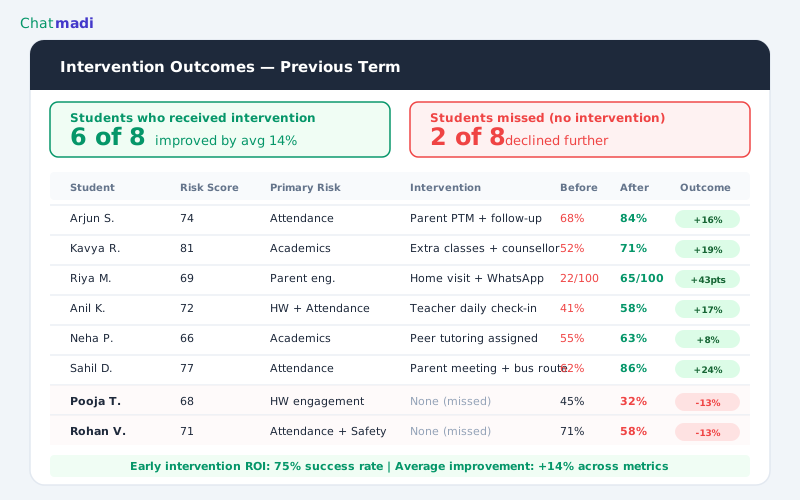
Intervention outcomes table showing 8 at risk students with 6 who improved after intervention and 2 who declined without
The Intervention Protocol: What Works and What Doesn't
Schools using Chatmadi's at-risk detection have identified clear patterns in what works and what does not. What works: personal outreach from the class teacher within 48 hours of the alert. A phone call is more effective than a WhatsApp message for at-risk students because it demonstrates genuine concern and allows for a real conversation. The call should focus on understanding the situation, not on lecturing the parent about attendance or homework. What works: offering specific, practical support. If the parent is struggling with homework follow-up, offer to simplify the communication. If the student has been ill, offer to share class notes. If there are financial pressures, connect the family with any available support. What works: following up consistently. A single outreach is rarely sufficient. Check in again after one week and after two weeks to ensure the situation is improving. What does not work: sending automated reminder messages without personal context. At-risk families need human connection, not system notifications. What does not work: involving the principal as the first step. The class teacher relationship is the foundation. Principal involvement should be reserved for situations where the class teacher's outreach has not produced results after two to three weeks. What does not work: waiting for the situation to resolve itself. At-risk signals that are not addressed within four weeks almost always worsen.
Frequently Asked Questions
How early can the AI detect at-risk students?
The system can flag at-risk patterns as early as two to three weeks into a new term, when sufficient data points have accumulated to detect declining trends. The earlier in the term the detection happens, the more time there is for effective intervention.
Can the at-risk score be wrong?
Yes. The score is probabilistic, not deterministic. A student flagged as at-risk may have a temporary situation that resolves on its own. However, it is better to investigate a false positive than to miss a student who genuinely needs help.
Does the at-risk system replace the need for teacher observation?
No. The AI complements teacher observation by surfacing data patterns that are difficult to detect through classroom interaction alone. Teachers who combine their own observations with the AI's data signals have the most complete picture of each student's wellbeing.
Can parents see their child's at-risk score?
No. The at-risk score is an internal management tool. Parents see only the communication they receive from the teacher, which is framed as concern and support rather than risk scoring.
What happens to the at-risk data at the end of the academic year?
At-risk data is retained as part of the student's historical profile. If a student was at-risk in one year, the following year's class teacher can see this history and monitor the student more closely from the start.
---
The warning signs are in the data. Chatmadi reads them so you can act before the exam results confirm what could have been prevented. Start free at chatmadi.com For a broader view of how to measure student welfare beyond academic performance, the student welfare tracking guide covers the signals that marks and attendance alone miss.
TagsAI attendance tracking school Indiastudent welfare tracking software schoolacademic performance tracking school Indiachronic absenteeism tracking school softwareChatmadi
C
Chatmadi Team
School Communication Intelligence
The Chatmadi team writes about AI-powered parent communication, school management best practices, and WhatsApp intelligence for Indian schools. Built by Eduloom Technologies OPC Pvt Ltd, Mysore.