Bullying in Indian Schools: How to Create an Early Warning System
In this article
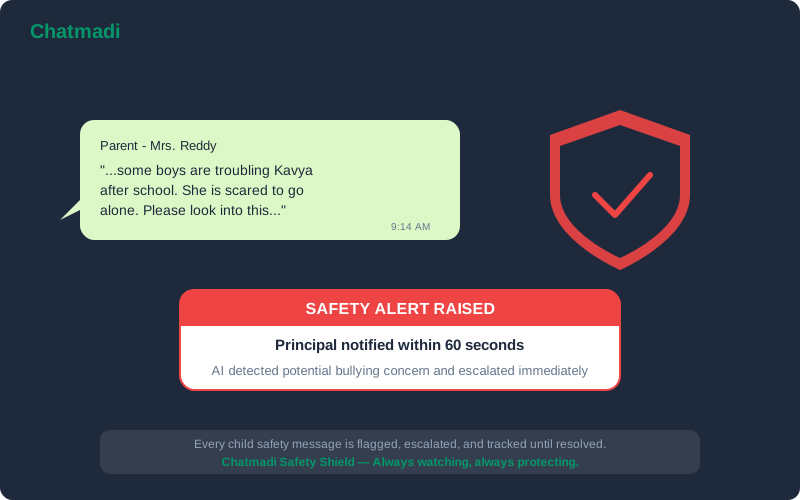
Bullying in Indian schools is one of the most underreported problems in education. National surveys suggest that 40 to 50% of Indian students experience some form of bullying during their school years, yet fewer than 10% of incidents are formally reported to school authorities. The gap between occurrence and reporting is not because students do not suffer. It is because the reporting channels are broken. Students fear retaliation from bullies. Parents hesitate to escalate formally because they worry about their child being labelled as "difficult" or about damaging their relationship with the school. Teachers are stretched too thin to notice subtle behavioural changes in a class of 35 students. The result is that most bullying in Indian schools is invisible to the people who have the power to stop it. Bullying detection school software India schools need must work differently. It must detect signals where they naturally appear, not where schools expect them. And increasingly, those signals appear in parent WhatsApp messages. Chatmadi's AI reads these messages, detects bullying-related concerns, and escalates them to teachers and principals within minutes.
The Bullying Crisis Indian Schools Aren't Seeing — Because They're Not Looking
The typical Indian school's approach to bullying is reactive. A student complains to a teacher. The teacher investigates. If the complaint is substantiated, the bully is counselled or punished. The problem with this approach is that it depends on students reporting, and most students do not report. Research consistently shows that children between the ages of 6 and 14 are unlikely to report bullying to school authorities for several reasons. They fear the bully will escalate. They believe teachers will not take action. They feel ashamed. They do not want to be seen as complainers. They have normalised the behaviour because "everyone gets teased." Parents are more likely to act than students, but even parents face barriers. A parent who calls the school to report bullying risks being seen as overprotective. A parent who escalates to the principal risks creating tension with the school. Many parents choose to address the issue with their child at home rather than involve the school. But here is what parents do: they message the class teacher on WhatsApp. And when they do, the language is often indirect. They do not write "My child is being bullied." They write "Some boys are troubling Aditi after school" or "Kavya says she does not want to sit next to certain children" or "Rohan has been coming home upset every day this week." These messages contain genuine bullying signals, but they are easy to miss in a WhatsApp conversation that also includes homework queries, fee questions, and logistical messages.
How Bullying Signals Appear in Parent WhatsApp Messages
Bullying signals in parent messages typically fall into four categories. Category one: direct reports. These are the most explicit signals. "Ma'am, Aditi told me that some older boys are pushing her during recess." "A group of girls is excluding Priya from lunch every day." "Rohan says a boy in his class keeps taking his lunch money." These messages clearly describe bullying behaviour and are the easiest for both humans and AI to identify. Category two: behavioural change reports. These are more subtle. "Ma'am, Kavya does not want to come to school anymore. She used to love school." "Arjun has been very quiet this week. Did something happen?" "Diya cried this morning and refused to go to school. She will not tell me why." These messages describe changes in the child's behaviour that may or may not be related to bullying. They require investigation. Category three: indirect complaints. "Is there a problem with the bus seating? Rohan keeps asking to sit somewhere else." "Can you check if someone is bothering Priya in the library period?" "Aditi says she does not want to go for PT class anymore." These messages hint at a specific situation without directly naming it as bullying. The parent may be testing the school's response before escalating. Category four: pattern indicators. A single message may not indicate bullying, but a pattern of messages from the same parent over two to three weeks almost certainly does. If Mrs. Sharma has sent three messages in two weeks about Aditi being "upset" or "not wanting to come to school," the AI recognises the pattern even if no single message crosses the bullying threshold on its own. Chatmadi detects all four categories using contextual analysis that goes beyond simple keyword matching.
How Chatmadi Detects and Escalates Bullying Concerns Automatically
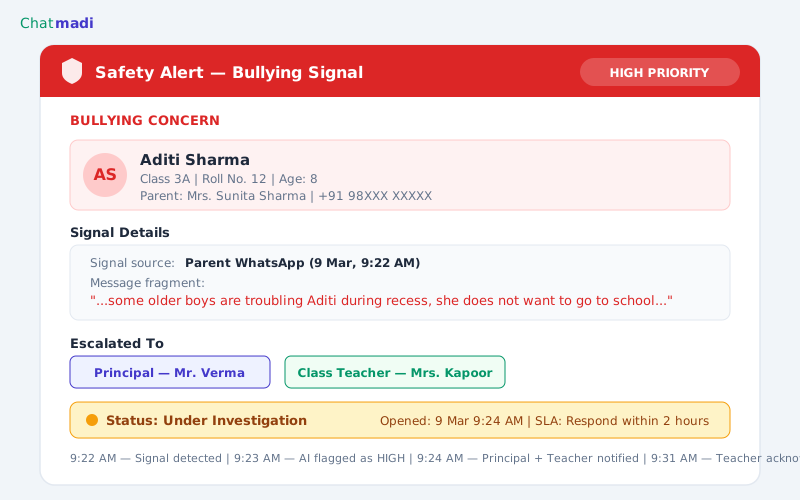
Chatmadi's bullying detection operates through its safety alert system. When a parent message is identified as containing a bullying-related signal, the system classifies it by severity. High severity signals include descriptions of physical aggression (pushing, hitting, taking belongings), sustained harassment (repeated targeting over multiple days), intimidation or threats, and any signal that suggests the child is afraid to attend school. These generate an immediate alert to both the class teacher and the principal. Medium severity signals include social exclusion, verbal teasing, behavioural changes that suggest distress, and single-incident reports that may or may not indicate a pattern. These generate an alert to the class teacher with a recommendation to investigate. The alert card includes the original parent message, the student's name and class, the detected signal type, the severity level, and a timestamp. The teacher can take immediate action through the alert interface: acknowledge the alert, add investigation notes, contact the parent, or escalate to the principal. Critically, the system also performs pattern detection across time. If multiple parents report concerns about the same student being a bully, or if one parent reports escalating concerns over several days, the system connects these signals and raises the severity level. A series of medium-severity alerts about the same student within a two-week period automatically elevates to a high-severity systemic alert.
Safety alert card showing high priority bullying concern for Aditi Sharma Class 3A with escalation details and action log
How-To: Building a Bullying Early Warning System in Your School
An effective early warning system requires technology, process, and culture. Here is how to build all three using Chatmadi. Technology setup: in Chatmadi's safety settings, ensure that bullying-related detection categories are enabled. Configure escalation paths: high-severity bullying alerts should reach the principal and the school counsellor (if available) in addition to the class teacher. Set the pattern detection window to 14 days so that multiple messages from the same parent within two weeks are connected. Process setup: establish a response protocol for bullying alerts. When a high-severity alert is raised, the class teacher must acknowledge it within 2 hours and begin an investigation within 24 hours. When a medium-severity alert is raised, the class teacher must review it within 24 hours and decide whether further action is needed. All alerts must be documented with investigation notes and outcomes, regardless of whether the concern is substantiated. Culture setup: communicate to parents that the school takes all welfare concerns seriously and encourages them to share any concerns about their child's experience at school. This can be done through a message at the start of the academic year: "Dear parents, if your child ever mentions anything that concerns you about their school experience, please share it with us immediately. We investigate every concern thoroughly and confidentially." This message gives parents permission to report without feeling like they are overreacting.
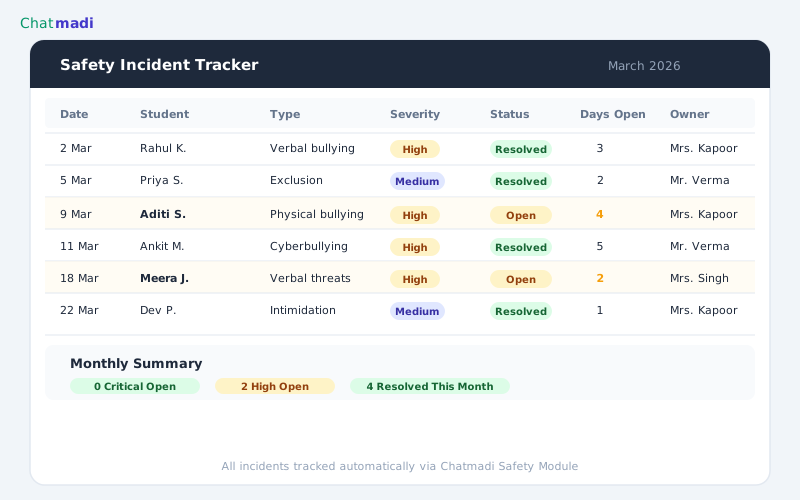
Safety incident tracker table showing 6 incidents with status severity and resolution details
What to Do in the 48 Hours After a Bullying Alert Is Raised
The first 48 hours after a bullying alert determine whether the situation is resolved or whether it escalates. Hour zero to four: acknowledge the alert and read the parent's original message carefully. Send an immediate response to the parent: "Thank you for sharing this with us. We take this very seriously. I will look into this today and get back to you." Do not ask for details over WhatsApp. Schedule a phone call or in-person meeting for sensitive discussions. Hour four to twelve: speak with the affected child privately and compassionately. Use open-ended questions: "How are things going for you at school?" and "I heard you have been upset recently. Can you tell me about it?" Do not lead with accusations or mention the parent's message directly. Let the child share at their own pace. Document what the child says. Hour twelve to twenty-four: if the child's account suggests bullying, speak with the alleged bully separately. Observe classroom dynamics during break times and transition periods. Speak with other teachers who interact with both students to get a broader picture. Update the safety alert in Chatmadi with all investigation findings. Hour twenty-four to forty-eight: determine the appropriate response based on the investigation. This may include counselling for the affected child, behavioural intervention for the bully, classroom seating changes, increased supervision during specific periods, or a meeting with both sets of parents. Update the parent who reported the concern with a summary of actions taken. If the investigation reveals a POCSO-relevant concern, follow the POCSO reporting protocol immediately. Close the alert in Chatmadi with a full resolution record.
Frequently Asked Questions
Does Chatmadi report bullying directly to external authorities?
No. Chatmadi raises internal alerts to school staff. The school decides what action to take, including whether external reporting is necessary. For POCSO-relevant concerns, schools have a legal obligation to report to the authorities, and Chatmadi's documentation supports this process.
What if the AI flags a message as bullying-related but it is not?
False positives are possible and expected. A parent who says "the boys were troubling each other during the cricket match" might trigger a flag. Teachers can dismiss false positives with a note. It is better to investigate a false positive than to miss a genuine concern.
Can Chatmadi detect cyberbullying?
If a parent reports cyberbullying in a WhatsApp message to the teacher, Chatmadi will detect the concern. The system analyses parent messages to the school, not the children's own digital interactions.
How does the pattern detection work across multiple parents?
If three different parents mention concerns about the same child being a bully within a two-week period, the system connects these reports and generates a systemic alert. This helps identify serial bullies who may be targeting multiple students.
What training should teachers receive alongside using Chatmadi's bullying detection?
Teachers should receive training on recognising bullying signs, conducting sensitive conversations with children, and following the school's anti-bullying protocol. Chatmadi provides the detection and documentation layer, but the human response requires training and empathy.
---
Every child deserves to feel safe at school. Chatmadi ensures bullying signals are never lost in the noise. Start free at chatmadi.com
Tagsbullying detection school software Indiachild safety monitoring school softwarePOCSO alert school software Indiastudent welfare tracking software schoolChatmadi
C
Chatmadi Team
School Communication Intelligence
The Chatmadi team writes about AI-powered parent communication, school management best practices, and WhatsApp intelligence for Indian schools. Built by Eduloom Technologies OPC Pvt Ltd, Mysore.