POCSO Compliance for Schools: How AI Helps You Catch What Slips Through
In this article
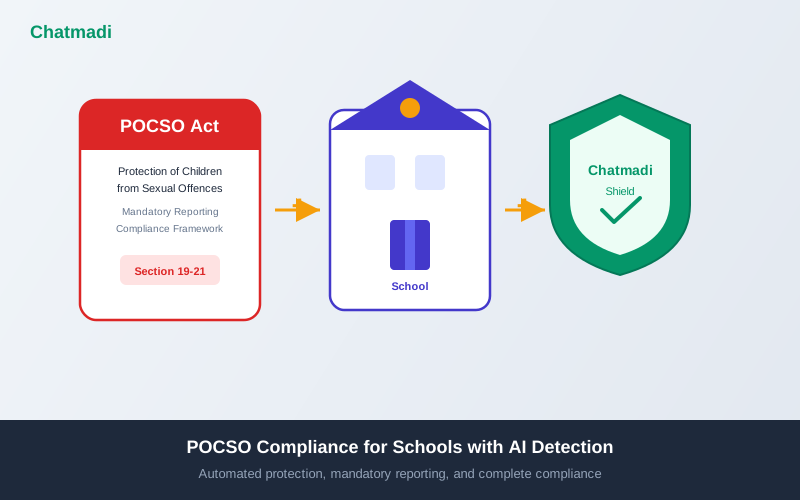
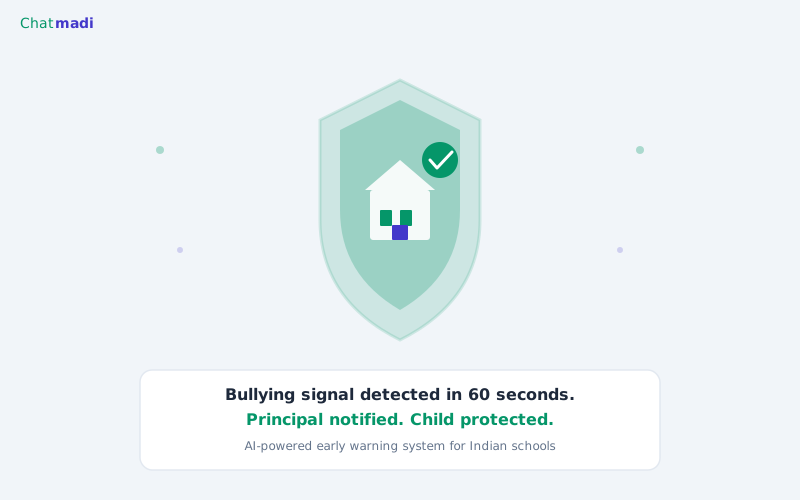
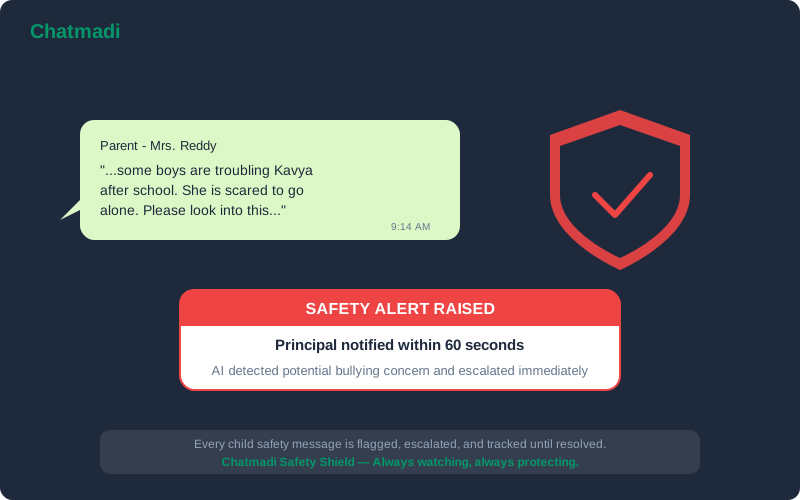
The Protection of Children from Sexual Offences Act, 2012, places a clear legal obligation on every person who has knowledge of or reasonable apprehension that a child is being sexually abused. This includes every teacher, every administrator, and every school staff member. The obligation is not discretionary. It is mandatory. Failure to report carries penalties under Section 21 of the Act. Yet the reality in most Indian schools is that there is no systematic mechanism to identify when a parent's message might contain a POCSO-relevant signal. A parent's WhatsApp message about their child's distress gets read alongside 40 other messages about homework, fees, and bus timings. The signal is lost in the noise. POCSO alert school software India schools need must ensure that these signals are never missed. Chatmadi's AI creates a safety net that detects welfare concerns in parent messages and escalates them immediately, helping schools meet their legal obligations and protect their students.
What POCSO Requires of School Staff and Administration
POCSO places three specific obligations on school staff. First, the obligation to report. Section 19 of the Act requires any person who has knowledge or reasonable apprehension that an offence under POCSO has been committed to report it to the local police or the Special Juvenile Police Unit. This is not optional. A teacher who receives information suggesting possible abuse and does not report it is violating the law. Second, the obligation to act without delay. The Act specifies that reports must be made as soon as possible. There is no grace period. A school that learns of a potential concern on Monday and waits until Friday to act has failed in its duty. Third, the obligation to support the child. Schools must ensure that the child is not subjected to further harm and that the school environment remains safe for the child while the matter is being investigated. Beyond POCSO, schools also have obligations under the Juvenile Justice Act, the Right to Education Act, and various state-level child protection guidelines. The common thread across all of these is that schools must have a system to detect, report, and respond to child welfare concerns. A system that depends entirely on individual teachers remembering to escalate what they read in a WhatsApp message is not a system. It is a hope. Chatmadi replaces hope with a structured, AI-powered safety net.
Why WhatsApp Is Now a Key Channel for Welfare Disclosures
A decade ago, parents who had concerns about their child's safety at school would come to the school in person or call the principal. Today, the first disclosure often happens on WhatsApp. A parent messages the class teacher at 9 PM: "Ma'am, Kavya told me something happened in the bus today and she is very upset. Can you please check?" A parent sends a voice note describing their child's anxiety about going to school. A parent mentions in a group chat that their child has been "acting differently" since a particular incident. These disclosures happen on WhatsApp because WhatsApp is the default communication channel. Parents message their concerns the moment they arise, not during school hours, not through formal channels, but on WhatsApp at whatever time the concern occurs to them. This means that WhatsApp has become a critical channel for early detection of welfare concerns. But WhatsApp was not designed for case management. Messages arrive, they scroll past, and unless the teacher specifically notices and acts on them, they disappear into the conversation history. Chatmadi bridges this gap by treating every parent message as potential data that needs to be scanned for safety signals, regardless of when it arrives or how the conversation flows.
How Chatmadi Creates a POCSO-Aware Safety Net
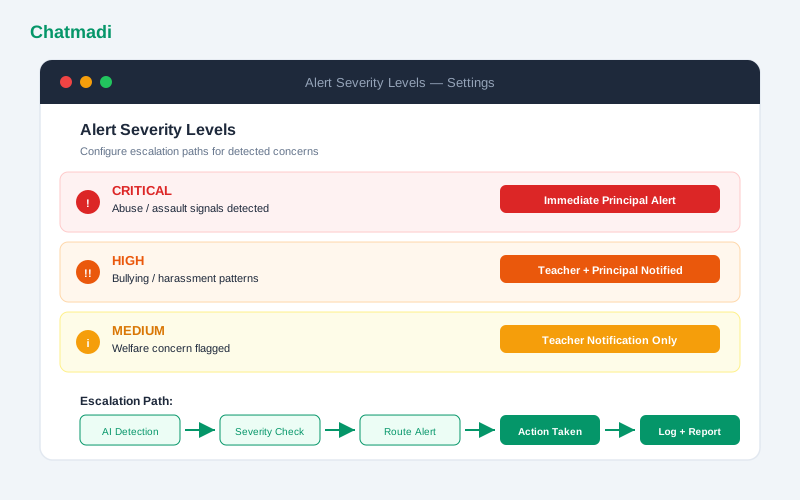
Chatmadi's safety detection system is designed specifically for the Indian school context, with awareness of POCSO categories and the language patterns Indian parents use when raising concerns. The system operates at three severity levels. Critical alerts are triggered by messages that contain signals potentially relevant to POCSO offences: mentions of inappropriate touching, sexual language, abuse-related terms, or descriptions of situations that suggest a child may have been subjected to sexual offences. These alerts are sent immediately to the principal and any designated child protection officer. High alerts are triggered by messages indicating physical harm by another person, sustained bullying or harassment, threats, intimidation by other students or adults, or any situation where the child expresses fear of coming to school. These alerts are sent to both the class teacher and the principal. Medium alerts are triggered by messages indicating emotional distress, behavioural changes, social exclusion, or general welfare concerns that do not meet the threshold of the higher categories. These alerts are sent to the class teacher for investigation. The AI uses contextual analysis, not just keyword matching. It distinguishes between "Rohan had a fight with his friend over a toy" (low concern) and "Rohan says an older boy keeps threatening him and taking his lunch" (high concern). It recognises Hindi and regional language patterns alongside English. It identifies both explicit disclosures and indirect signals such as "my child does not want to come to school anymore and will not tell me why."
Alert severity levels settings showing Critical High and Medium tiers with escalation path diagram
How-To: Setting Up Your School's POCSO Alert Response Protocol
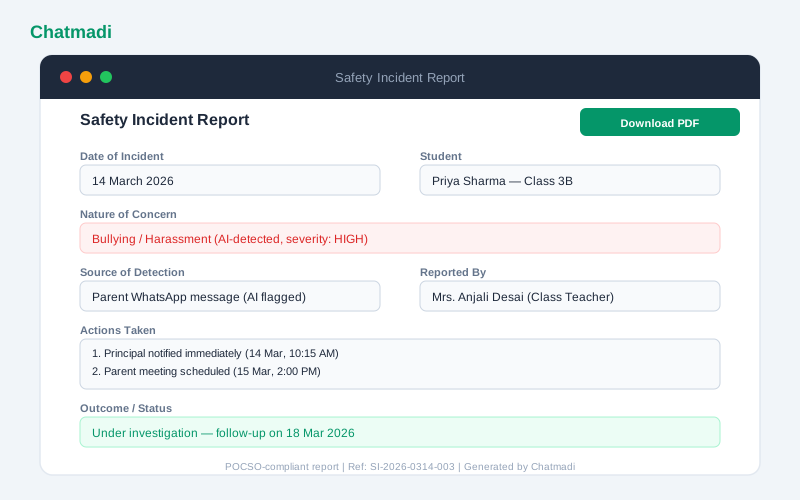
Setting up a POCSO-compliant response protocol in Chatmadi involves five steps. Step one: designate your child protection team. Every school should have a designated child protection officer, typically the principal or a senior teacher trained in child protection. In Chatmadi, designate this person as the primary recipient of all Critical and High alerts. Add a secondary contact as backup. Step two: configure alert routing. In the safety settings, ensure Critical alerts route to the principal and child protection officer simultaneously. High alerts should route to the class teacher and principal. Medium alerts route to the class teacher with a copy to the principal's dashboard. Step three: establish response timelines. Critical alerts: acknowledgement within 30 minutes, initial investigation within 2 hours, decision on external reporting within 24 hours. High alerts: acknowledgement within 2 hours, investigation within 24 hours, resolution plan within 48 hours. Medium alerts: review within 24 hours, follow-up action within one week. Step four: create a documentation protocol. Every safety alert must be documented with the original concern, the investigation steps taken, the findings, and the resolution. Chatmadi's safety alert system includes fields for all of these, creating a timestamped record that demonstrates due diligence. Step five: train all staff annually. Every teacher and staff member should understand what POCSO requires of them, how to recognise disclosure signals, and how the school's alert system works. Chatmadi provides the technology, but the human response is equally critical.
Safety incident report form with date student nature of concern source actions taken and outcome fields
What to Do in the 24 Hours After a Safety Alert Is Triggered
The first 24 hours after a safety alert are the most important. Hour zero to one: read the alert, read the original parent message, and acknowledge receipt. Send a response to the parent: "Thank you for bringing this to our attention. We take this very seriously and are looking into it immediately." Do not ask the parent for details over WhatsApp. Sensitive discussions should happen in person or over the phone. Hour one to four: speak with the child in a safe, private setting. Do not interrogate. Use open-ended questions: "How are you feeling today?" and "Can you tell me about what happened?" Document what the child says, in their own words. If another student is involved, speak with that student separately. Hour four to eight: brief the principal and child protection officer on what the investigation has found so far. Assess whether the concern meets the threshold for external reporting under POCSO or other child protection laws. If it does, prepare the report. If the concern involves a school staff member, immediately ensure the child has no unsupervised contact with that person while the investigation is ongoing. Hour eight to twenty-four: if external reporting is required, file the report with the local police or Special Juvenile Police Unit. Update the safety alert in Chatmadi with all actions taken. Follow up with the parent to inform them of the steps the school has taken, without compromising any ongoing investigation. Document every step. The Chatmadi safety log creates a timestamped record of the entire response process, which serves as evidence of the school's compliance with its legal obligations.
Frequently Asked Questions
Does Chatmadi automatically file POCSO reports with the police?
No. Chatmadi raises internal alerts to school staff. The decision to file a report with the authorities is the school's legal responsibility. Chatmadi documents the timeline and actions taken, which supports the school's compliance process.
What if a safety alert turns out to be a false positive?
False positives are expected and are preferable to missed signals. Teachers can dismiss false positives with a note explaining why the alert was not a genuine concern. The system learns from these dismissals to improve future accuracy.
Can Chatmadi detect safety concerns in Hindi or regional language messages?
Yes. Chatmadi's AI is trained to recognise safety-relevant signals in Hindi, Hinglish (mixed Hindi-English), and common regional language phrases that Indian parents use when discussing child welfare concerns.
Is the safety alert data stored securely?
Safety alert data is stored with the highest security standards in Chatmadi's infrastructure. Access is restricted to designated school staff members. The data is encrypted and subject to strict access controls.
Should every school have a POCSO response protocol?
Yes. Every school in India is legally required to have procedures for handling POCSO-related concerns. Chatmadi's alert system provides the detection and documentation layer, but schools must also have trained staff and established response procedures.
---
POCSO compliance is not optional. Chatmadi ensures no safety signal in a parent's message goes undetected. Start free at chatmadi.com
TagsPOCSO alert school software Indiachild safety monitoring school softwarebullying detection school software Indiastudent welfare tracking software schoolChatmadi
C
Chatmadi Team
School Communication Intelligence
The Chatmadi team writes about AI-powered parent communication, school management best practices, and WhatsApp intelligence for Indian schools. Built by Eduloom Technologies OPC Pvt Ltd, Mysore.