DPDPA Compliance for Indian Schools: What the Data Protection Law Means for Your WhatsApp Communication
In this article
India's Digital Personal Data Protection Act, passed in 2023 and progressively coming into effect, is the country's first comprehensive data protection legislation. For Indian schools, the Act creates a new set of legal obligations around how student and parent data is collected, stored, processed, and shared. Many of these obligations apply directly to how schools use WhatsApp, which is currently the primary data channel through which Indian schools receive sensitive information about students and families every day.
Table of Contents
- [Obligation 1: Lawful Basis for Data Processing](#obligation-1-lawful-basis-for-data-processing)
- [Obligation 2: Notice to Data Principals](#obligation-2-notice-to-data-principals)
- [Obligation 3: Data Minimisation](#obligation-3-data-minimisation)
- [Obligation 4: Children's Data Protection](#obligation-4-childrens-data-protection)
- [Obligation 5: Data Principal Rights](#obligation-5-data-principal-rights)
- [Obligation 6: Data Breach Notification](#obligation-6-data-breach-notification)
Most school administrators are aware that DPDPA exists. Far fewer have a clear picture of what it requires specifically from schools, and even fewer have examined whether their current WhatsApp communication practices comply with its provisions. This guide is for school principals and administrators who want to understand their DPDPA obligations and take concrete steps toward compliance before enforcement becomes active.
This guide provides general information about DPDPA and its implications for Indian schools. It is not legal advice. Schools with specific compliance concerns should consult a qualified legal professional.
What DPDPA Covers and Why Schools Are Affected
The Digital Personal Data Protection Act 2023 defines "personal data" broadly as any data that can identify an individual. For schools, this definition captures an extensive range of information that flows through WhatsApp every day: student names, class assignments, health and absence information, photographs, academic performance data, family situations communicated by parents, fee payment records, and welfare concerns.
Schools are "Data Fiduciaries" under DPDPA, meaning they decide the purpose and means of processing personal data. This classification creates specific obligations around consent, data minimisation, purpose limitation, and the rights of data principals, which in the context of schools means students and their parents.
The Act gives particular attention to children's data. Students under 18 are classified as data principals whose data requires additional protection. Schools that process children's data must obtain verifiable parental consent and are prohibited from processing children's data in ways that are likely to cause harm or that involve behavioural monitoring or targeted advertising.
For most Indian schools, these provisions apply to virtually everything that flows through WhatsApp: absence messages about named students, parent queries about individual children's academic performance, fee payment confirmations that link specific parents to specific students, welfare concerns that describe a child's personal circumstances, and photographs taken at school events.
Six Obligations DPDPA Creates for Indian Schools
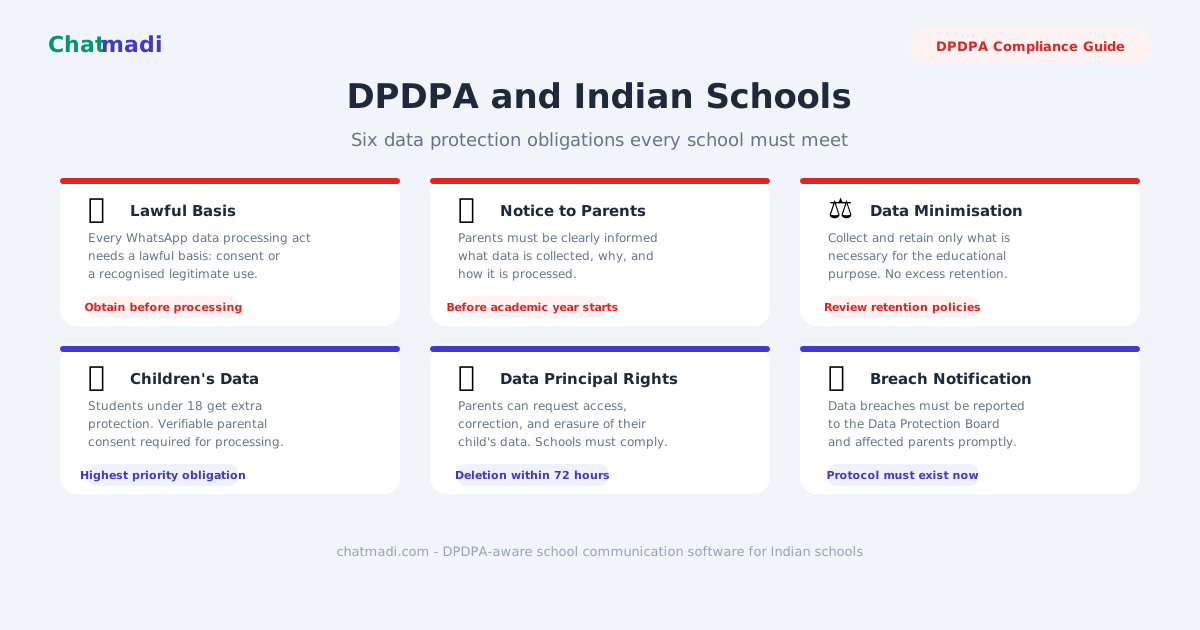
Obligation 1: Lawful Basis for Data Processing
DPDPA requires that every act of processing personal data must have a lawful basis. For schools, the most relevant lawful basis is consent from the data principal (the parent, acting on behalf of their minor child) or a legitimate use recognised by the Act.
The practical implication for WhatsApp communication is significant. When a parent sends a message about their child to a teacher's personal WhatsApp number, that message contains personal data. The school's processing of that data (reading it, acting on it, storing it, or sharing it with another staff member) requires either the parent's informed consent or a recognised legitimate use.
Most schools have never obtained formal consent for WhatsApp-based communication. The practice evolved organically because WhatsApp was convenient, not because schools designed a data processing policy and sought consent from parents before beginning. DPDPA does not make historical informal practices automatically lawful.
Schools should document the lawful basis for each type of WhatsApp communication they engage in with parents and ensure their admission process includes a clear data processing consent that covers WhatsApp communication specifically.
Obligation 2: Notice to Data Principals
Before collecting and processing personal data, schools must provide parents with a clear, accessible notice in English or any language recognised in the Eighth Schedule of the Constitution. This notice must describe what data is being collected, the purpose of collection, how it will be used, and the rights of the data principal.
For schools using WhatsApp as a primary communication channel, the notice obligation means parents should be clearly informed that their WhatsApp messages may be analysed, that information about their child extracted from those messages may be stored in the school's management system, and that certain messages (particularly those containing welfare signals) may be shared with other school staff members.
A WhatsApp group description or a line in a PTM circular is not sufficient notice under DPDPA. The notice must be specific, comprehensible, and clearly communicated before data processing begins, which in practical terms means before the academic year starts and before parents join class WhatsApp groups.
Obligation 3: Data Minimisation
DPDPA requires that only the data necessary for the specified purpose should be collected and processed. Schools cannot collect or retain personal data beyond what is needed for their legitimate educational function.
For WhatsApp communication, this obligation has practical implications. Schools should not be retaining entire WhatsApp conversation histories indefinitely. They should not be sharing individual student information across WhatsApp groups where that information is visible to other parents. They should not be using WhatsApp to collect sensitive personal data, such as medical information, that goes beyond what is necessary for the school's educational function.
The school communication software buying guide identifies data practices as a key evaluation criterion for any school technology platform. Tools that store only what they need, process data for defined purposes, and delete data that is no longer necessary are significantly easier to manage from a DPDPA compliance perspective than tools with broad and undefined data retention practices.
Obligation 4: Children's Data Protection
The DPDPA provisions on children's data are the most directly relevant to schools. The Act prohibits tracking or behavioural monitoring of children and requires verifiable parental consent for processing children's data. Schools must ensure that any technology platform they use for student-related data processing meets these requirements.
For AI-powered school communication tools specifically, this means the AI analysis of WhatsApp conversations should be designed to extract information relevant to the child's education and welfare, not to profile children's behaviour for non-educational purposes. The distinction matters legally and ethically.
The AI conversation analysis feature in Chatmadi is designed specifically for educational purposes: identifying absence notifications, fee payment confirmations, welfare signals, and homework acknowledgements. It does not build behavioural profiles, does not retain conversation content beyond the processing purpose, and does not share data with third parties for commercial purposes.
Schools should verify these data practices for any technology vendor they work with and obtain written confirmation of the vendor's DPDPA compliance approach before processing children's data through their systems.
Obligation 5: Data Principal Rights
DPDPA gives parents, as data principals acting on behalf of their minor children, specific rights that schools must be prepared to honour. These include the right to access their personal data, the right to correction of inaccurate data, the right to erasure of data that is no longer necessary, and the right to withdraw consent for data processing.
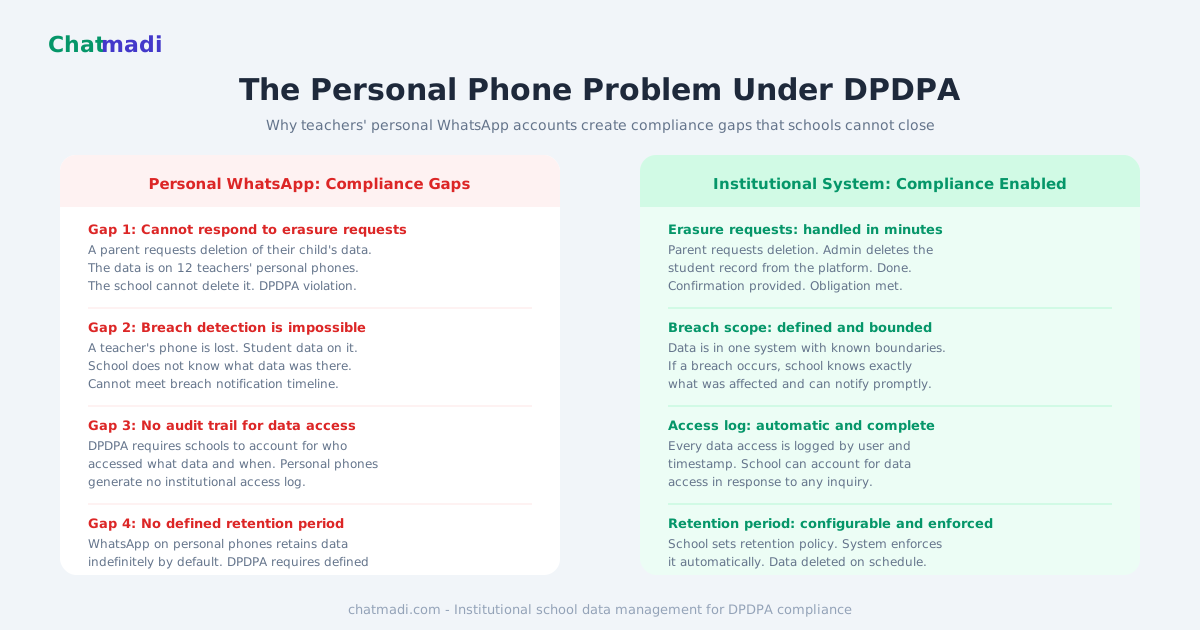
For schools, the right to erasure has practical implications. A parent who withdraws their child from the school and requests deletion of their personal data must receive confirmation that the data has been deleted from all school systems. If that data includes WhatsApp messages stored in a teacher's personal phone, the school has a compliance gap that it cannot close without addressing the personal phone problem.
This is one of the strongest arguments for schools to use purpose-built school communication software rather than personal WhatsApp accounts for school communication: purpose-built software can respond to data deletion requests systematically, while data stored in teachers' personal WhatsApp accounts cannot be deleted by the school in response to a parent request.
Obligation 6: Data Breach Notification
DPDPA requires Data Fiduciaries to notify the Data Protection Board and affected data principals in the event of a personal data breach. For schools, a data breach could include a teacher's personal phone being lost or stolen (with WhatsApp conversations about students on it), unauthorised access to a school's communication system, or the inadvertent sharing of student data in an incorrect WhatsApp group.
Schools should have a defined data breach response procedure and should ensure all staff understand what constitutes a reportable breach. The notification timeline under DPDPA is short, making advance preparation essential.
The Personal Phone Problem and DPDPA
The most significant DPDPA compliance gap in Indian schools is the widespread use of teachers' personal WhatsApp accounts for school communication. When a teacher uses their personal phone to communicate with parents about students, several DPDPA obligations become difficult or impossible to meet.
Data processed on personal phones cannot be systematically deleted in response to a data erasure request. Data breaches involving personal phones are difficult to detect and report on the timeline DPDPA requires. The school cannot provide parents with a clear account of what data is stored and where, because the data is distributed across dozens of personal devices that the school does not control.
This does not mean schools must immediately prohibit all personal WhatsApp use for school communication. The practical reality of Indian school operations makes such a prohibition unworkable in most schools. But it does mean schools should have a clear plan for transitioning the most sensitive data processing (welfare communications, individual student performance data, fee records) to institutional systems that the school controls and can manage in compliance with DPDPA.
The how AI reads school conversations guide explains how WhatsApp export analysis works: teachers export conversations from their personal WhatsApp and upload the exports to the school's system. This approach keeps the sensitive data processing within an institutional system while allowing teachers to continue using their preferred communication channel. The personal phone remains the communication device, but the data extracted from those communications is managed institutionally.
What Schools Should Do Now
DPDPA compliance for Indian schools is a process, not a single action. Schools that are beginning their compliance journey should prioritise four immediate steps.
Step 1: Audit current data practices. Identify every channel through which personal data about students and parents is currently processed. This includes class WhatsApp groups, teacher personal numbers used for school communication, school administration WhatsApp contacts, and any school management software currently in use. Document what data flows through each channel and what happens to that data. Step 2: Update admission documentation. Add a clear, specific data processing notice to the school's admission documentation. This notice should describe the WhatsApp communication approach the school uses, what data is extracted from those communications, how it is stored, and parents' rights under DPDPA. Obtain explicit written consent that covers WhatsApp communication before the academic year begins for new students and retrospectively for existing students. Step 3: Transition sensitive communication to institutional systems. Welfare communications, individual academic performance discussions, and fee-related communication should be handled through systems the school controls rather than teachers' personal WhatsApp accounts. This reduces the school's compliance exposure and makes it possible to respond to data principal rights requests systematically. Step 4: Establish a data breach response protocol. Define what constitutes a reportable breach for the school, who is responsible for making the notification, and what the notification process looks like. Train all staff who handle student or parent data on their obligations under this protocol.The school setup guide covers how to configure Chatmadi's data handling settings in a way that supports DPDPA compliance, including data retention settings and how to respond to data deletion requests from parents.
How School Communication Software Supports DPDPA Compliance
Purpose-built school communication software that processes WhatsApp data in a controlled, institutional environment is significantly easier to manage from a DPDPA compliance perspective than a collection of teachers' personal WhatsApp accounts.
When schools use Chatmadi for WhatsApp communication analysis, the data processing happens within a defined institutional system with documented purposes (educational communication, welfare monitoring, fee management), controlled access (only authorised staff can access student data), and defined retention practices (data is retained for the duration of the academic relationship and can be deleted on request).
This institutional approach does not make compliance automatic. Schools still need consent documentation, clear privacy notices, and staff training. But it creates the technical foundation that makes compliance possible, which is not the case when student data is scattered across dozens of personal phones.
For schools evaluating technology platforms from a DPDPA perspective, the key questions to ask any vendor are: where is data stored (within India, as DPDPA prefers), what is the data retention period, how are deletion requests handled, what is the vendor's own DPDPA compliance status, and what contractual commitments does the vendor make regarding data processing on behalf of the school.
Chatmadi stores all school data on infrastructure within India, retains data for the duration of the school's active subscription, supports deletion of individual student records in response to erasure requests, and operates as a Data Processor on behalf of schools that are the Data Fiduciary. Schools should request a data processing agreement from Chatmadi before processing student data through the platform.
Start free at chatmadi.com. The Starter plan allows schools to test the platform's data handling approach before committing to a paid subscription. Schools with specific DPDPA compliance questions can contact the Chatmadi team directly through the platform.
Frequently Asked Questions
Is Chatmadi DPDPA compliant?Chatmadi is designed to support DPDPA compliance for Indian schools and operates as a Data Processor under the Act. All data is stored within India. The platform supports data deletion requests, provides schools with access to the data processed through the system, and does not share school data with third parties for commercial purposes. Schools should request a data processing agreement before processing student data through the platform. No software platform can make a school automatically DPDPA compliant: compliance also requires the school's own documentation, consent processes, and staff practices to meet the Act's requirements.
Do schools need to inform parents that AI is reading their WhatsApp messages?Yes. DPDPA's notice obligation requires schools to inform parents clearly about how their data is processed, including whether AI analysis is used to extract information from WhatsApp conversations. This notice should be part of the school's admission documentation and data processing consent. The notice should explain what the AI does (detects absence notifications, fee payments, welfare signals), what data is retained, how long it is kept, and parents' rights regarding their data.
Does DPDPA apply to WhatsApp conversations between parents and teachers?Yes. Any communication that contains personal data about an identifiable individual, including a student, is covered by DPDPA when processed by the school. A parent's WhatsApp message to a teacher about their child's absence contains personal data (the child's name, the reason for absence, possibly health information). When the teacher reads that message and acts on it in their capacity as a school employee, the school is processing personal data and DPDPA obligations apply.
What is the penalty for DPDPA non-compliance for schools?DPDPA provides for significant financial penalties for non-compliance, with the amount varying by the nature and severity of the violation. The Act also provides for the Data Protection Board to investigate complaints and impose remedies. Schools should not assume that penalties will only apply to large technology companies: the Act applies to all organisations processing personal data, including schools. The details of enforcement mechanisms and penalty amounts are being finalised through rules under the Act.
How should schools handle existing WhatsApp data from previous academic years?Schools should review their data retention practices for historical WhatsApp communication. Data that is no longer necessary for the educational purpose for which it was collected should be deleted. For data that the school has a legitimate reason to retain (such as records relevant to ongoing welfare concerns or fee disputes), the school should ensure it is stored securely and that its retention can be justified under DPDPA. Schools should also update their data retention policy to define specific retention periods for different categories of school communication data going forward.
Chatmadi Team
School Communication Intelligence
The Chatmadi team writes about AI-powered parent communication, school management best practices, and WhatsApp intelligence for Indian schools. Built by Eduloom Technologies OPC Pvt Ltd, Mysore.
Ready to Try Chatmadi at Your School?
Free to start. Setup in 15 minutes. No new apps for parents.
Set Up My School Free →