Multi-Campus School Management in India: Communication Challenges and Technology Solutions
In this article
India's private school sector has produced a distinctive institution: the multi-campus school group. From the large chains that operate dozens of campuses across multiple cities to the local school group that started with one campus in 2005 and opened a second in the next neighbourhood in 2012 and a third across town in 2018, multi-campus school management is a reality for a significant and growing portion of Indian private school administration.
Table of Contents
- [Challenge 1: The Invisible Cross-Campus Parent](#challenge-1-the-invisible-cross-campus-parent)
- [Challenge 2: The Inconsistent WhatsApp Practices Problem](#challenge-2-the-inconsistent-whatsapp-practices-problem)
- [Challenge 3: The Absence of Group-Level Visibility](#challenge-3-the-absence-of-group-level-visibility)
- [Challenge 4: The Duplicated Administrative Burden](#challenge-4-the-duplicated-administrative-burden)
- [Challenge 5: The Staff Transfer Knowledge Gap](#challenge-5-the-staff-transfer-knowledge-gap)
- [Unified Student Records Across Campuses](#unified-student-records-across-campuses)
- [Campus-Level and Group-Level Dashboards](#campus-level-and-group-level-dashboards)
- [Consistent Communication Standards Enforced by the Platform](#consistent-communication-standards-enforced-by-the-platform)
The communication challenges that arise when a school operates across two or more campuses are qualitatively different from the challenges of managing a single large school. They are not simply bigger versions of the same problem. They are structurally distinct problems that arise from the combination of geographic separation, duplicated administrative structures, inconsistent data practices across campuses, and the absence of any unified view of the school group's operational health.
Most school management software in India was designed for a single campus. Applying it to a multi-campus context either requires running separate instances of the same software for each campus (creating data silos that defeat the purpose of group-level oversight) or attempting to shoehorn all campuses into a single account structure that the software was never designed to support.
This guide is for school group directors, managing trustees, and principals who are responsible for the operational performance of more than one campus and who want to understand both the specific challenges they face and the technology approaches that actually address them.
The Multi-Campus Reality in Indian Private Education
Before examining solutions, it is worth understanding how multi-campus school groups in India typically evolve, because the evolution pattern directly shapes the communication problems they face.
Most Indian school groups did not begin as planned chains. They began as a single successful school whose founders opened a second campus in response to demand that the first campus could not accommodate. The second campus inherited the first campus's brand, its teaching philosophy, and in many cases its first principal. What it did not inherit was a unified administrative system, because no such system existed.
Each campus developed its own operational rhythms. Its own WhatsApp groups for each class. Its own fee collection process. Its own approach to absence tracking. Its own way of communicating exam results to parents. The only unifying elements were the brand name and the broad academic philosophy.
By the time the group has three or four campuses, the school group director is managing what are effectively three or four separate schools that share a name but have diverged significantly in their operational practices. This divergence is invisible until a problem surfaces: a parent who moves their child from Campus A to Campus B and discovers that the admission process, the WhatsApp communication style, and the fee payment system are all different. Or a school group director who tries to compare fee collection performance across campuses and discovers that each campus measures it differently.
According to the Ministry of Education's school statistics, the private unaided school sector in India is growing, and within it, multi-campus groups are a significant and expanding category. The operational challenges these groups face are not going away. They are growing with the sector.
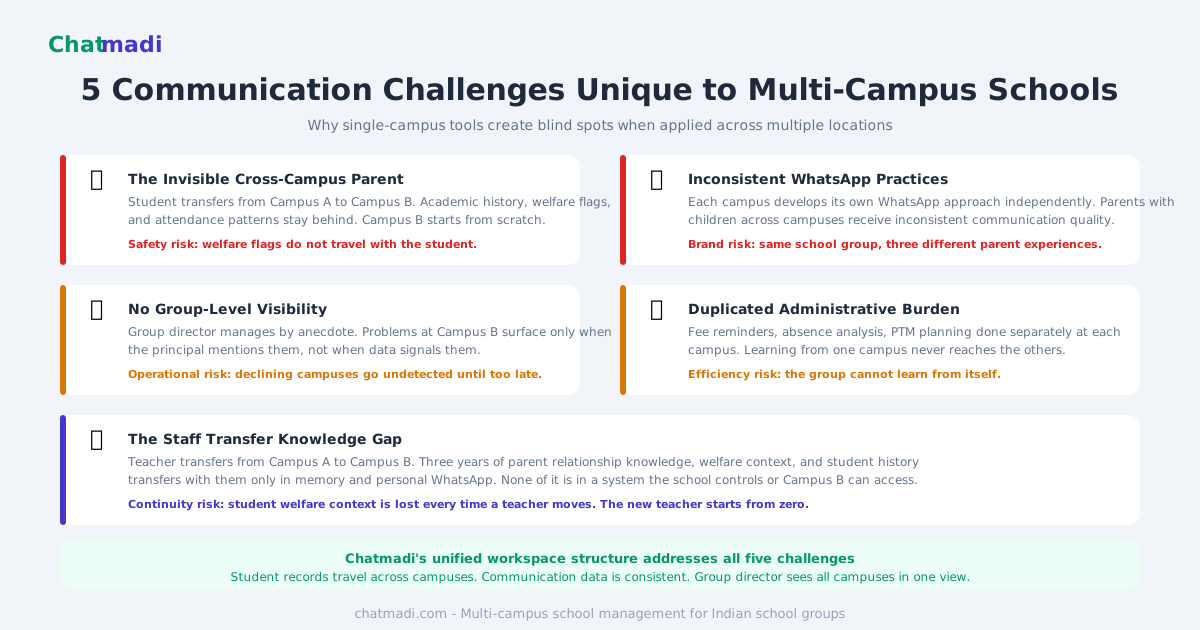
Five Communication Challenges Unique to Multi-Campus Schools
Challenge 1: The Invisible Cross-Campus Parent
Indian families move. They relocate within the same city, and when they do, they often want to move their child to the campus nearest their new home while staying within the same school group they trust. This is a reasonable expectation from the parent's perspective. From the school group's perspective, it requires something that most school management systems cannot deliver: a unified student record that travels with the student across campuses.
When Campus A and Campus B run separate systems, a student transferring from one to the other is effectively a new admission at Campus B. Their attendance history, their academic performance records, their welfare flags, and their family's payment history are all left behind at Campus A. Campus B starts from scratch.
This is not just an inconvenience. It is a safety gap. A student with a welfare flag or a pattern of concerning absences at Campus A who transfers to Campus B arrives as an unknown quantity. The class teacher at Campus B has no context for this student's history. If the flag was serious, the gap in institutional knowledge is a genuine risk.
Challenge 2: The Inconsistent WhatsApp Practices Problem
Each campus in a school group typically develops its own WhatsApp communication practices independently. Campus A might have a strict policy where only the class teacher sends messages to the class group. Campus B might allow any teacher to message any parent directly. Campus C might use a school-wide broadcast list rather than class groups.
This inconsistency creates three problems. First, parents who have children across campuses (which happens when siblings attend different campuses of the same group) receive a different quality and style of communication from each campus and draw unflattering comparisons. Second, the school group director cannot get a unified view of communication quality across campuses because each campus's data is in a different format and managed differently. Third, when the group wants to send a school-wide communication, such as a fee structure update or a calendar change, it requires coordinating separate WhatsApp processes across each campus.
The school communication software buying guide identifies consistent communication standards as a key requirement for any school that is managing its brand across multiple contexts. For multi-campus groups, the challenge is implementing those standards across geographically separate operations with their own administrative cultures.
Challenge 3: The Absence of Group-Level Visibility
A single-campus principal can walk into any classroom and know, at a human level, what is happening in their school. They see the teachers, the students, the daily rhythms. Their intuitive understanding of their school's health is grounded in direct observation.
A school group director with three campuses cannot achieve this intuitively. They must rely on reports from each campus principal, and those reports inevitably reflect what each principal chooses to surface rather than providing a complete and consistent picture. Underperforming campuses are managed through selective reporting. Problems that are visible in the data are invisible in the narrative.
Without a unified data platform, the school group director is managing by anecdote. They know something is wrong at Campus B because Campus B's principal sounds stressed on the phone. They do not have the ability to see, in real time, that Campus B's attendance is declining, that fee collection is behind, and that there have been three unresolved welfare alerts in the past two weeks.
The school analytics guide for principals explains how data-driven school management changes decision-making for single-campus principals. For multi-campus directors, the same principles apply but the stakes are higher and the data gaps are wider.
Challenge 4: The Duplicated Administrative Burden
Every administrative function that a single-campus school performs once, a multi-campus group performs multiple times. Fee reminders go out from each campus separately, with different timing, different wording, and different follow-up processes. Absence analysis happens at each campus independently, with no comparison across campuses to identify whether attendance patterns are a school-specific issue or a systemic problem. PTM planning happens in isolation at each campus.
This duplication is not just inefficient. It prevents the school group from learning from itself. If Campus A discovers that sending a specific type of fee reminder at a specific time in the month dramatically improves collection rates, Campus B and Campus C do not automatically benefit from that learning. The discovery stays at Campus A.
A unified communication and management platform creates the operational conditions for learning to transfer across campuses. When all campuses share a data structure, a practice that works well at one campus can be identified from the data and replicated across the group.
Challenge 5: The Staff Transfer Knowledge Gap
School groups move teachers and administrators between campuses. This is one of the genuine advantages of the multi-campus model: it creates career pathways and allows talent to be deployed where it is most needed. The challenge is that when a teacher or administrator moves from one campus to another, their institutional knowledge of their previous campus does not move with them in any structured way.
A class teacher who spent three years at Campus A, building deep knowledge of forty families across that time, moves to Campus B. Everything she knows about those families exists in her memory, in her personal WhatsApp, and in whatever notes she took in her personal diary. None of it is in a system that Campus B can access.
This knowledge gap is particularly acute for welfare-related information. If a teacher at Campus A had an ongoing concern about a specific student's home situation, and that teacher transferred to Campus B, the concern would need to be raised again from scratch by the new class teacher, assuming the new teacher even noticed the signals.
What Multi-Campus Schools Need from Technology
The requirements for a technology platform that genuinely serves a multi-campus school group are distinct from the requirements for a single-campus tool. Three capabilities are non-negotiable.
Unified Student Records Across Campuses
A student who transfers from Campus A to Campus B should have their complete record follow them: academic history, attendance pattern, welfare flags, family communication history, and fee payment record. The receiving campus should not need to reconstruct this information from scratch.
This requires a data architecture where the student record is associated with the school group, not with the individual campus. Each campus has access to the students currently enrolled there, while the group director has access to the complete student record regardless of which campus the student is currently at.
Campus-Level and Group-Level Dashboards
Campus principals need a view of their campus. The group director needs a view of all campuses simultaneously. These are not the same view, and a platform that only provides one or the other fails at least one of these users.
The campus-level dashboard should show everything a single-campus principal needs: class-level attendance, welfare alerts, fee collection status, and communication activity. The group-level dashboard should show comparative data across campuses: which campus has the highest attendance, which has the most outstanding fees, which has had the most welfare alerts this term, and which is performing above or below group averages on each key metric.
The class teacher dashboard provides the campus-level view. For multi-campus groups, a group-level aggregation of this data gives the school group director the comparative visibility they need to manage across campuses.
Consistent Communication Standards Enforced by the Platform
When the platform defines how communication is structured, categorised, and routed, individual campus variation in communication practices reduces automatically. If all campuses use the same platform to process WhatsApp conversations, all campuses produce data in the same format, enabling cross-campus comparison and group-level learning.
This does not mean every campus must communicate identically with parents. Different campuses serve different communities and may need different communication approaches. But the underlying data structure should be consistent so that the group director can compare fee collection communication effectiveness across campuses without needing to translate between three different reporting formats.
Setting Up Multi-Campus Management in Chatmadi
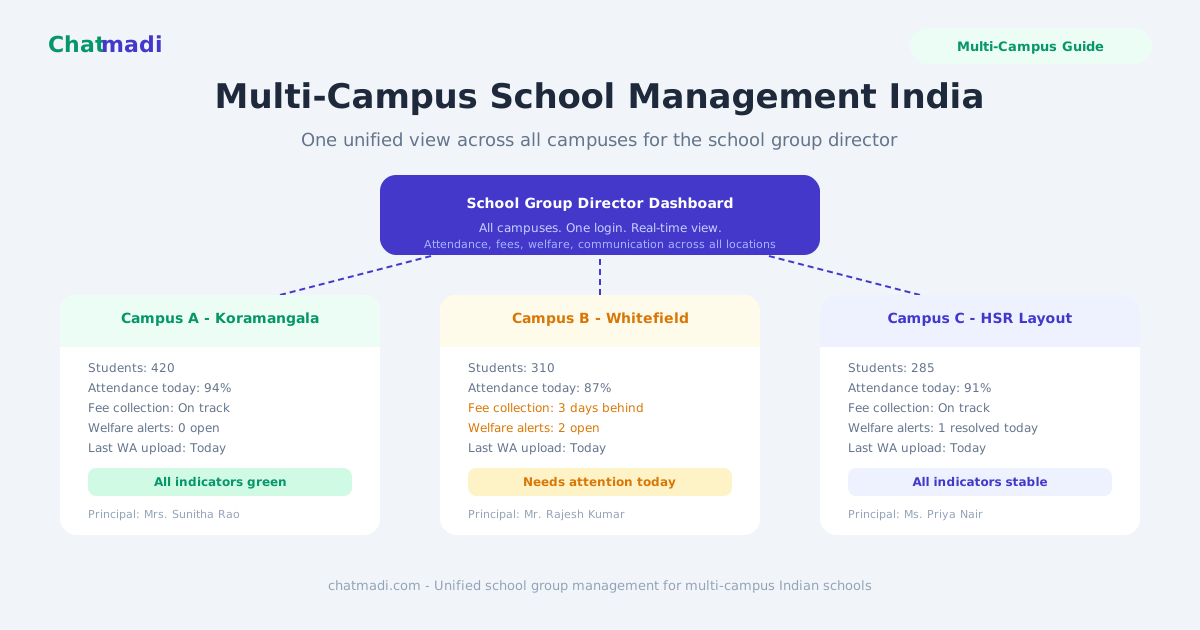
Chatmadi supports multi-campus school groups through a workspace structure that allows each campus to operate with its own data while providing the group director with visibility across all campuses.
Each campus is configured as a separate workspace within the group account. Campus principals and teachers access only their campus data. The group director has a cross-workspace view that shows key metrics across all campuses simultaneously.
WhatsApp conversation analysis works the same way at each campus: teachers export conversations from their campus's class groups and upload them to their campus workspace. The AI analysis produces consistent categorised output regardless of which campus the conversation came from, enabling cross-campus comparison of absence patterns, fee communication effectiveness, and welfare signal frequency.
For schools setting up a multi-campus structure, the school setup guide covers the configuration process for individual campuses. Campus structures can be added incrementally, starting with the campus that has the most acute communication challenges and expanding to other campuses once the first is running smoothly.
The WhatsApp CRM for schools comprehensive guide provides context on the full range of capabilities available across all school types, including the multi-campus use cases described in this guide.
The Group Director's Dashboard: What It Should Show
A school group director managing three campuses needs a different daily interface from a single-campus principal. The group director's morning check should answer five questions in under five minutes.
Attendance comparison: Which campus has unusual absence patterns today? Is there a campus where attendance is significantly below the group average, suggesting a local issue that requires investigation? Welfare alert status: Are there unresolved welfare alerts at any campus? How long have they been open? Which campus principal needs to follow up? Fee collection status: Where are fee collections across each campus relative to the target for this period? Which campus is ahead and which is behind, and why? Communication activity: Are all campuses processing WhatsApp communications regularly? A campus that has not uploaded any conversations in four days may indicate a teacher compliance issue or a system problem. Upcoming critical dates: PTMs scheduled across campuses, examination periods, fee due dates, and any other calendar items that require coordination across the group.This five-question daily check requires a platform that aggregates data from all campuses in real time. Without it, the school group director is managing by assumption rather than by data.
Start free at chatmadi.com. Multi-campus school groups can configure their first campus on the Starter plan and test the platform before adding additional campuses. Growth and Pro plans support multiple campuses with the cross-campus visibility features described in this guide. Contact the Chatmadi team to discuss the specific configuration that fits your school group's structure.
Frequently Asked Questions
Can Chatmadi manage campuses in different cities within the same school group?Yes. Chatmadi's workspace structure supports campuses in any location. Each campus operates as an independent workspace for day-to-day management, and the group director account has visibility across all campuses regardless of their geographic location. WhatsApp conversation analysis works the same way for a campus in Bengaluru as for a campus in Mysore or Hyderabad.
How does student transfer between campuses work in Chatmadi?When a student transfers from one campus to another within the group, the student record can be transferred between workspaces. The receiving campus gets the student's academic history, attendance record, welfare flags, and family contact information. This eliminates the knowledge gap that typically occurs when a student transfers between campuses that run separate systems.
Can different campuses have different fee structures in the same school group?Yes. Fee structures in Chatmadi are configured at the campus level, not the group level. Campus A in one neighbourhood can have a different fee structure from Campus B in another neighbourhood, reflecting the different cost profiles and parent demographics of each location. Group-level fee reporting aggregates collection data from all campuses while preserving campus-specific fee structure details.
How does the group director access data from all campuses without logging into each campus separately?The group director account provides a unified view of key metrics across all campuses from a single login. Detailed campus-level data requires accessing the individual campus workspace, but the group-level dashboard provides the comparative summary data that the group director needs for day-to-day oversight without requiring separate logins for each campus.
Is there a limit on the number of campuses a school group can add to Chatmadi?The School plan supports unlimited campuses within a school group. Growth and Pro plans support up to three and five campuses respectively. School groups with more than five campuses should contact the Chatmadi team to discuss a custom configuration for their specific group structure.
Chatmadi Team
School Communication Intelligence
The Chatmadi team writes about AI-powered parent communication, school management best practices, and WhatsApp intelligence for Indian schools. Built by Eduloom Technologies OPC Pvt Ltd, Mysore.
Ready to Try Chatmadi at Your School?
Free to start. Setup in 15 minutes. No new apps for parents.
Set Up My School Free →