School Exam Results Communication: How to Share Results With Parents Without WhatsApp Chaos
In this article
Every Indian school goes through the same difficult period twice a year. Results are in. The marks register is ready. The class teacher knows that some students did well, some struggled, and a few need immediate parental intervention. And then comes the question that every teacher and every principal quietly dreads: how do we communicate this to parents in a way that is informative, sensitive, systematic, and does not create three days of frantic WhatsApp messages that nobody has time to answer?
Table of Contents
- [The Scale Problem](#the-scale-problem)
- [The Sensitivity Problem](#the-sensitivity-problem)
- [The Follow-Up Problem](#the-follow-up-problem)
- [Problem 1: No Context for the Numbers](#problem-1-no-context-for-the-numbers)
- [Problem 2: No Differentiation by Performance Category](#problem-2-no-differentiation-by-performance-category)
- [Problem 3: No Record of What Was Communicated](#problem-3-no-record-of-what-was-communicated)
- [Problem 4: No Connection to the Next Steps](#problem-4-no-connection-to-the-next-steps)
- [Problem 5: The Reaction Management Problem](#problem-5-the-reaction-management-problem)
- [Phase 1: Preparation](#phase-1-preparation)
- [Phase 2: Delivery](#phase-2-delivery)
- [Phase 3: Follow-Up](#phase-3-follow-up)
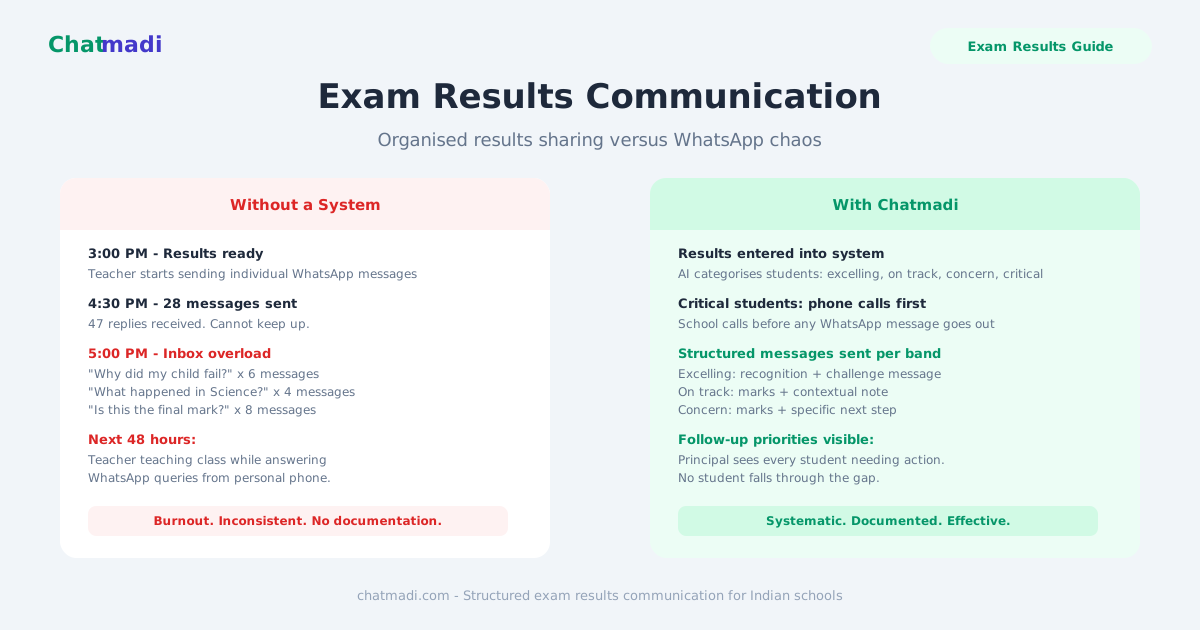
Most schools answer that question the same way: they do not have a system. Results go out in report cards distributed at PTMs, or uploaded to a portal that 40 percent of parents never check, or messaged individually by class teachers to each parent on WhatsApp, one by one, over the course of an exhausting afternoon. The result of this approach is predictable. Parents who received concerning results call, message, and appear at the school office simultaneously. Teachers spend the next two days responding to individual WhatsApp queries instead of teaching. Parents who were not reached feel they were deliberately kept in the dark. And the students who most needed timely parental intervention are often the last ones whose parents received meaningful communication about the results.
This guide is for school administrators and class teachers who want to change that pattern.
Why Exam Results Communication Fails in Most Indian Schools
The failure mode is consistent across school types and sizes. It comes down to a combination of three structural problems.
The Scale Problem
A class teacher with 40 students sending individual results to each parent via WhatsApp is looking at 40 personalised messages. For a school with 20 classes, that is 800 individual messages going out in the same two-hour window. Each message invites a reply. Each reply arrives in the teacher's personal WhatsApp during the same afternoon. By 6 PM, the teacher has 200 unread WhatsApp messages and no way to prioritise the ones that actually require a response versus the ones that are just acknowledgements.
This is not a communication strategy. It is a recipe for teacher burnout and inconsistent parent experience. Some parents receive detailed explanations. Others receive nothing because the teacher ran out of time and energy. The parents whose children needed the most attention are often the ones whose calls the teacher did not get back to until the following week.
The Sensitivity Problem
Exam results contain information that needs to be communicated thoughtfully. A student who failed a subject, a student who dropped significantly from their previous performance, or a student whose results suggest a learning difficulty all require a communication approach that is different from a routine announcement.
When results go out over WhatsApp, the medium itself works against sensitivity. A message saying "Rohan scored 34 out of 100 in Mathematics" delivered in a class group chat or even in a private message carries no context, no preparation, and no opportunity for the teacher to gauge the parent's reaction before they absorb the information. Parents have WhatsApp open on their phone throughout the day. A result notification arrives between a cooking video and a family chat message. The context in which they receive difficult academic news is completely unsuitable for the nature of the information.
The Follow-Up Problem
After results are communicated, the schools that communicate most effectively are the ones that have a plan for what comes next. Which students need additional support? Which families need a follow-up conversation? Which results suggest a pattern that requires a change in approach for the next academic term?
Without a systematic results communication process, the follow-up is reactive rather than planned. Parents who are distressed reach out. Parents who accepted bad results without understanding their implications do not. Students who needed intervention three months ago are still waiting for it when the next set of results arrives.
According to NCERT's guidelines on learner assessment and feedback, results communication should be part of a comprehensive feedback cycle that includes understanding of performance, identification of learning gaps, and actionable next steps for both the student and the family. A WhatsApp message with a mark out of 100 satisfies none of these requirements.
The Five Problems with WhatsApp Results Communication
Problem 1: No Context for the Numbers
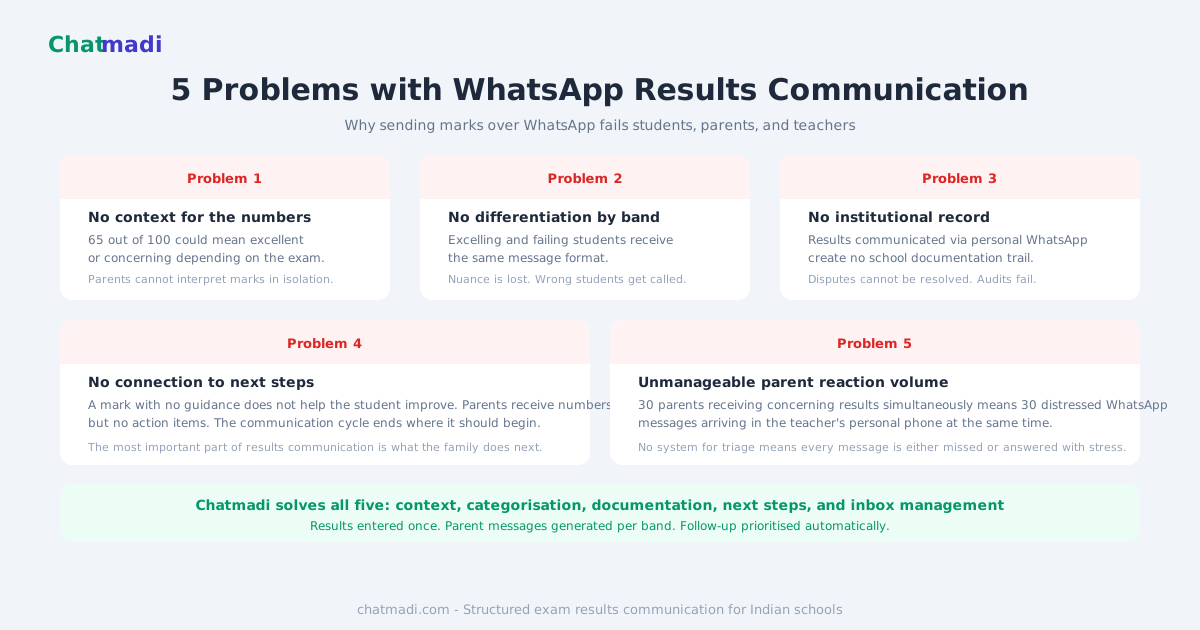
A mark means nothing in isolation. 65 out of 100 is exceptional in one examination and concerning in another, depending on the difficulty of the paper, the class average, and what the student scored previously. When results go out as numbers over WhatsApp without context, parents cannot interpret what they mean. They either assume the worst or assume everything is fine, neither of which may reflect reality.
Problem 2: No Differentiation by Performance Category
Every class has students in different performance categories: students who are excelling, students who are on track, students who need monitoring, and students who need immediate intervention. Communicating with all four categories in the same way, with the same message format and the same timing, serves none of them well.
A parent of a student who scored 95 percent needs acknowledgement and encouragement. A parent of a student who dropped from 75 to 52 percent needs context, concern, and a suggested next step. A parent of a student who failed needs a phone call, not a WhatsApp message. Treating all of these as the same communication task is a fundamental error in results management.
Problem 3: No Record of What Was Communicated
When results are communicated via personal WhatsApp messages, there is no institutional record of what was said to which parent. If a parent later claims they were not informed about their child's performance, or if a student's academic difficulties become a concern that requires review, the school has no documented communication trail. The teacher's personal WhatsApp is not a school record.
Problem 4: No Connection to the Next Steps
Results communication that ends with the mark communicated has not completed the communication cycle. The most valuable part of results communication is what comes after: what does this mean for the student's preparation for the next examination, what support is available, and what should the parent do differently at home?
Most WhatsApp-based results communication does not include this information because including it in a WhatsApp message makes the message too long to read. The medium constrains the quality of the communication.
Problem 5: The Reaction Management Problem
When a parent receives bad news about their child's academic performance, they are likely to have an emotional reaction. That reaction often manifests as an immediate WhatsApp message to the teacher. If thirty parents are receiving concerning results simultaneously, the teacher receives thirty emotional WhatsApp messages simultaneously. There is no way to manage this effectively without a system.
What Good Exam Results Communication Looks Like
Effective exam results communication has three phases: preparation, delivery, and follow-up. Each phase has specific requirements that determine whether the overall communication is useful or just a formality.
Phase 1: Preparation
Before any result reaches any parent, the school should have a clear picture of the results landscape. Which students improved significantly? Which students dropped significantly? Which students failed one or more subjects? Which students are at risk of not meeting the academic threshold for the year?
The academic assessment management feature builds this picture automatically from entered results, categorising students by performance band and generating class-level intelligence before communication begins. This preparation work makes the delivery phase significantly more effective.
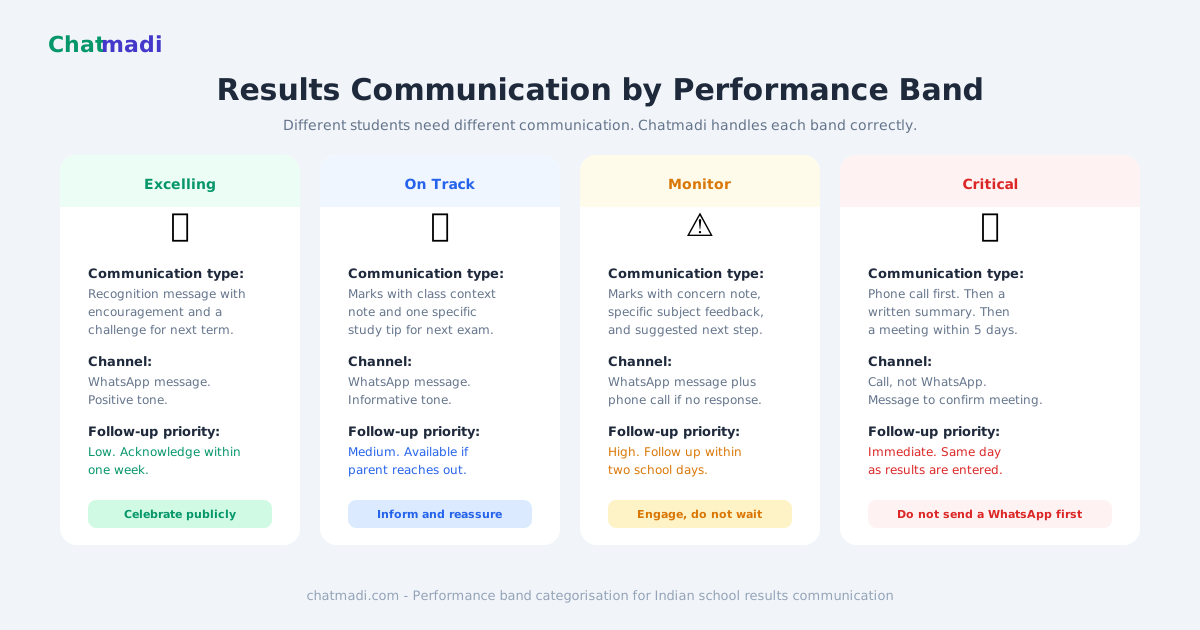
Preparation also means deciding which communication channel is appropriate for which performance category. Excellent results can be communicated via a well-formatted WhatsApp message or a digital report card. Average results with specific feedback require a more detailed message. Concerning results require a phone call. Failed results require a meeting, not a message.
Phase 2: Delivery
The delivery of results should be structured by performance category, not by class or alphabetical order. Start with the students who need the most careful communication: those who failed, those who dropped significantly, and those whose results suggest a pattern of concern. These conversations should happen personally, by phone or in a scheduled meeting, before any general results communication goes out to the class.
For the majority of students, results communication can happen through a structured WhatsApp message that includes the marks, a brief contextual note comparing to the class average, and a specific next step. The message format should be consistent across the school so parents know what to expect and how to read it.
The exam results broadcast feature generates per-student result messages that include context and next steps, and sends them via WhatsApp for schools on the Pro and School plans with WABA connected. For schools without WABA, it generates formatted messages that class teachers can send manually, reducing the personalisation burden while maintaining quality.
Phase 3: Follow-Up
The 48 hours after results communication are the highest-value period for parent engagement. Parents who received concerning results are paying attention. Parents who have questions are ready to listen to answers. This is the window for meaningful follow-up conversations.
The follow-up plan should be categorised by student situation. Students who failed need a meeting scheduled within five school days. Students who dropped significantly need a phone conversation within two school days. Students who are on track need an acknowledgement and encouragement message within the week. Students who excelled need recognition and a challenge for the next term.
Without a system that categorises students by follow-up priority after results communication, this window closes without being used. The class teacher dashboard shows each student's performance category after results are entered, making follow-up prioritisation visible without requiring the teacher to construct it manually.
The Exam Results Communication Timeline for Indian Schools
Indian schools operate on examination cycles that create specific communication moments across the academic year. Understanding these moments allows schools to build a communication plan rather than reacting to each examination in isolation.
For CBSE schools, the academic year generates Unit Test results, Half Yearly results, and Annual results at minimum. For ICSE and ISC schools, internal assessment components add additional result communication moments throughout the year. For state board schools, the Quarterly, Half-Yearly, and Annual examination pattern creates its own rhythm.
The AI-powered school analytics guide shows how schools that track results communication systematically can identify patterns that single-examination communication misses: the student who consistently drops between the first and second unit test, the class where average performance declined across two examination cycles, the subject where student performance is systematically below expectations.
These patterns are only visible when results are entered systematically, communicated with documentation, and followed up in a way that generates records. They are invisible when results are communicated via individual WhatsApp messages from personal phones with no institutional record.
Managing Parent Reactions After Results
The most challenging part of exam results communication in India is not the delivery. It is what comes after. Parents who received concerning results will reach out. Some will be upset. Some will question the marking. Some will demand meetings. Some will simply need reassurance.
Managing this without a system means every teacher is individually managing an inbox of anxious parent messages while also teaching their classes. With a system, the responses are structured, the meetings are scheduled in advance rather than demanded unpredictably, and the teacher has documentation of what was communicated to whom and when.
Specific communication strategies for different parent reactions after results:
The parent who questions the marking: Have a clear and consistent policy on result review requests. Communicate this policy as part of the results communication itself. "If you have questions about the marking, please send a message to [school contact] by [date] to schedule a review conversation." This prevents the class teacher's personal WhatsApp from becoming the results review channel. The parent who compares to other students: Address this proactively. Include a brief note about the class average and performance distribution in the results communication. When parents know the context, they ask fewer comparative questions. The parent who disappears after bad results: Some parents who receive concerning results about their child do not respond, do not engage, and do not act. This is often the most worrying outcome because the child who most needs parental support at home does not receive it. Follow-up calls, not messages, are the only effective channel for these families. The parent whose child performed poorly despite apparent effort: This is the most delicate situation and requires the most careful communication. The PTM module within the school management system provides AI-generated preparation for exactly this kind of conversation, including talking points and areas to approach carefully. The PTM management guide covers this in detail.Setting Up Results Communication at Your School
The practical steps to implementing structured results communication are straightforward. Enter results into the system as they are marked, rather than at the end of the examination period. This allows the system to generate performance analysis in real time rather than requiring a batch process.
Configure the performance categories relevant to your school's grading standard. Chatmadi's default performance bands, excelling, on track, monitor, concern, and critical, can be adjusted to reflect the specific grading thresholds your school uses. Each band generates a different follow-up priority and a different communication approach.
Designate one contact for results queries from parents rather than routing all queries to individual class teachers' personal numbers. This protects teacher time and ensures consistent communication to parents who have questions.
The school setup guide covers the complete configuration process for results communication, including how to enter results in bulk for large classes and how to configure the performance band thresholds for your school's specific grading approach.
Start free at chatmadi.com. Academic assessment and results management are included in the Growth plan and above. Schools on the Starter plan can explore the results entry interface and see how performance band categorisation works before upgrading.
Frequently Asked Questions
How does Chatmadi send exam results to parents via WhatsApp?On Pro and School plans with WhatsApp Business API connected, Chatmadi generates a personalised result message for each student and sends it directly to the linked parent contact via WhatsApp. The message includes the student's marks, a contextual note about class performance, and a next step. For schools without WABA, the system generates formatted messages that class teachers copy and send from their own WhatsApp, reducing manual composition time to seconds per student.
Can results be communicated in different languages for different parents?The result message templates in Chatmadi can be configured in any language. A school with a mix of English-speaking and Kannada-speaking parents can configure templates in both languages and assign the appropriate template based on the parent's communication preference. This is particularly useful for state board schools where the parent community communicates across multiple languages.
How does the system handle parents who respond to results messages with questions?Results messages sent via WABA create a conversation thread in the Chatmadi WhatsApp inbox. Incoming parent replies are visible to the accounts team or class teacher who manages the inbox. The WhatsApp inbox feature allows staff to respond to parent queries directly from the platform without requiring the response to come from a teacher's personal WhatsApp.
Does entering results into Chatmadi replace the school's report card process?No. Chatmadi's results entry and communication feature is designed to work alongside the school's existing report card process. It adds a structured WhatsApp communication layer that precedes or supplements the formal report card, giving parents timely information about their child's performance rather than waiting for the PTM to receive it. The formal report card process continues as normal.
Can the principal see results across all classes in one view?Yes. The principal dashboard shows results summary data across all classes after results are entered. This includes class averages by subject, performance band distribution per class, and a list of students in the critical and concern bands across the school, prioritised for follow-up. This gives the principal visibility into academic health across the school that is not available from individual class report cards.
Chatmadi Team
School Communication Intelligence
The Chatmadi team writes about AI-powered parent communication, school management best practices, and WhatsApp intelligence for Indian schools. Built by Eduloom Technologies OPC Pvt Ltd, Mysore.
Ready to Try Chatmadi at Your School?
Free to start. Setup in 15 minutes. No new apps for parents.
Set Up My School Free →