WhatsApp vs School App vs ERP: Which Communication Tool Is Right for Your School
In this article
Every Indian school is using at least one of three tools to communicate with parents: WhatsApp, a dedicated school communication app, or a school ERP. Many schools are using two of the three simultaneously, creating duplicated effort and confused parents who receive the same information through multiple channels. Some schools are attempting to use all three at once and wondering why communication feels more fragmented than it did when they relied on WhatsApp alone.
Table of Contents
- [What WhatsApp Does Well](#what-whatsapp-does-well)
- [Where WhatsApp Fails](#where-whatsapp-fails)
- [What School Apps Do Well](#what-school-apps-do-well)
- [Where School Apps Fail](#where-school-apps-fail)
- [What School ERPs Do Well](#what-school-erps-do-well)
- [Where School ERPs Fail](#where-school-erps-fail)
- [Small Schools: Under 200 Students](#small-schools-under-200-students)
- [Medium Schools: 200 to 500 Students](#medium-schools-200-to-500-students)
- [Large Schools: 500 Students and Above](#large-schools-500-students-and-above)
The confusion is understandable. Each of these three tool categories has genuine strengths, genuine weaknesses, and a specific type of school for which it is the best primary choice. The mistake most Indian schools make is choosing based on what a vendor demonstrated in a sales presentation rather than on a clear-eyed assessment of their own school's communication reality.
This guide is a decision framework. It explains what each tool category does well, where each one fails, and which combination of tools makes sense for which type of Indian school. By the end, a school principal should be able to identify which combination fits their school without needing to sit through a single sales demo.
Tool Category 1: WhatsApp
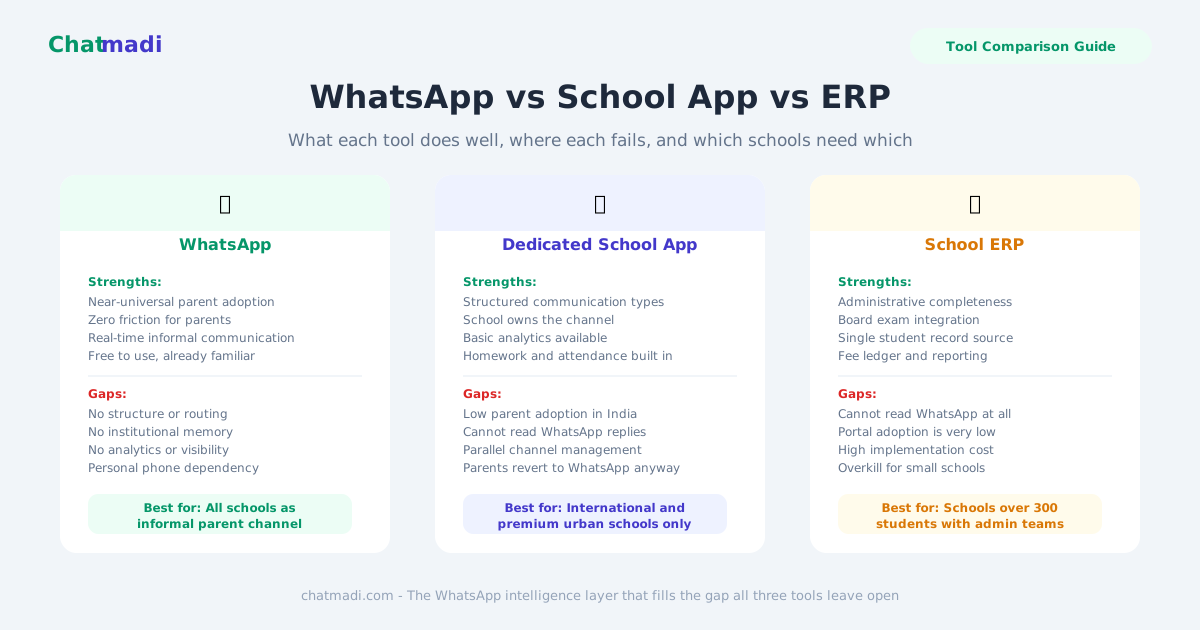
WhatsApp is not a school communication tool. It is a consumer messaging application that Indian schools have adopted for school communication because it is where parents already are and because it costs nothing to use. Understanding both the genuine strengths and the structural limitations of WhatsApp as a school communication channel is the starting point for any honest tool evaluation.
What WhatsApp Does Well
Adoption: WhatsApp has near-universal adoption among Indian smartphone users. According to WhatsApp's own data, India has the largest WhatsApp user base in the world. When a school communicates via WhatsApp, it is communicating through a channel that 95 percent of Indian parents are already using daily. No other communication tool can claim this. Informal communication quality: WhatsApp is excellent for the kind of informal, real-time communication that characterises healthy parent-teacher relationships. A parent who messages a class teacher at 7 PM to say their child will be absent tomorrow is using exactly the right tool for that interaction. The informality and immediacy of WhatsApp are features, not bugs, for this type of communication. Zero parent-side friction: Parents who communicate via WhatsApp do not need to download a new app, create an account, or learn a new interface. The barrier to communication is essentially zero. This is why WhatsApp-based communication routinely achieves higher parent participation than any dedicated school app that requires a separate login.Where WhatsApp Fails
No structure: WhatsApp has no concept of a student, a class, a teacher role, or a school workflow. A fee payment confirmation, an absence notification, a PTM RSVP, and a complaint about a teacher's behaviour all arrive in the same chat thread as the same type of message. Nobody routes them. Nobody categorises them. Whoever happens to read the message decides what to do with it. No institutional memory: Information shared in WhatsApp conversations exists on participants' personal phones. When a teacher leaves the school, their WhatsApp history leaves with them. There is no institutional record of what was communicated to which parent, when, and what followed. This is both an operational problem and a compliance problem under DPDPA. No analytics: A school using only WhatsApp for parent communication cannot tell you how many parents acknowledged last week's homework, what percentage of absences were proactively notified versus discovered, or which families have not communicated with the school in thirty days. These are all signals that matter for student outcomes and that WhatsApp cannot surface. Personal phone dependency: When school communication runs through teachers' personal WhatsApp accounts, the school has no control over the channel. It cannot ensure consistent response times. It cannot access the data. It cannot respond to a parent's data deletion request. It cannot detect a pattern of concerning messages from a parent who is reaching out across multiple teachers. Best for: Schools that are beginning their communication improvement journey. Schools where parents strongly resist any new app or platform. As a supplementary informal channel for any school that has a more structured primary channel.Tool Category 2: Dedicated School Communication Apps
Dedicated school communication apps, including platforms like Toddle, ClassDojo, and various India-specific school apps, were designed to bring structure to school-parent communication. They offer features that WhatsApp cannot: homework tracking, attendance marking, fee payment portals, PTM scheduling, and broadcast messaging with delivery receipts.
What School Apps Do Well
Structured communication: School apps provide a purpose-built interface for school-specific communication types. Homework assignments have a specific interface. Attendance has a specific interface. Fee payment has a specific interface. Parents who use the app know where to find each type of information rather than scrolling through a WhatsApp group. Institutional control: Unlike WhatsApp, communication through a school app belongs to the school, not to individual teachers' personal phones. The school can set response time standards, monitor communication patterns, and access historical records without depending on teachers to export their personal chat histories. Analytics: Most school apps provide basic analytics: how many parents opened each message, how many acknowledged homework, what the PTM RSVP rate is. This data, even at a basic level, is significantly more useful than the zero analytics that WhatsApp provides.Where School Apps Fail
The adoption problem: Every Indian school that has introduced a dedicated school app has encountered the adoption problem. A portion of the parent community downloads and uses the app enthusiastically. A larger portion downloads it, uses it for two weeks, and stops. A third portion never downloads it at all. The school ends up managing communication across two channels simultaneously: the app for engaged parents and WhatsApp for everyone else.The adoption problem is structural. Indian parents already have a communication tool they trust and use for everything. Asking them to adopt a separate tool specifically for school communication adds friction that a significant percentage of parents will not accept. This is not a criticism of parents. It is a realistic assessment of human behaviour around tool adoption.
Cannot read WhatsApp: School apps can send messages to parents. They cannot read the messages parents send back via WhatsApp. The information asymmetry is permanent: the school can push information through the app, but the intelligence that flows back from parents through WhatsApp is invisible to the app.This is the fundamental limitation of every dedicated school app for Indian schools. The parents who don't use the app communicate through WhatsApp. The school has no systematic way to capture that communication.
Best for: Schools where parent digital literacy is high and consistent, such as international schools and premium urban private schools. Schools that want a structured broadcast channel alongside WhatsApp for informal communication.Tool Category 3: School ERPs
School ERPs (Enterprise Resource Planning systems) are comprehensive administrative platforms designed to manage every aspect of school operations: admissions, student records, fee management, timetabling, examination records, report cards, and human resources. Major platforms include Fedena, Entab, SchoolERP, and many India-specific systems.
What School ERPs Do Well
Administrative completeness: A well-implemented school ERP is the most comprehensive administrative system available for schools. It maintains a structured record of every student, every fee transaction, every examination result, and every staff member. It can generate report cards, produce fee ledgers, and track admissions from enquiry to enrolment with complete documentation. Board and examination integration: Indian school ERPs are built around the specific requirements of CBSE, ICSE, and state board examinations. They understand the examination calendar, the mark sheet formats required by each board, and the documentation requirements for board registration. This deep integration with Indian examination processes is a genuine competitive advantage over international school software platforms. Data integrity: Because ERPs maintain a single source of truth for all school administrative data, they dramatically reduce the data inconsistency problems that affect schools managing information across multiple disconnected systems. A student's fee record, attendance record, and academic record are all in one place.Where School ERPs Fail
Cannot read WhatsApp: ERPs were designed to manage data that is entered by school staff. They have no mechanism for reading incoming parent communication and extracting intelligence from it. A fee payment confirmation that a parent sends via WhatsApp is invisible to the ERP unless a staff member manually reads the message and enters the payment. Require parent portal adoption: ERP communication features require parents to log into a web portal or a connected mobile app. As with dedicated school apps, parent adoption of ERP portals is consistently low in Indian schools. The portal works well for parents who choose to use it. The majority of parents continue to communicate via WhatsApp, creating a parallel communication channel that the ERP cannot capture. Implementation complexity and cost: ERPs require significant implementation time, training investment, and ongoing maintenance. For schools under 300 students, the operational overhead of maintaining a full ERP often outweighs the administrative benefit. Best for: Schools over 300 students that need comprehensive administrative record-keeping, board examination management, and multi-year student history. Best used alongside a WhatsApp communication layer rather than as a replacement for it.The Honest Assessment: None of the Three Solves Everything
The honest conclusion from comparing all three tool categories is that none of them solves the full communication problem facing Indian schools. Each one addresses part of the problem while leaving another part unaddressed.
WhatsApp has universal adoption but no structure, no institutional memory, and no analytics. School apps have structure but low adoption. ERPs have administrative completeness but cannot read WhatsApp.
The gap that none of the three fills is the most important one for Indian schools: the ability to read the WhatsApp conversations that are already happening between parents and teachers, extract structured intelligence from those conversations, and route that intelligence to the right people in the school's administrative structure.
This gap is what Chatmadi was designed to fill. Rather than asking schools to replace WhatsApp (which would fail the adoption test) or to add another app that parents will not use (which would fail for the same reason), Chatmadi reads the WhatsApp conversations that are already happening and converts them into structured school intelligence.
The AI conversation analysis guide explains in detail how this process works. The school communication software buying guide provides a framework for evaluating any communication tool against the specific needs of your school.
The Decision Framework: Which Tools for Which School
The right combination of tools depends on four factors: school size, parent community digital literacy, board affiliation, and the school's primary communication challenge.
Small Schools: Under 200 Students
For small schools, the overhead of implementing and maintaining a full ERP is rarely justified. The administrative complexity of a 150-student school is manageable without enterprise software. The right approach for small schools is:
Primary channel: WhatsApp for all parent communication. This is what the parent community already uses and what teachers are already comfortable with. Supplementary layer: AI WhatsApp analysis to extract intelligence from those conversations without changing how anyone communicates. Absence notifications, fee payment confirmations, and welfare signals are detected automatically from the existing WhatsApp conversations. What to avoid: Full ERP implementation. The implementation cost and administrative overhead will exceed the benefit at this scale. A dedicated school app is also unlikely to achieve sufficient adoption to justify the parallel channel management burden.Medium Schools: 200 to 500 Students
Medium schools benefit from more structure than WhatsApp alone can provide, but may not need the full complexity of an enterprise ERP. The right approach:
Primary channels: WhatsApp for parent communication plus a structured admin system for student records, fee management, and examination tracking. This could be a mid-tier ERP or a purpose-built school management platform. Intelligence layer: AI WhatsApp analysis that reads the WhatsApp conversations and feeds structured data into the admin system, eliminating the need for staff to manually transcribe information from WhatsApp into the records system. What to avoid: Dedicated school apps that require parents to change their communication behaviour. At this scale, the adoption problem is manageable but not solved, and the parallel channel management burden grows with school size.Large Schools: 500 Students and Above
Large schools need the administrative completeness of a full ERP, the intelligence extraction of AI WhatsApp analysis, and potentially a structured broadcast channel for school-wide communication. The right approach:
Foundation: Full ERP for student records, fee management, examination processing, and administrative reporting. Communication intelligence: AI WhatsApp analysis that captures the parent communication that flows through teachers' WhatsApp accounts and feeds structured signals into the ERP and to the relevant staff members. Optional broadcast channel: A dedicated school app or WhatsApp Business API broadcasting for school-wide announcements, PTM scheduling, and structured homework communication, alongside the informal WhatsApp channel. What to avoid: Expecting the ERP portal to replace WhatsApp for parent communication. It will not. Design the communication architecture around the reality that parents will continue to use WhatsApp for informal communication regardless of what portal or app the school provides.The WhatsApp Business API guide for schools explains how schools can use the official WhatsApp API for structured broadcasts while maintaining the informal WhatsApp channel for day-to-day communication.
The ERP Integration Question
For schools that already have an ERP, the question is not whether to replace it with Chatmadi. It is whether to add Chatmadi as the WhatsApp intelligence layer that feeds the ERP with data it cannot currently access.
An ERP that receives a daily feed of structured data from WhatsApp conversations, including confirmed absences, fee payment detections, PTM RSVPs, and welfare flags, is significantly more useful than an ERP whose data depends entirely on manual staff input. The gap between what the ERP knows and what actually happened in the school's parent community shrinks dramatically when WhatsApp intelligence flows into the ERP rather than staying trapped in teachers' personal phones.
The school ERP vs WhatsApp CRM guide covers the integration question in detail, including how to think about which system owns which data and how to avoid creating duplicate records across systems.
Making the Decision for Your School
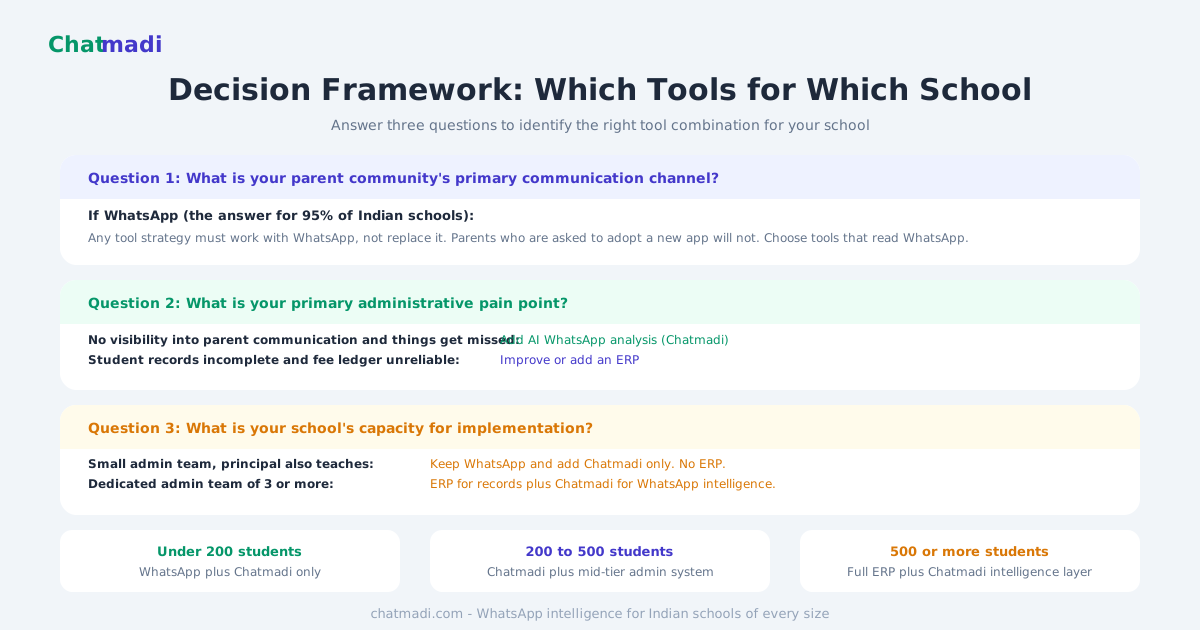
The decision framework simplifies to three questions that any school principal can answer in under ten minutes.
Question 1: What is your parent community's primary communication channel? If the answer is WhatsApp, which it is for the overwhelming majority of Indian schools, then any communication strategy must work with WhatsApp rather than trying to replace it. Tools that require parents to change their communication behaviour will fail. Question 2: What is your primary administrative pain point? If the answer is "we have no visibility into what parents are communicating and we miss things," the solution is AI WhatsApp analysis. If the answer is "our student records are incomplete and our fee ledger is unreliable," the solution includes ERP improvement. If the answer is "parents ignore our broadcasts," the solution includes improving broadcast quality and channel selection. Question 3: What is your school's capacity for implementation? A school with one part-time administrator and a principal who teaches six periods per day has different implementation capacity from a school with a five-person admin team. Complexity that cannot be implemented and maintained consistently is not an improvement. Choose the simplest solution that genuinely solves the primary problem.For most Indian schools under 500 students, the simplest solution that genuinely solves the primary problem is: keep WhatsApp, add AI analysis to extract intelligence from it, and use the structured data to improve administrative decision-making. This is precisely the problem Chatmadi was built to solve.
Start free at chatmadi.com. Schools can begin with a single class, upload their first WhatsApp conversation exports, and see how the AI analysis works before committing to any configuration. No existing tools need to be replaced. No parents need to change anything. The intelligence starts flowing from the conversations that are already happening.
Frequently Asked Questions
Can Chatmadi replace a school ERP?No, and it is not designed to. Chatmadi is a WhatsApp intelligence layer that extracts structured data from parent-teacher WhatsApp conversations and provides schools with attendance tracking, fee detection, welfare monitoring, and parent engagement analytics. It does not manage admissions workflows, generate board-examination report cards, or maintain the comprehensive administrative record that a full ERP provides. For schools that need ERP functionality, the right approach is to use both: an ERP for administrative record-keeping and Chatmadi as the WhatsApp intelligence layer that feeds the ERP with data it cannot otherwise access.
Can Chatmadi replace a dedicated school app?For most Indian schools, yes. The core function of a dedicated school app is to provide parents with structured access to school information and to provide the school with structured access to parent responses. Chatmadi achieves the same outcomes without requiring parents to download or adopt a new app, because it works with WhatsApp rather than requiring a separate channel. Schools that have already invested in a school app can continue using it for structured broadcasts while adding Chatmadi as the intelligence layer for the WhatsApp channel.
Does Chatmadi work with schools that have no ERP?Yes. Chatmadi is a standalone platform that works independently of any ERP. Schools that do not have an ERP can use Chatmadi for attendance tracking, fee management, welfare monitoring, academic assessment recording, and parent engagement analytics. These features cover the core operational data needs of most Indian schools under 500 students without requiring a separate ERP implementation.
Which Indian school boards does Chatmadi support?Chatmadi supports CBSE, ICSE, all State Boards (Karnataka SSLC, Maharashtra SSC, Tamil Nadu TNBSE, Telangana SSC, and others), IB (PYP, MYP, DP), and IGCSE. The AI analysis understands each board's academic terminology, examination calendar, and the specific communication patterns that characterise each board's parent community.
How long does it take to see results from Chatmadi?Schools that upload their first WhatsApp conversation exports and process them through the AI analysis typically see the first batch of structured intelligence (detected absences, fee payment confirmations, welfare signals) within minutes of the first upload. The first week of use typically reveals missed fee payments, unrecorded absences, and welfare signals that were previously invisible to the school's administrative team. Meaningful changes in parent engagement scores and attendance patterns become visible over the first term of consistent use.
Chatmadi Team
School Communication Intelligence
The Chatmadi team writes about AI-powered parent communication, school management best practices, and WhatsApp intelligence for Indian schools. Built by Eduloom Technologies OPC Pvt Ltd, Mysore.
Ready to Try Chatmadi at Your School?
Free to start. Setup in 15 minutes. No new apps for parents.
Set Up My School Free →