ICSE School Parent Communication: Why ICSE Schools Have Different WhatsApp Problems
In this article
Walk into an ICSE school in Bengaluru, Mumbai, or Delhi and ask the principal about their biggest operational challenge. The answer is almost never the syllabus. It is the communication. Specifically, it is the volume, complexity, and diversity of parent communication that arrives via WhatsApp every single day, and the complete absence of any system designed to handle it at the scale and specificity that ICSE parent communities demand.
Table of Contents
[What Makes ICSE Schools Different as Communication Environments](#what-makes-icse-schools-different-as-communication-environments)
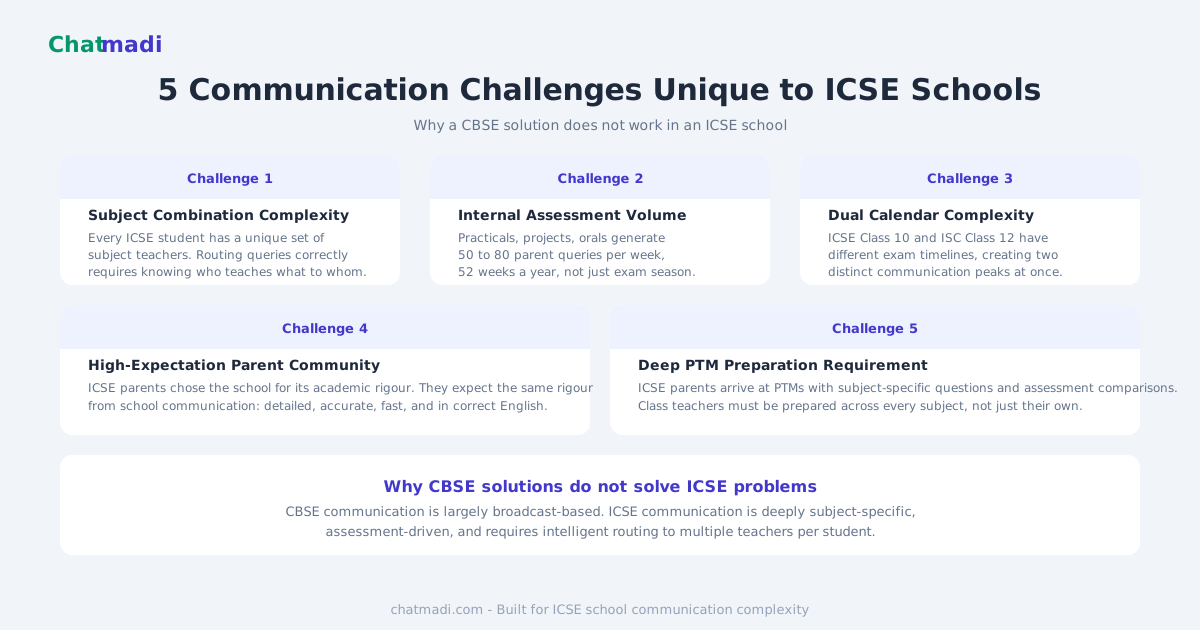
[Five Communication Challenges Unique to ICSE Schools](#five-communication-challenges-unique-to-icse-schools)
- [Challenge 1: The Subject Combination Complexity](#challenge-1-the-subject-combination-complexity)
- [Challenge 2: The Internal Assessment Communication Volume](#challenge-2-the-internal-assessment-communication-volume)
- [Challenge 3: The Dual Calendar Complexity](#challenge-3-the-dual-calendar-complexity)
- [Challenge 4: The Language Standard Expectation](#challenge-4-the-language-standard-expectation)
- [Challenge 5: The PTM Depth Requirement](#challenge-5-the-ptm-depth-requirement)
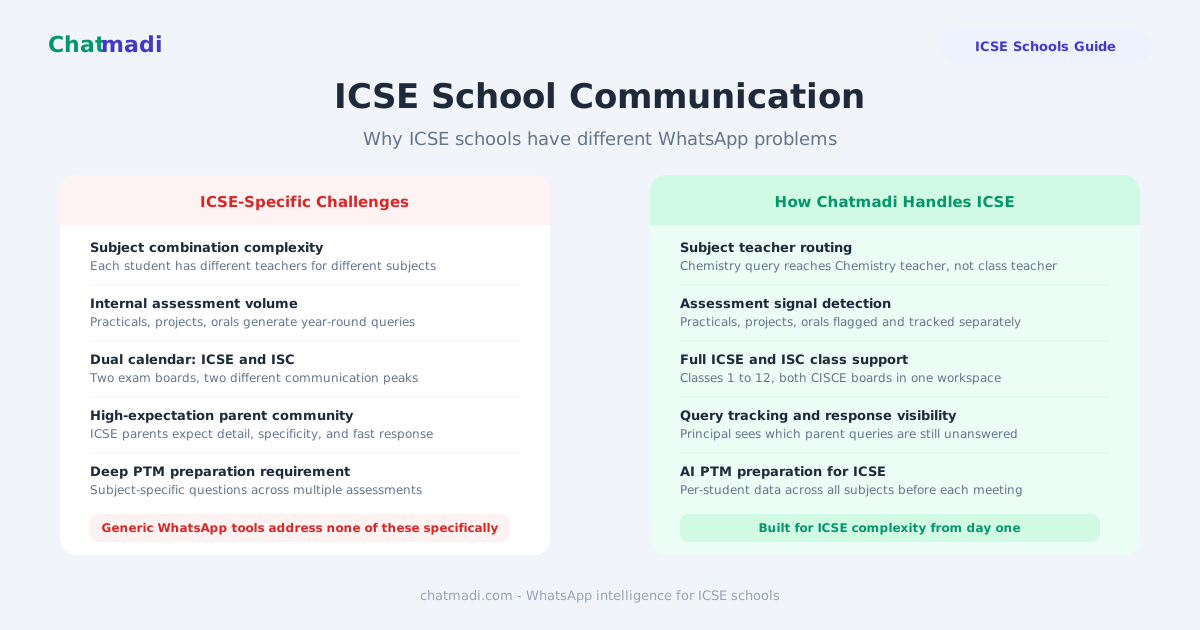
ICSE schools are not like other schools in India, and their parent communication challenges are not like other schools' challenges either. A solution designed for a generic Indian school, or worse, one designed specifically for CBSE institutions, will leave most ICSE-specific problems completely unaddressed. Understanding why requires understanding what makes ICSE parent communication structurally different.
ICSE school parent communication challenges on WhatsApp
What Makes ICSE Schools Different as Communication Environments
ICSE schools operate under the Council for the Indian School Certificate Examinations, which administers two distinct examinations: ICSE for Class 10 and ISC for Class 12. This dual-board structure creates a school environment with two different examination calendars, two different assessment patterns, and two distinct sets of parent anxiety around academic performance.
The ICSE syllabus is known for its breadth and depth. Students typically study more subjects than their CBSE counterparts, with significantly more internal assessment components: practical examinations, project submissions, oral assessments, and coursework that is evaluated across the year rather than in a single final examination. Each of these assessment moments is a trigger for parent communication.
ICSE parent communities are also, statistically, among the most engaged and most demanding in Indian private education. Schools affiliated with CISCE tend to draw from socioeconomic segments where both parents are educated, often professionally, and have strong opinions about academic standards, communication quality, and the level of detail they expect from school administrators and teachers.
The combination of a complex academic structure and a highly engaged parent community creates a WhatsApp environment unlike any other type of Indian school.
Five Communication Challenges Unique to ICSE Schools
Challenge 1: The Subject Combination Complexity
ICSE students, particularly in Classes 9 and 10, choose from a range of subject combinations. Some students take a language in addition to English. Some choose between History-Civics-Geography and other social science options. In Class 11 and 12 under ISC, the subject combination choices multiply further, with students selecting between science, commerce, and arts streams with specific subject selections within each.
This means a parent in an ICSE school is not asking about "school subjects" in a general sense. They are asking about their child's specific subject combination and the specific teacher responsible for each subject. When a parent sends a WhatsApp message asking about their child's Chemistry practical submission, that message must reach the Chemistry teacher for that specific class, not the general school WhatsApp contact.
Most WhatsApp management approaches fail here because they treat all parent messages as equivalent. In an ICSE school, a message about English Literature is meaningfully different from a message about Mathematics, and routing it to the right person requires understanding which teacher handles which subject for which student in which class.
Challenge 2: The Internal Assessment Communication Volume
Internal assessments are a defining feature of the ICSE and ISC curriculum. Practicals, projects, oral exams, and coursework components generate a continuous stream of parent queries throughout the academic year. Parents want to know deadlines for project submissions. They want to confirm that their child's practical attendance is recorded. They want to understand how internal marks will be calculated.
This is not a problem that spikes around exam season the way CBSE schools experience it. ICSE internal assessment communication is distributed across the entire academic year, with specific peaks around each assessment submission date. A school with 400 students in Classes 9 to 12 might handle 50 to 80 internal-assessment-related parent messages every week, 52 weeks a year.
Without a system that categorises these messages by type, routes them to the right teacher, and tracks whether they have been responded to, the administrative burden is overwhelming. The school analytics guide for principals shows how data-driven school management changes this kind of ongoing operational challenge.
Challenge 3: The Dual Calendar Complexity
ICSE and ISC examinations happen at different times. The Class 10 ICSE examinations begin in February and run through March. The Class 12 ISC examinations begin in February as well but extend further. Pre-board examinations, practical examination dates set by the school, and internal assessment deadlines create a calendar that is genuinely complex even for school administrators to track.
Parents of Class 10 and Class 12 students generate communication patterns that are significantly different from parents of younger students. From October onwards, the volume and urgency of communication from senior class parents increases substantially. These parents are communicating about board exam preparation, additional classes, doubts about syllabus changes, and requests for teacher availability outside school hours.
A class teacher in a CBSE school manages one examination cycle per year for their class. A senior class teacher in an ICSE school manages a continuous and escalating examination-related communication cycle from October through March, while also managing the regular ongoing communication from parents throughout the rest of the year.
Challenge 4: The Language Standard Expectation
ICSE schools are built around a strong English language education tradition. Parents of ICSE students have typically chosen the school in part because of its commitment to English medium instruction and high language standards. This creates a subtle but real communication challenge: parents expect communication from the school to reflect the same standard they chose the school for.
When WhatsApp communication from teachers to parents is informal, contains errors, or is inconsistently formatted, it creates a specific type of parent dissatisfaction in ICSE school communities that does not typically arise in the same way in other school types. ICSE parents notice and comment on the quality of written communication they receive from school staff.
This expectation extends to how the school manages inbound parent communication. Parents in ICSE communities expect their queries to be read, understood, and responded to with specificity. "We will look into it" is not a satisfactory response to a detailed query about how a specific practical assessment was marked.
Challenge 5: The PTM Depth Requirement
Parent-teacher meetings at ICSE schools are different from PTMs at most other schools. ICSE parents come to PTMs with subject-specific questions, comparisons between their child's performance in different assessments, and detailed queries about projection for final examinations. Class teachers must be prepared to speak to each student's performance across multiple subjects, not just the subjects they teach personally.
The preparation time required for an ICSE PTM is significantly higher than for a typical school PTM. The PTM planning guide for Indian schools covers preparation strategies that work across board types, but ICSE-specific PTM preparation requires understanding the CISCE assessment structure in depth.
PTM RSVPs at ICSE schools also tend to be more consistent: ICSE parents show up. This is good for parent engagement but increases the administrative burden of scheduling, managing, and following up on a high volume of substantive parent meetings.
Five unique parent communication challenges specific to ICSE schools
Why Generic WhatsApp Solutions Fail ICSE Schools
The tools most commonly marketed to Indian schools as WhatsApp management solutions were built for generic school contexts. They handle broadcast messaging, basic RSVP tracking, and simple absence notifications competently. For an ICSE school, these capabilities address perhaps 30 percent of the actual communication challenge.
The 70 percent they miss includes: routing subject-specific queries to the right teacher, categorising internal assessment communication separately from general queries, tracking the status of individual parent concerns across multiple messages and multiple days, and generating the kind of per-student academic communication intelligence that ICSE principals need to manage their schools effectively.
A school trying to use a broadcast-focused WhatsApp tool to manage ICSE parent communication will find that teachers are still manually routing messages, still missing internal assessment queries buried in group chats, and still unable to give the principal any visibility into what is happening at a student level across the school.
What ICSE Schools Actually Need from a Communication System
The requirements for ICSE school communication management are specific. The system must be able to categorise inbound parent messages by type: is this about attendance, about a specific assessment, about a welfare concern, about a fee payment, or about something else entirely? Each category needs to reach a different person.
It must handle the complexity of subject teacher assignments in an ICSE school, where five different teachers may be responsible for five different subjects for the same student. A query about one student's ISC project must reach the right subject teacher, not just the class teacher.
It must provide the principal with a school-wide communication intelligence view that shows not just who has sent messages but what those messages were about, which ones have been responded to, and which student situations require attention across classes and subjects.
The AI conversation analysis feature is designed to address exactly this kind of multi-dimensional communication challenge. It reads WhatsApp exports across all school conversations, categorises every message by the type of signal it contains, and routes each signal to the appropriate person in the school's role structure.
How AI Changes the ICSE Communication Picture
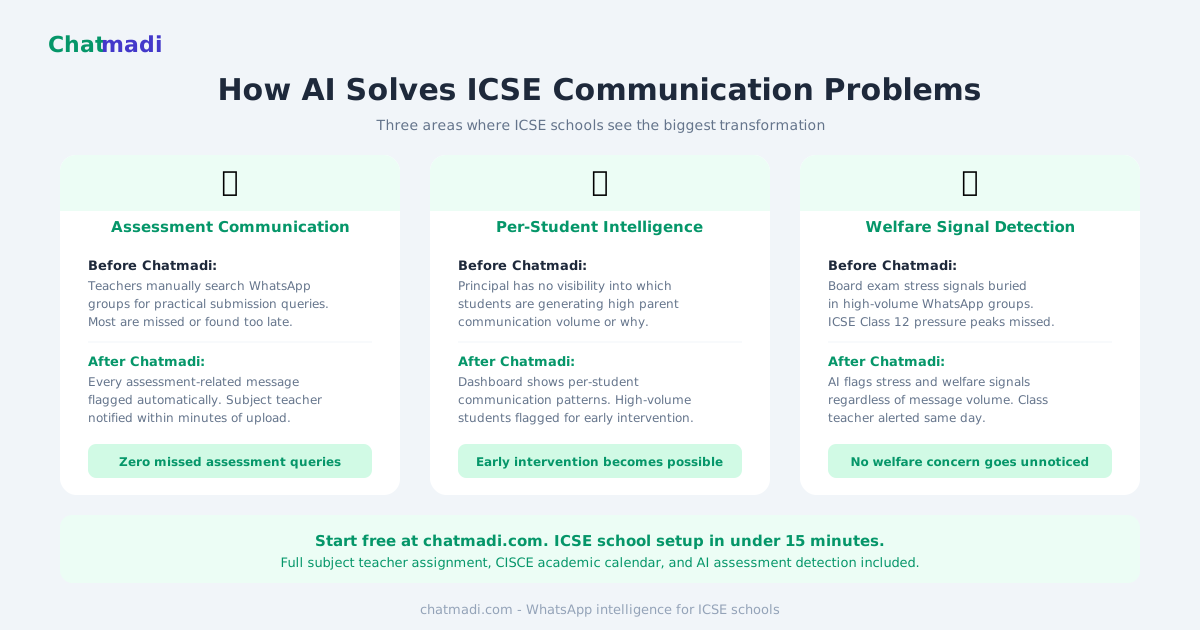
When an ICSE school implements AI-powered WhatsApp analysis, the transformation is most visible in three areas.
Internal assessment communication becomes manageable. Instead of teachers manually sifting through WhatsApp groups to find project submission queries buried between general parent messages, the AI flags every internal assessment mention automatically. Teachers see a categorised list of assessment-related parent messages, respond to them systematically, and the principal can see at a glance whether any assessment queries have been outstanding for more than 24 hours.
Per-student communication intelligence becomes available. The class teacher dashboard shows the principal and class teacher which students have high volumes of parent communication and what those communications are predominantly about. An ICSE student whose parents are sending multiple messages per week about a specific subject is likely struggling with that subject. This signal, previously invisible in the noise of WhatsApp groups, becomes visible and actionable.
Safety and welfare signals are not missed in the volume. ICSE senior class students face significant academic pressure, particularly from October onwards in Classes 10 and 12. Parents sometimes communicate welfare concerns, stress indicators, and emotional distress signals via WhatsApp in ways that teachers miss because the message came in among fifty others. The child safety alert system is designed to surface these signals regardless of the volume of surrounding communication.
How AI-powered WhatsApp analysis solves ICSE-specific communication problems
Getting Started: The ICSE-Specific Setup
Setting up an AI WhatsApp communication system in an ICSE school requires attention to the school's specific structure. The class and subject teacher assignment framework needs to reflect the ICSE subject combination reality, where each student may have a different set of subject teachers than the student sitting next to them.
The school's academic calendar, including internal assessment dates, practical examination schedules, and pre-board timelines, should be configured so the system understands the context of communication spikes when they occur. A surge in parent messages about "Chemistry practical" in November is contextually different from the same messages in February, and the system should reflect that.
The school setup guide covers the configuration process in detail. ICSE schools typically complete the initial setup in under an hour, with the subject teacher assignment configuration taking the most time for larger schools with complex subject combination matrices.
Start free at chatmadi.com. ICSE schools on the Starter plan can begin with one class and test the AI analysis with real WhatsApp exports before committing to a paid subscription.
Frequently Asked Questions
Does Chatmadi handle the ISC Class 11 and 12 subject combination structure?
Yes. The subject and class teacher assignment system in Chatmadi supports the full CISCE subject combination structure. Subject teachers can be assigned to specific subjects for specific classes, so a Chemistry teacher assigned to ISC Class 12 Science receives only Chemistry-related communication for those students, not unrelated queries from other classes or subjects.
How does the AI handle ICSE internal assessment-specific communication?
The AI identifies messages that reference assessments, projects, practicals, orals, and coursework submissions as academic performance signals. These are categorised separately from absence notifications and general queries, and routed to the subject teacher responsible for that assessment. The class teacher and principal also receive visibility into the volume and nature of assessment-related communication across the school.
Can Chatmadi handle both ICSE and ISC classes within the same school?
Yes. Chatmadi's class structure supports any number of classes across any combination of standards and boards within the same school workspace. A school running Classes 1 to 10 under ICSE and Classes 11 to 12 under ISC can manage all communication from a single platform with appropriate role-based access for each teacher.
How does the system manage the higher communication volume typical of ICSE parent communities?
The AI processes uploaded WhatsApp exports regardless of volume. A conversation with 500 messages is processed in the same seconds as one with 50 messages. The admin dashboard prioritises urgent signals, such as welfare concerns and assessment deadline queries, so high-volume communication does not obscure the messages that need immediate attention.
Does Chatmadi understand the specific academic terminology used in ICSE communication?
Yes. The AI understands ICSE-specific terms including CISCE, ISC, ICSE, practicals, internal assessment, project submission, oral examination, and the specific subject names used in ICSE schools. It also handles the mix of English and regional language communication that characterises parent groups in ICSE schools across different cities.
TagsICSE school parent communicationWhatsApp CRM for ICSE schoolsparent teacher communication app IndiaICSE school management softwareCISCE school communicationISC school WhatsApp management
C
Chatmadi Team
School Communication Intelligence
The Chatmadi team writes about AI-powered parent communication, school management best practices, and WhatsApp intelligence for Indian schools. Built by Eduloom Technologies OPC Pvt Ltd, Mysore.