International School Parent Communication India: IB and IGCSE Parent Expectations
In this article
India's international school sector has grown significantly over the past decade. Cities like Bengaluru, Mumbai, Hyderabad, Pune, and Gurgaon now host dozens of schools offering the International Baccalaureate (IB) programmes and the Cambridge International (IGCSE and A Level) curriculum. These schools serve a distinctive parent community: a mix of returning non-resident Indians, expatriate professionals, globally mobile families, and Indian families who have chosen an international curriculum for specific educational and career pathway reasons.
Table of Contents
- [The Returning NRI Family](#the-returning-nri-family)
- [The Expatriate Professional Family](#the-expatriate-professional-family)
- [The Indian Family Choosing International Education](#the-indian-family-choosing-international-education)
- [Expectation 1: Programme-Specific Communication Clarity](#expectation-1-programme-specific-communication-clarity)
- [Expectation 2: Assessment Communication Beyond Marks](#expectation-2-assessment-communication-beyond-marks)
- [Expectation 3: Multilingual Capability for Global Families](#expectation-3-multilingual-capability-for-global-families)
- [Expectation 4: Digital-First, WhatsApp-Aware Communication](#expectation-4-digital-first-whatsapp-aware-communication)
- [Expectation 5: Welfare Communication That Reflects International Standards](#expectation-5-welfare-communication-that-reflects-international-standards)
This parent community has communication expectations that are shaped by their international experience. They have dealt with schools in Singapore, Dubai, London, and New York. They know what excellent school communication looks like because they have experienced it. When an international school in Bengaluru or Mumbai fails to meet those expectations, parents do not quietly accept it. They escalate, they compare, and in some cases they move their child to a school that communicates better.
Managing parent communication in an international school in India requires understanding both the general principles of effective school communication and the specific expectations that IB and IGCSE parent communities bring from their international experience. This guide is for international school principals and administrators who want to close the gap between what their parent community expects and what the school currently delivers.
Who International School Parents in India Are
Before examining communication expectations, it is worth understanding the composition of the international school parent community in India, because the community is more diverse than it might appear from the outside.
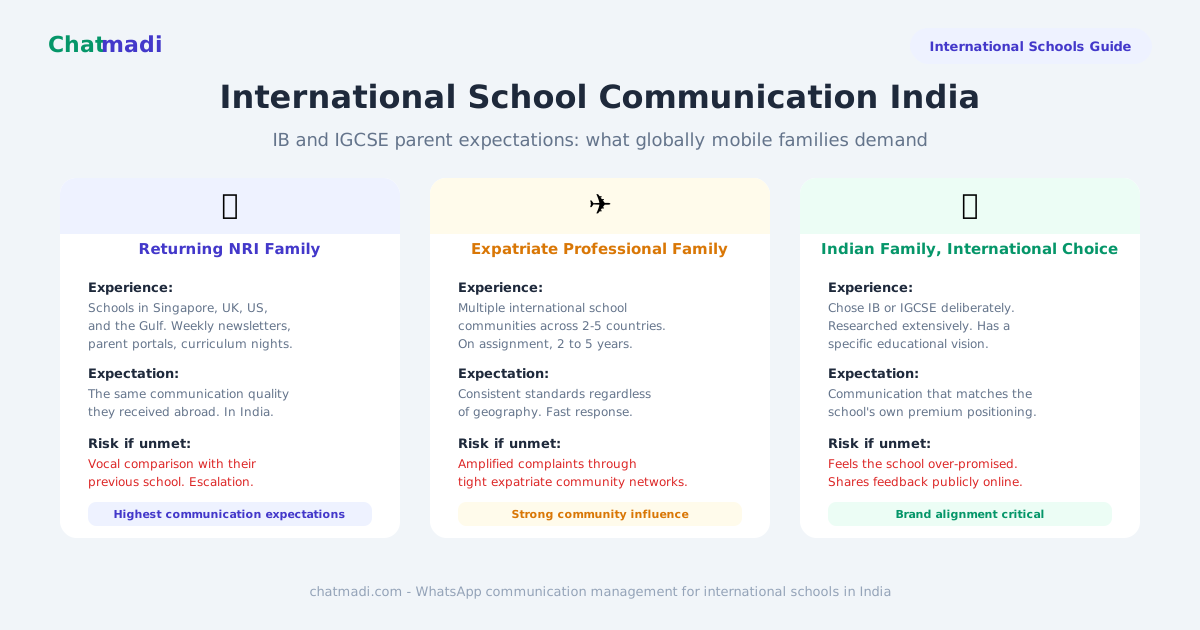
The Returning NRI Family
A significant portion of international school parents in India are returning non-resident Indians who spent years abroad and enrolled their children in international schools in the UK, the US, Singapore, or the Gulf. When they return to India, they want educational continuity for their children. They choose IB or IGCSE schools because the curriculum matches what their children have already studied, and because the qualification is internationally recognised if the family moves again.
These parents are familiar with the communication standards of well-resourced international schools abroad. They have received weekly newsletters from school heads in Singapore, used parent portals to track assessment submissions in London, and attended curriculum nights that explained the IB learner profile in detail. They bring these reference points to their school relationship in India.
The Expatriate Professional Family
Major Indian cities host substantial expatriate communities working in technology, finance, consulting, and manufacturing. These families are typically on assignments of two to five years and want their children to study a curriculum that travels with them. They choose IB or IGCSE schools because those qualifications will transfer to the next country on their assignment path.
Expatriate parents typically have experience with international school communities across multiple countries. They have strong opinions about what communication should look like and they advocate for those standards within the school community. Schools that fall short of international communication standards hear about it directly and publicly within the expatriate parent network.
The Indian Family Choosing International Education
A growing proportion of international school parents in India are Indian families who have not lived abroad but who have made an active choice to enrol their children in an international curriculum. Their motivations vary: some are preparing their children for university study abroad, some prefer the inquiry-based pedagogical approach of IB over the examination-focused approach of CBSE, and some are in professions where an international qualification carries specific value.
These parents have typically researched their school choice carefully. They are engaged, interested, and have high expectations for both the academic programme and the school's communication. They may not have international school communication as a personal reference point, but they have expectations shaped by the international school's own marketing and by the community of parents they join when their child enrols.
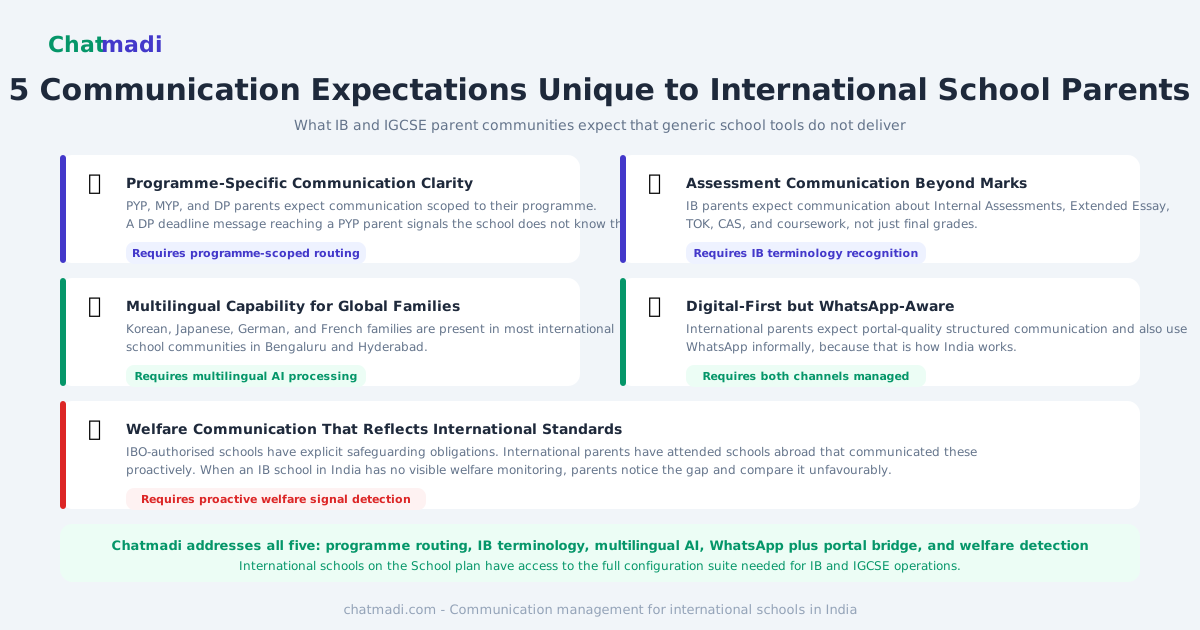
Five Communication Expectations Unique to International School Parents
Expectation 1: Programme-Specific Communication Clarity
IB schools run three distinct programmes: the Primary Years Programme (PYP) for students up to age 11, the Middle Years Programme (MYP) for students aged 11 to 16, and the Diploma Programme (DP) for students aged 16 to 19. IGCSE schools have their own distinct stage structure from Lower Secondary through to A Level.
Parents of international school students expect communication that is specific to the programme their child is in, not generic school-wide broadcasts. A PYP parent receiving a message about DP Internal Assessment deadlines has received irrelevant communication. A DP parent receiving a message framed in PYP language has received communication that signals the school does not know their child's context.
This requires a communication system that routes information by programme, not just by class or year group. A WhatsApp message about a PYP Exhibition should reach PYP parents and only PYP parents. A message about Extended Essay deadlines should reach DP parents specifically.
The class and subject management system in Chatmadi supports programme-specific class structures, enabling communication to be scoped by programme, year group, and subject as the school requires.
Expectation 2: Assessment Communication Beyond Marks
IB assessment, particularly in the MYP and DP, is fundamentally different from CBSE and ICSE examination-based assessment. It includes internal assessments, oral components, the Extended Essay, the Theory of Knowledge essay, CAS (Creativity, Activity, Service) requirements, and subject-specific investigations and projects.
Parents of IB students expect communication about each of these assessment components, not just final grades. When an internal assessment deadline is approaching, parents expect a reminder. When a student submits a draft Extended Essay, parents expect acknowledgement. When a student's CAS hours need updating, parents expect a notification.
This level of assessment-specific communication is far more granular than what most Indian schools, CBSE or otherwise, provide. It requires a system that can categorise communications by assessment type and route them to the relevant parents with programme-specific context.
The exam and assessment communication guide covers how to structure assessment communication in a way that is meaningful for parents. For international schools, this framework needs to be extended to cover the full range of IB assessment components.
Expectation 3: Multilingual Capability for Global Families
International school parent communities in India include families who communicate primarily in languages other than English and Hindi. Korean, Japanese, German, French, and Dutch families are present in meaningful numbers in the expatriate communities of Bengaluru and Hyderabad. Returning NRI families may communicate in English but expect the school to understand regional language signals from grandparents or domestic staff who communicate with the school about a child's absence.
A school communication system that can only process English misses a portion of its international parent community's actual communication. The multilingual AI analysis capability is particularly relevant for international schools where the parent community genuinely spans multiple languages.
Expectation 4: Digital-First, WhatsApp-Aware Communication
International school parents, particularly expatriate families, are highly digital. They are comfortable with school portals, mobile apps, and digital communication tools. At the same time, they have rapidly adopted WhatsApp as their primary informal communication channel in India, particularly after arriving from countries where WhatsApp is less dominant.
This creates a specific dynamic: international school parents expect digital-first communication that is as seamless as the portals they used in Singapore or the UK, but they also communicate informally with teachers and the school via WhatsApp because that is how India works. The best international school communication systems need to bridge these two channels: maintaining the formal, structured communication of a digital portal while capturing and processing the informal WhatsApp channel that is the reality of day-to-day parent communication in India.
The WhatsApp API for schools guide explains how schools can integrate formal WhatsApp Business communication with their existing parent communication approach, creating a channel that feels both familiar to Indian WhatsApp users and professional to international school parents.
Expectation 5: Welfare Communication That Reflects International Standards
International schools, particularly IBO-authorised schools, have explicit obligations under the IB's own guidelines around student welfare, safeguarding, and pastoral care. Parents who have attended IB schools internationally have experience of schools that take these obligations seriously and communicate about welfare proactively.
When an IB school in India fails to communicate a welfare concern promptly, or fails to have visible welfare monitoring systems, international school parents notice. They compare it to the safeguarding standards of schools they have attended elsewhere. The gap is not always in the school's actual welfare practice. It is often in the communication of that practice.
The child safety alert system provides the welfare monitoring infrastructure that makes it possible to communicate welfare practices to parents with confidence. When a welfare signal is detected, acknowledged, and acted on within 24 hours, the school can honestly tell its parent community that it has systems in place that reflect international standards.
The IGCSE Difference: Cambridge Curriculum Communication Needs
IGCSE and A Level schools, while sharing some characteristics with IB schools, have specific communication needs shaped by the Cambridge curriculum's structure.
IGCSE students typically begin their two-year course in Year 10, with examinations at the end of Year 11. A Level students spend two years in Years 12 and 13 preparing for their final examinations. This extended examination preparation cycle creates a communication rhythm where the urgency of parent communication increases steadily from the beginning of Year 10 and reaches its peak in the months before examinations.
Cambridge schools also deal with a specific type of parent anxiety around predicted grades and university applications. For students applying to universities in the UK, the US, or other international destinations, predicted grades and school references submitted through UCAS or Common App are critically important. Parents of students in Years 12 and 13 are deeply anxious about these processes and expect their school to communicate clearly about the timeline, requirements, and status of these applications.
School communication systems for Cambridge schools need to accommodate this examination cycle awareness. Communication around Cambridge deadlines, coursework submission dates, and predicted grade discussions should be part of the school's structured communication calendar, not ad hoc responses to parent queries.
The PTM management system can be adapted to accommodate the specific parent meeting needs of Cambridge schools, including dedicated discussions about university application trajectories in Year 12 and 13 PTMs.
What International Schools Do Differently in Parent Communication
The international schools in India with the strongest parent community relationships share a set of communication practices that distinguish them from schools where parent satisfaction is a persistent challenge.
Weekly programme-specific newsletters. The most effective international schools in India send a brief, programme-specific newsletter every Friday that covers what students learned that week, what is coming up the following week, and any assessment or event communications. This weekly rhythm creates a predictable communication pattern that parents can rely on. Proactive assessment calendar communication. Assessment deadlines are communicated to parents at the beginning of each term with a full calendar, not one week before each deadline. This allows families to plan around assessment submissions and reduces the anxiety of deadline surprises. Clear channel demarcation. The best international schools are explicit with parents about which channel is for which type of communication. WhatsApp is for urgent or informal communication. Email is for formal communications and documents. The school portal is for assessment records and official correspondence. Clarity about channels reduces the noise in each channel and ensures important communications are not missed. Cultural sensitivity in communication tone. International school parent communities span many cultural backgrounds, and communication tone that works well for one community may not work for another. Schools that are aware of this calibrate their communication tone accordingly, being more formal with some communities and more informal with others.The school communication software buying guide provides a framework for evaluating whether any school communication tool genuinely meets the needs of a diverse, internationally oriented parent community.
Setting Up Chatmadi for an International School
International schools have a more complex class and curriculum structure than CBSE or state board schools, and the configuration of a communication management system needs to reflect that complexity.
Programme structure: Configure classes to reflect the programme structure of your school. PYP classes (Year 1 through Year 6), MYP classes (Year 7 through Year 11), and DP classes (Year 12 and Year 13) should each be configured with the correct year group labels and with subject teachers assigned appropriately for the MYP and DP, where each student has multiple subject teachers with different assessment responsibilities. Assessment categorisation: For IB schools, configure the AI analysis to recognise IB-specific assessment terminology: Internal Assessment, Extended Essay, Theory of Knowledge, CAS, and subject-specific assessment names. For Cambridge schools, configure recognition of Cambridge-specific terms: coursework, practical assessment, predicted grades, and examination entries. Language context: For international schools with significant non-English-speaking parent communities, ensure the system is configured to process communication in the relevant languages. Korean, Japanese, French, and German parent messages should be analysed for the same absence, welfare, and fee payment signals that English messages are analysed for.The school setup guide covers the complete configuration process. International schools with complex programme structures typically take two to three hours for initial setup, compared to under an hour for simpler CBSE schools. This additional setup time is an investment in a configuration that genuinely reflects the school's operational complexity.
Start free at chatmadi.com. International schools on the School plan have access to the full range of features including unlimited classes, unlimited subjects, multi-programme configuration, and the complete AI analysis suite. Schools can begin with one programme (PYP, MYP, or DP) and expand to others once the first is working well.
Frequently Asked Questions
Does Chatmadi understand IB-specific terminology in parent communication?Yes. The AI analysis is configured to recognise IB-specific terms including Internal Assessment, Extended Essay, Theory of Knowledge, CAS, PYP Exhibition, MYP Personal Project, and DP assessments. Messages from parents that reference these terms are correctly categorised as academic assessment communications and routed to the relevant subject or programme teacher.
Can the system handle communication across PYP, MYP, and DP within the same school workspace?Yes. All three IB programmes can be configured within a single school workspace, with classes organised by programme and year group. Communication is scoped by programme automatically, so a broadcast to PYP parents does not reach MYP or DP parents. Subject teacher assignments reflect the more complex teaching structure of the MYP and DP, where each student has multiple subject teachers.
How does Chatmadi handle the higher fee levels typical of international schools in India?Fee detection and management in Chatmadi works with any fee amount. International school fee structures, which are typically significantly higher than CBSE school fees and often structured with annual payment options, are supported in the fee management configuration. Fee payment confirmation messages, whether from bank transfers or UPI payments, are detected and routed to the accounts team regardless of the amount.
Do international school parents in India use WhatsApp as much as other Indian school parents?Yes. WhatsApp adoption among international school parents in India is very high, including among expatriate families who may not have used WhatsApp before arriving in India. The convenience and ubiquity of WhatsApp in the Indian school context means that even parents from countries where WhatsApp is less common quickly adopt it for school communication. International school parents also tend to be highly responsive to WhatsApp communication because of their generally high digital engagement.
How should international schools communicate their use of AI analysis to parents?International school parents are typically comfortable with technology and appreciate transparency about how it is used. Schools should include a clear explanation of AI-assisted communication analysis in their data processing notice (required under DPDPA) and can also explain it proactively in a welcome communication at the start of the academic year. Framing the AI analysis as a tool that helps the school respond faster and miss fewer important parent messages is generally well received by international school parent communities.
Chatmadi Team
School Communication Intelligence
The Chatmadi team writes about AI-powered parent communication, school management best practices, and WhatsApp intelligence for Indian schools. Built by Eduloom Technologies OPC Pvt Ltd, Mysore.
Ready to Try Chatmadi at Your School?
Free to start. Setup in 15 minutes. No new apps for parents.
Set Up My School Free →