School Teacher Performance Review: A Data-Driven Guide for Indian Principals
In this article
Teacher performance review is one of the most consequential and most uncomfortable responsibilities of an Indian school principal. Done well, it identifies teachers who need support, recognises teachers who are excelling, and gives every teacher a clear picture of where they stand and what is expected of them. Done poorly, it becomes a once-a-year classroom observation that tells the teacher nothing they did not already know and tells the principal nothing they could not have guessed.
Table of Contents
- [Signal 1: Parent Communication Response Rate](#signal-1-parent-communication-response-rate)
- [Signal 2: Absence Notification Handling Rate](#signal-2-absence-notification-handling-rate)
- [Signal 3: Syllabus Coverage Progress](#signal-3-syllabus-coverage-progress)
- [Signal 4: Homework Assignment and Follow-Up Consistency](#signal-4-homework-assignment-and-follow-up-consistency)
- [Signal 5: Student Welfare Alert Response Time](#signal-5-student-welfare-alert-response-time)
- [Signal 6: Class-Level Student Outcome Trends](#signal-6-class-level-student-outcome-trends)
- [Component 1: Data Review Before the Conversation](#component-1-data-review-before-the-conversation)
- [Component 2: The Performance Conversation](#component-2-the-performance-conversation)
- [Component 3: Documented Follow-Up Plan](#component-3-documented-follow-up-plan)
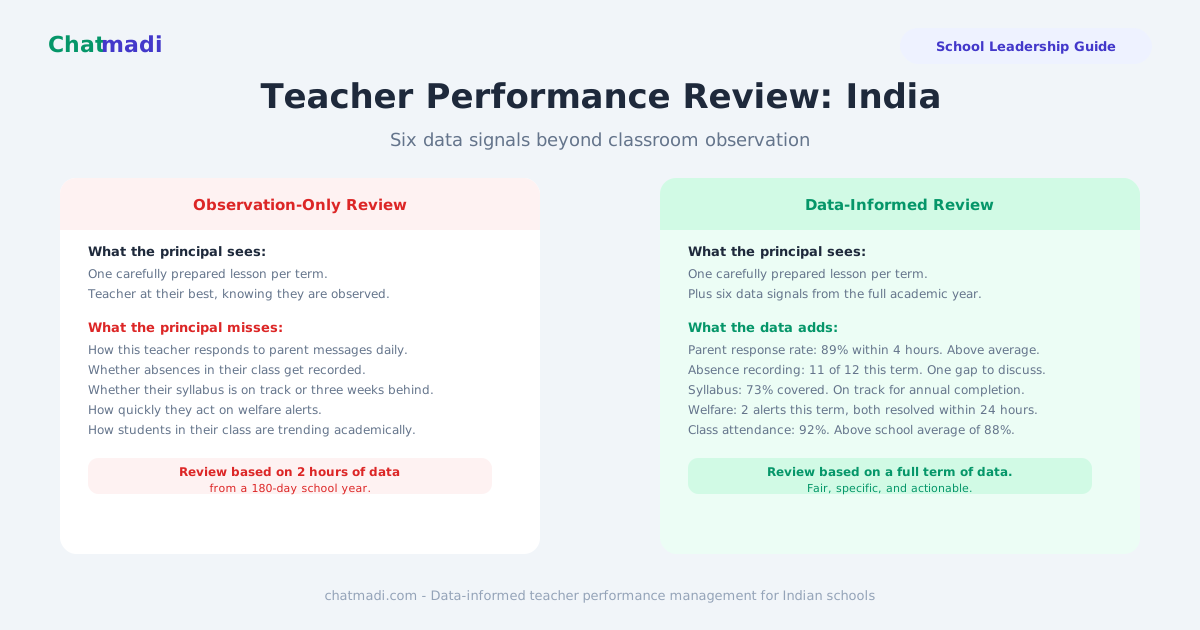
Most Indian school principals review teacher performance primarily through classroom observation. The principal or a senior academic coordinator sits in on one or two classes per teacher per year, completes a standardised observation form, and conducts a brief conversation about the observed lesson. This approach is better than nothing. It is significantly worse than what is possible when the principal uses the data that is already flowing through the school's daily operations to inform the review.
The data signals that matter for teacher performance are not hidden. They emerge from the teacher's daily communication with parents, from student attendance patterns in the teacher's class, from homework completion rates, from syllabus coverage progress, and from the welfare outcomes of students in their care. These signals are available to any school that has a systematic approach to capturing and reviewing them. Most schools do not.
This guide is for Indian school principals who want to conduct teacher performance reviews that are grounded in observable, consistent data rather than subjective impressions from a single classroom visit.
Why Observation-Only Reviews Are Not Enough
The classroom observation model for teacher performance review has two fundamental limitations that are well-documented in education research internationally and visible to any experienced Indian school principal.
The first limitation is the observer effect. Teachers who know they are being observed teach differently from how they teach on any other day. They prepare more thoroughly, manage the class more carefully, and present material in a more polished way than is their daily practice. The observed lesson is a performance of teaching, not a sample of it. A principal who bases 80 percent of a teacher's performance review on two observed lessons is reviewing a teacher's ability to perform under observation, not their day-to-day teaching quality.
The second limitation is that classroom observation captures only what happens inside the classroom. It does not capture how the teacher communicates with parents, how responsive the teacher is to student welfare concerns, how consistently the teacher covers the syllabus, or how student outcomes in the teacher's class compare to other classes teaching the same subject. These are all dimensions of teacher performance that matter for student outcomes and that observation alone cannot reveal.
According to NCERT's teacher performance framework, effective teacher evaluation should incorporate multiple sources of evidence over time, not rely on isolated observations. The framework identifies student learning outcomes, professional responsibilities, and parent and community engagement as components of teacher performance that observation cannot adequately capture.
Indian schools that supplement classroom observation with data from daily school operations conduct more accurate, more fair, and more useful performance reviews than schools that rely on observation alone.
Six Data Signals That Reveal Teacher Performance
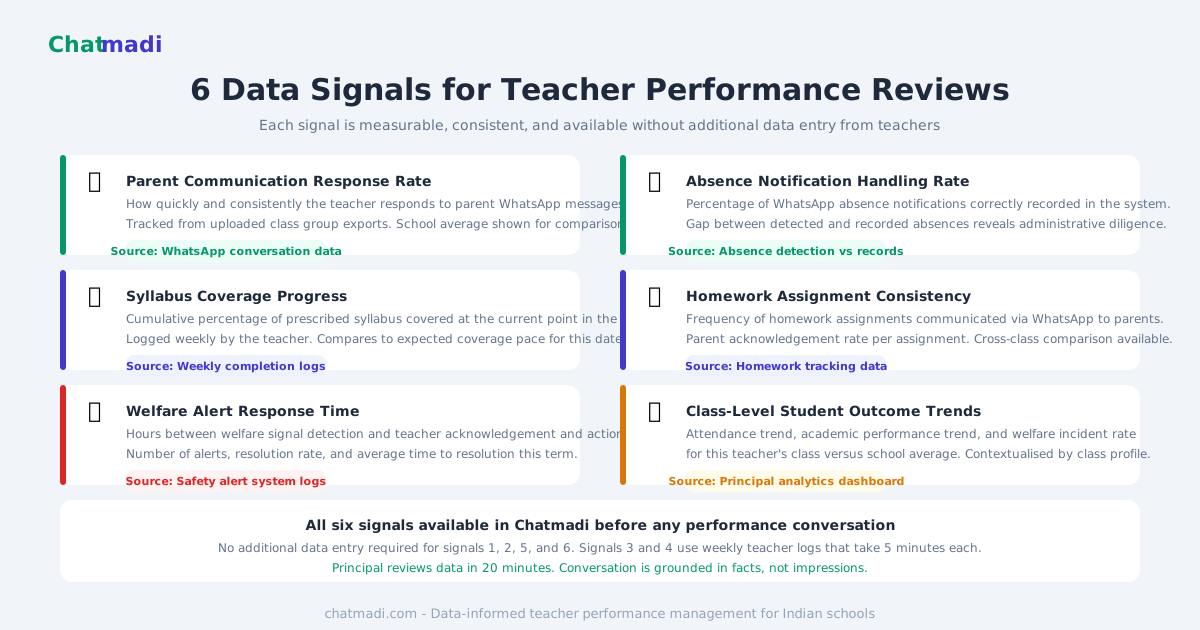
Signal 1: Parent Communication Response Rate
How quickly and how consistently a class teacher responds to parent communication via WhatsApp is a measurable dimension of professional responsibility. A class teacher who typically responds to parent messages within two hours during school hours is performing a different level of service from one who takes two days to respond or who does not respond at all.
This signal is not about quantity of communication. It is about responsiveness to the parent community the teacher is responsible for. A class teacher whose parents feel heard and responded to builds a qualitatively different relationship with their class's families than one whose parents feel ignored. That relationship affects everything from PTM attendance to homework completion to welfare communication.
Response rate to parent communication can be tracked from WhatsApp conversation data. When teachers upload class group exports, the system can identify messages directed at the teacher and track whether and when a response followed. The parent engagement measurement guide explains how communication patterns at the class level reflect teacher communication behaviour.
Signal 2: Absence Notification Handling Rate
When a parent sends an absence notification, does the class teacher acknowledge it within the school day? Does the absence get recorded in the attendance system? Is it authorised or left as an unconfirmed absence?
The gap between absence notifications received and absences correctly recorded in the attendance system is a direct measure of a class teacher's administrative diligence. A teacher who receives twelve absence notifications in a week and correctly records all twelve is performing differently from one who records four and misses eight. Both teachers may deliver equally good lessons. Only one is managing the administrative responsibilities of their role.
The attendance tracking guide explains how the gap between WhatsApp-detected absences and manually recorded absences surfaces in the system. This gap is a reliable teacher performance signal that the principal can review at any time without needing to observe a class.
Signal 3: Syllabus Coverage Progress
Class teachers and subject teachers are responsible for covering the syllabus within the academic year. The weekly syllabus completion log tracks how much of the prescribed syllabus has been covered by each teacher, week by week, across the academic year.
A teacher who is consistently on track or ahead of schedule is managing their teaching time effectively. A teacher who is consistently behind is not, regardless of how good their individual lessons look when observed. The principal who reviews syllabus coverage data across all classes can identify teachers who are falling behind early enough in the academic year to intervene constructively, rather than discovering the gap at year end when it is too late to address.
The syllabus completion tracking guide explains how the weekly logging system works and how the cumulative coverage percentage is calculated per subject per teacher.
Signal 4: Homework Assignment and Follow-Up Consistency
A class teacher who assigns homework consistently, communicates it clearly to parents via WhatsApp, and follows up on completion is performing a different level of pedagogical service from one who assigns homework irregularly and does not track whether it is completed.
The homework tracking data from WhatsApp conversation analysis shows which teachers are assigning homework and communicating about it, which parents are acknowledging it, and what the completion rates look like across different teachers' classes. Cross-class comparison of homework acknowledgement rates can reveal significant differences in how different teachers manage the homework communication cycle.
The homework tracking guide covers how homework communication data is captured and what patterns it reveals across a school's teacher community.
Signal 5: Student Welfare Alert Response Time
When a welfare signal is detected from parent communication in a class teacher's WhatsApp group, how quickly does the class teacher act on it? A class teacher who reviews welfare alerts daily and follows up within 24 hours is performing a different level of pastoral care from one who lets alerts sit unreviewed for a week.
This signal is one of the most ethically significant dimensions of teacher performance. The speed and quality of a class teacher's response to welfare concerns about their students is not a secondary performance metric. It is a core professional responsibility. Principals who do not track welfare response time are missing one of the most important signals of how well their teachers are fulfilling their duty of care.
The child safety alert system records when each alert was generated and when it was acknowledged and acted on. This timeline is available to the principal as part of the teacher's operational record.
Signal 6: Class-Level Student Outcome Trends
Ultimately, a teacher's performance is assessed by the outcomes of the students they teach. Class-level academic performance trends, attendance trends, and welfare incident rates are all aggregate signals of how well the teacher is managing their class's educational and pastoral needs.
This signal requires the most careful interpretation. Class-level outcomes are influenced by many factors beyond the teacher's control, including the academic starting point of the students, the socioeconomic context of the class's families, and the resources available to the teacher. A principal who uses class-level outcomes as the sole performance measure without accounting for context will reach unfair conclusions.
Used alongside the five signals above, class-level outcome trends provide important context for the full picture of a teacher's performance. A teacher whose class has declining attendance, low homework completion, unresolved welfare alerts, and below-average academic performance presents a very different picture from a teacher whose class has the same academic outcomes but strong communication, high homework completion, and no unresolved welfare issues.
The school analytics guide for principals explains how class-level performance data is aggregated and compared across the school, giving principals the cross-class view they need to contextualise individual teacher performance.
Structuring the Data-Informed Performance Review
A data-informed teacher performance review has three components: data review before the conversation, the performance conversation itself, and a documented follow-up plan. Each component serves a distinct purpose.
Component 1: Data Review Before the Conversation
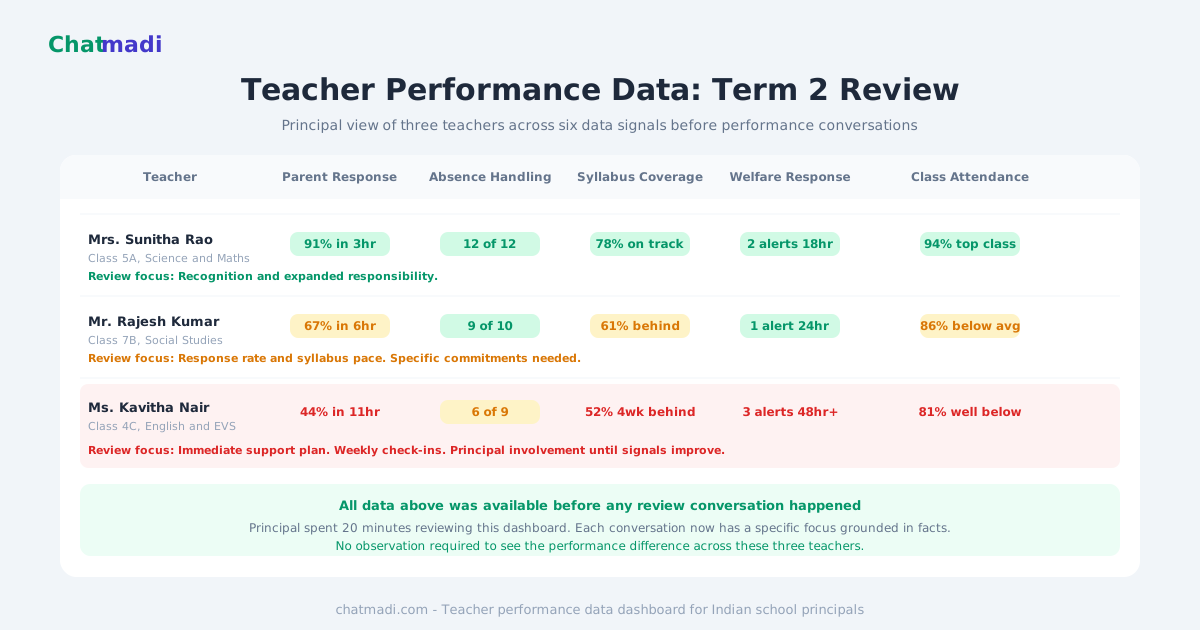
Before meeting with any teacher for a performance review, the principal should spend fifteen to twenty minutes reviewing the teacher's data profile. This includes: the teacher's parent communication response rate over the previous term compared to the school average; the teacher's syllabus coverage progress at the current point in the academic year; the homework assignment and acknowledgement pattern for the teacher's class; the welfare alert response timeline for any alerts generated from the teacher's class this term; and the class-level attendance trend compared to other classes in the same standard.
This data review ensures that the performance conversation is grounded in observable patterns rather than subjective impressions. The teacher cannot dispute the data (though they can explain it), and the principal cannot be accused of bias when the review is based on consistent, measurable signals.
Component 2: The Performance Conversation
The performance conversation should begin with the principal sharing the data review: not as an accusation but as an opening of a genuine professional dialogue. "I have been looking at the communication data from your class this term. I want to understand what you are seeing from your side."
This framing accomplishes two things. It signals to the teacher that the principal is using data, not impression, which immediately raises the seriousness of the conversation. It also invites the teacher to provide context that the data alone cannot capture.
A teacher whose parent response rate is low may have a legitimate explanation: a family crisis that consumed their attention for several weeks, a class whose parents prefer to communicate by phone rather than WhatsApp, or a period of illness that affected their response time. The data surfaces the pattern. The conversation explains it.
The strongest performance conversations end with specific, measurable commitments from the teacher about what will change in the next term. "I will aim to respond to parent messages within four hours during school hours" is a specific commitment. "I will try to be more responsive" is not.
Component 3: Documented Follow-Up Plan
Every performance conversation should produce a brief documented record: what was discussed, what commitments were made, and what the principal will do to support the teacher in meeting those commitments. This document protects both parties and creates accountability on both sides.
The follow-up plan should include a date for a brief mid-term check-in. Not another formal review: just a fifteen-minute conversation to see whether the commitments are being met and whether the teacher needs any support. The mid-term check-in is where the principal demonstrates that performance management is an ongoing process, not an annual event.
Common Mistakes in Indian School Teacher Performance Reviews
Even principals who want to conduct fair and useful performance reviews make consistent mistakes that undermine the process.
Mistake 1: Using observation as the primary evidence. For all the reasons discussed above, observation-only reviews are incomplete. Supplement observation with data. The data should inform the observation focus areas, and the observation should provide context for the data patterns. Mistake 2: Comparing teachers without accounting for context. A teacher whose class has a high proportion of students from difficult home circumstances cannot be fairly compared to a teacher whose class has a uniformly stable home environment. Contextualise data comparisons carefully. Mistake 3: Reviewing performance annually rather than continuously. Annual reviews are too infrequent to be useful as a development tool. The most effective approach is continuous monitoring with a formal review twice a year and brief monthly check-ins. The data signals described in this guide are available continuously, enabling the principal to have more frequent and more specific conversations with teachers throughout the year. Mistake 4: Not sharing data with teachers throughout the year. Teachers should not see performance data for the first time in a review conversation. They should have access to their own data throughout the year: their parent response rates, their syllabus coverage progress, their class attendance trends. The principal who shares data transparently and continuously builds a culture of professional accountability. Mistake 5: Ignoring strong performers. Performance management in most Indian schools focuses almost entirely on underperformers. Strong performers receive little feedback, limited recognition, and no specific development support. This is a retention risk: high-performing teachers who feel unrecognised leave. The data-informed review framework should be applied equally to strong performers, with conversations focused on recognition and development rather than remediation.The staff performance management guide covers additional strategies for building a performance management culture in Indian schools that goes beyond the annual review.
Using Chatmadi Data in Teacher Performance Reviews
The operational data that Chatmadi captures from daily school communication provides several of the six signals described in this guide without requiring any additional data entry from teachers or administrators.
The parent communication response rate is derived from uploaded WhatsApp conversation exports. The absence handling rate is derived from the comparison between WhatsApp-detected absences and recorded absences. The welfare alert response timeline is captured automatically when alerts are generated and reviewed. The homework communication pattern is visible from conversation analysis across class groups.
The syllabus coverage progress requires weekly input from teachers through the completion logging feature, but this input takes less than five minutes per teacher per week and produces a cumulative progress record that is available to the principal at any time.
The class-level outcome data, including attendance trends and academic performance by class, is available in the principal dashboard once exam results are entered.
Together, these data sources give the principal a coherent performance picture for each teacher that can be reviewed in twenty minutes before any performance conversation. The principal dashboard features bring this data together in a single view designed for school leadership decision-making.
Start free at chatmadi.com. The data signals most relevant to teacher performance review are available on the Growth plan and above. Principals can begin with one class and one teacher to experience how the data picture builds before rolling out the approach across the school.
Frequently Asked Questions
Should teachers know that their communication data is being tracked for performance review purposes?Yes. Transparency about data use is both ethically correct and practically effective. Teachers who know that their parent response rate, syllabus coverage, and welfare alert handling are visible to the principal are more likely to maintain consistent performance in these areas. This is professional accountability of the same kind that applies to any professional role where performance is assessed against measurable standards. Schools should disclose this data use in staff employment documentation and in the data processing notice required under DPDPA.
How should the principal handle a teacher who disputes the data?Data disputes should be taken seriously. If a teacher says their parent response rate appears low because a large number of parent messages were misdirected to a different contact, that is verifiable and should be verified. The data is a starting point for a conversation, not a verdict. The principal's response to a data dispute should be curiosity and investigation, not defensiveness. If the data is accurate and the teacher is disputing the underlying reality rather than the data itself, that is a different conversation.
How frequently should teacher performance data be reviewed with teachers?Formal performance review conversations should happen twice a year: once at the end of the first term and once at the end of the academic year. Informal data sharing should happen more frequently. Once a month, teachers should receive a brief summary of their key metrics: parent response rate this month, syllabus coverage progress, any welfare alerts and their status. This continuous sharing normalises data-informed professional development and reduces the anxiety that builds when data is withheld until a formal review.
Can performance data be used as a basis for dismissal in Indian schools?This is a legal question that depends on the terms of the teacher's employment contract and the applicable labour law. This guide is not legal advice. Schools should consult qualified legal counsel before using performance data in any employment action. What can be said generally is that documented performance data, applied consistently across all teachers with appropriate warning processes, is a stronger basis for any employment action than subjective impression alone.
What is the principal's responsibility when data reveals that a strong teacher is being underutilised?Strong teachers whose data consistently shows high parent engagement, full syllabus coverage, excellent welfare response, and strong student outcomes should be recognised and given expanded responsibility. Options include mentoring newer teachers, leading subject department reviews, contributing to school-wide communication standard-setting, or taking on a specialised role in the school's welfare or academic leadership. Principals who identify strong performers through data and then leave those performers in identical roles year after year are wasting a talent development opportunity and increasing the risk of losing those teachers.
Chatmadi Team
School Communication Intelligence
The Chatmadi team writes about AI-powered parent communication, school management best practices, and WhatsApp intelligence for Indian schools. Built by Eduloom Technologies OPC Pvt Ltd, Mysore.
Ready to Try Chatmadi at Your School?
Free to start. Setup in 15 minutes. No new apps for parents.
Set Up My School Free →