NEP 2020 and School Management Software: What Indian Schools Must Prepare For
In this article
The National Education Policy 2020 is the most significant reform of India's education system in over three decades. Its implications for how schools are run, how students are assessed, and how parents are engaged extend well beyond curriculum design. For school administrators and principals who are trying to implement NEP 2020 requirements while managing the daily operational complexity of a school, the question of technology is unavoidable: what does your school management software need to do differently to support what NEP 2020 is asking of you?
Table of Contents
[Understanding What NEP 2020 Actually Requires of Schools](#understanding-what-nep-2020-actually-requires-of-schools)
Most school software in India was designed for a pre-NEP 2020 world. It was built around mark-based assessment, terminal examinations, and a communication approach where schools broadcast information to parents rather than genuinely engaging them in their child's learning journey. NEP 2020 asks for something fundamentally different, and the technology schools use to manage their operations needs to reflect that difference.
This guide examines five specific areas where NEP 2020 creates new requirements for school management software, and explains what schools should look for when evaluating whether their current or prospective technology platform is actually capable of supporting the policy's implementation.
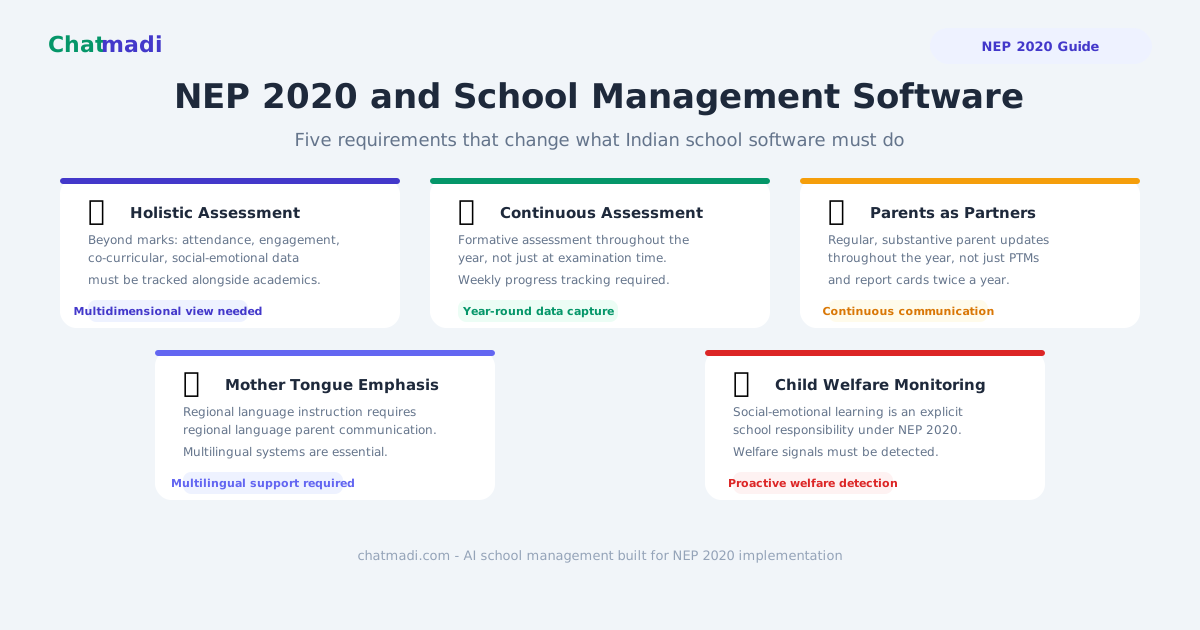
NEP 2020 requirements for Indian school management software, showing five areas where schools need technology support
Understanding What NEP 2020 Actually Requires of Schools
Before examining the technology implications, it is worth grounding the discussion in what NEP 2020 specifically asks schools to do differently. The policy runs to nearly 500 pages, but its core requirements for school operations fall into five areas that have direct implications for the software schools use.
Holistic and multidimensional assessment rather than single-examination results. NEP 2020 explicitly calls for 360-degree assessment that captures academic performance, co-curricular engagement, social-emotional development, and physical well-being. A school that continues to assess students purely on terminal examination marks is not implementing NEP 2020.
Formative assessment throughout the academic year rather than only summative assessment at examination time. This requires systems that can track student progress continuously, not just capture marks at the end of a term.
Genuine parent partnership in the child's learning journey. NEP 2020 uses the phrase "parents as partners" to describe a relationship where parents are informed, engaged participants in their child's education rather than recipients of occasional report cards.
Mother tongue and regional language emphasis in the early years of schooling. This has direct implications for how schools communicate with parents, as communication in a child's home language becomes more important under NEP 2020's vision.
Child welfare and social-emotional learning as explicit school responsibilities. NEP 2020 requires schools to track and support students' emotional wellbeing, not just their academic performance.
Area 1: Assessment Beyond Marks
The most operationally significant change NEP 2020 requires is the shift from mark-based to holistic assessment. This is not simply a philosophical preference. NEP 2020 specifically mandates that assessment include self-assessment, peer assessment, and teacher assessment across multiple dimensions of student development.
For school management software, this means the system must be able to record and track data beyond marks out of 100. It must capture attendance patterns (as a welfare signal, not just an administrative record), homework engagement rates, participation in co-curricular activities, and teacher observations about social-emotional development. It must also enable class teachers to see patterns across these dimensions for each student, not just academic performance in isolation.
This is a significant departure from how most Indian school software works. The overwhelming majority of school ERPs were built around the examination ledger as the primary data structure. They are good at recording and reporting marks. They are poor at capturing the qualitative, multidimensional data that NEP 2020 assessment requires.
The class teacher dashboard in Chatmadi is designed around a multidimensional student view that includes attendance percentage, homework acknowledgement rates, welfare flag status, and absence pattern analysis alongside academic performance data. This is not incidental to NEP 2020 implementation. It is the kind of student view the policy requires teachers to maintain.
Area 2: Continuous and Formative Assessment Records
NEP 2020 requires that assessment happen continuously across the academic year, not just at unit test, half yearly, and annual examination points. This means schools need systems that can receive, store, and surface assessment data at any point in the year, not just around formal examination cycles.
For most Indian schools, the practical challenge here is not the intention but the data management. A class teacher conducting informal formative assessments throughout the year, recording observations about student understanding, and tracking which students are falling behind in specific topics generates data continuously. Without a system that can capture this data systematically, it remains in the teacher's notebook or memory and cannot be aggregated, reported, or shared with parents.
The syllabus completion logging feature is directly relevant to this NEP 2020 requirement. When teachers log which topics were covered each week, the system builds a cumulative record of what has been taught and, by implication, what students have been assessed on. This continuous record becomes the basis for the kind of ongoing progress tracking NEP 2020 envisions.
For parent communication, continuous assessment also means parents should be receiving regular updates about their child's progress rather than waiting for a report card twice a year. This is where WhatsApp, as India's primary parent communication channel, becomes directly relevant to NEP 2020 implementation.
Area 3: Parents as Partners in Learning
NEP 2020's vision of parents as partners is the area with the most direct implications for school communication technology. The policy is explicit that schools must engage parents as active participants in the learning process, not as passive recipients of grades.
In practice, this means parents should know what their child is learning each week, not just what marks they received at the end of the term. It means parents should receive regular communication about their child's engagement, welfare, and progress. It means parent-teacher meetings should be substantive conversations about the child's development rather than a brief handover of a report card.
Most Indian schools communicate with parents reactively: when there is a problem, when fees are due, when an examination is approaching, or when a PTM is scheduled. NEP 2020 asks for proactive, continuous parent engagement. The schools that implement this most effectively are the ones that have systems for generating regular, substantive parent communication without it requiring hours of additional work from already stretched teachers.
The AI weekly digest feature is designed for exactly this use case. Every week, the system generates a natural-language summary of each class's activities, absences, homework engagement, and upcoming events, written in a format that teachers can share with parents directly. This transforms the "parents as partners" requirement from an aspiration into an operational reality without adding significant teacher workload.
The parent engagement tracking guide shows how schools that measure and systematically improve parent engagement achieve better outcomes across attendance, homework completion, and academic performance, all of which are directly relevant to NEP 2020's goals.
Area 4: Mother Tongue and Regional Language Communication
NEP 2020's emphasis on mother tongue medium instruction in the early years of schooling has a less obvious but important implication for school communication: if children are learning in their home language, communication with their parents should ideally happen in that language as well.
For Indian schools, this is not a simple requirement to implement. It requires school communication systems that can handle regional language content, and it requires teachers and administrators who can communicate effectively in the relevant language. But the technology foundation for this is the starting point.
The state board school communication guide covers the regional language communication challenge in detail. The relevant point for NEP 2020 is that a school implementing the policy's mother tongue emphasis while still communicating exclusively in English with regional language parents is creating a disconnect that undermines the policy's intent.
AI-powered communication tools that process and understand regional language parent messages, as described in the guide to how Chatmadi reads school conversations, provide the technical foundation for genuine multilingual parent engagement that NEP 2020's vision requires.
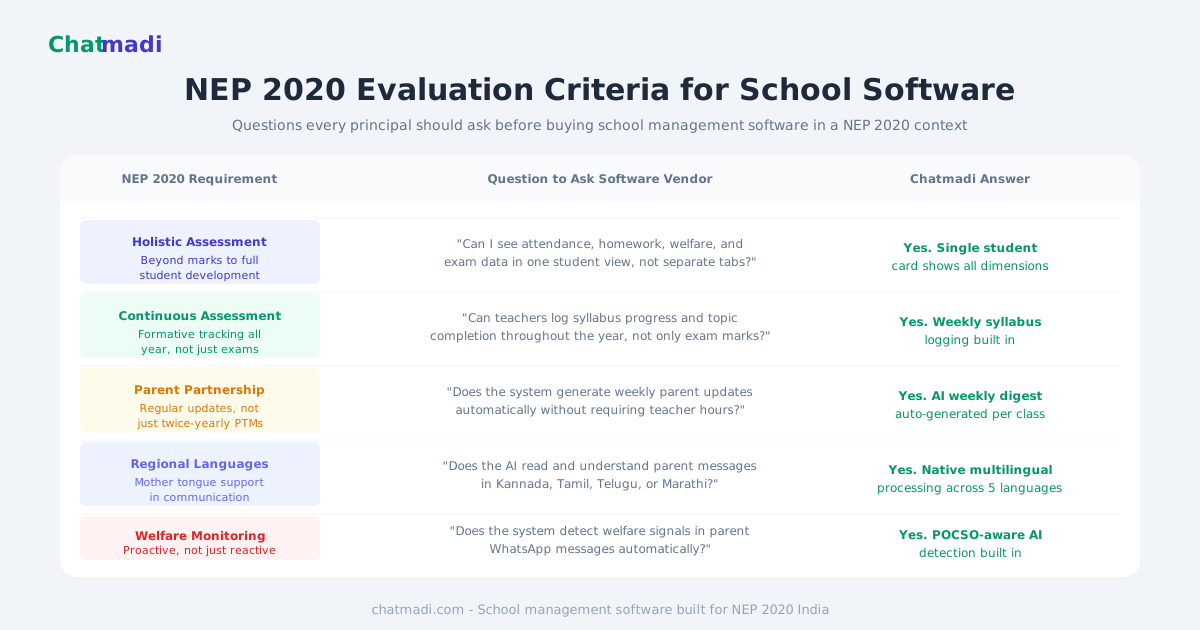
Five NEP 2020 requirements that directly affect school parent communication and student assessment
Area 5: Child Welfare and Social-Emotional Learning
NEP 2020 explicitly identifies student wellbeing and social-emotional learning as school responsibilities. This means schools must have systems for identifying students who are experiencing difficulties that go beyond academic performance: emotional distress, social challenges, family difficulties, and safety concerns.
For school management software, this requirement means the system must be able to surface welfare signals that arrive through school communication channels, not just track academic data. When a parent sends a WhatsApp message expressing concern about their child's emotional state, that message must reach the right person and trigger the appropriate response.
Most school software has no capacity for welfare monitoring from communication channels. It may have a field in the student database for welfare flags, but those flags require a teacher to manually notice a concern and record it. The actual signal, the parent's worried WhatsApp message, is invisible to the system.
The child safety alert system addresses this directly. When teachers upload WhatsApp conversation exports, the AI identifies welfare signals: bullying mentions, distress indicators, isolation concerns, and family difficulty signals. Each flagged message creates an alert that reaches the class teacher and principal, ensuring that the welfare monitoring responsibility NEP 2020 places on schools is actually discharged rather than being a policy aspiration with no operational mechanism.
The POCSO compliance guide for Indian schools covers the specific welfare monitoring obligations that Indian schools carry under POCSO, which NEP 2020 reinforces and extends.
What NEP 2020 Means for School Technology Buying Decisions
For a school principal or administrator evaluating school management software in 2025, NEP 2020 should inform the evaluation criteria in four specific ways.
Assessment flexibility. Does the system support multidimensional student assessment, or is it built only around examination marks? Can it capture qualitative teacher observations, welfare flags, and engagement data alongside academic performance? Can it generate the kind of holistic student view NEP 2020 requires without requiring teachers to manually compile data from multiple systems?
Communication continuity. Does the system enable continuous parent communication throughout the academic year, or is it designed primarily for periodic report card distribution? Can it generate regular progress updates for parents without requiring teachers to spend hours composing individual messages? Does it work with WhatsApp, the channel Indian parents actually use?
Regional language support. Can the system process parent communication in regional languages? Can teachers using the system communicate with parents in their preferred language? Does the communication intelligence the system provides work across all the languages spoken in the school's parent community?
Welfare integration. Does the system surface welfare signals from communication channels, or does it require manual welfare flag entry? Can it detect the difference between a routine absence notification and a message that contains a welfare concern? Does it route welfare signals to the right person automatically?
Data continuity across the academic year. Can the system maintain a continuous student record that reflects progress throughout the year, not just at examination time? Can this data be shared with parents progressively rather than only in terminal reports?
The school communication software buying guide covers evaluation frameworks for school technology in detail. The NEP 2020 criteria above should be added to any evaluation checklist for schools taking the policy seriously.
The Practical Reality of NEP 2020 Implementation
It would be dishonest to suggest that any software platform fully solves the challenge of NEP 2020 implementation. The policy requires changes in pedagogy, teacher training, assessment design, and school culture that go well beyond what any technology can deliver. Software is an enabling tool, not a substitute for the human work of education reform.
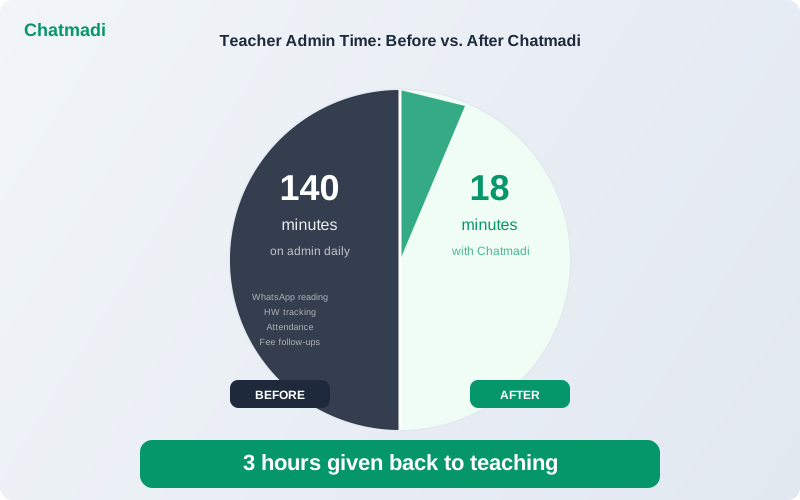
What software can do is remove the operational friction that makes NEP 2020 implementation harder than it needs to be. When teachers spend less time on manual communication and data entry, they have more capacity for the qualitative, relationship-based work that NEP 2020's vision of holistic education requires. When parents receive regular updates about their child's progress via WhatsApp rather than waiting for a PTM twice a year, the parent partnership NEP 2020 envisions becomes a lived reality rather than a policy statement.
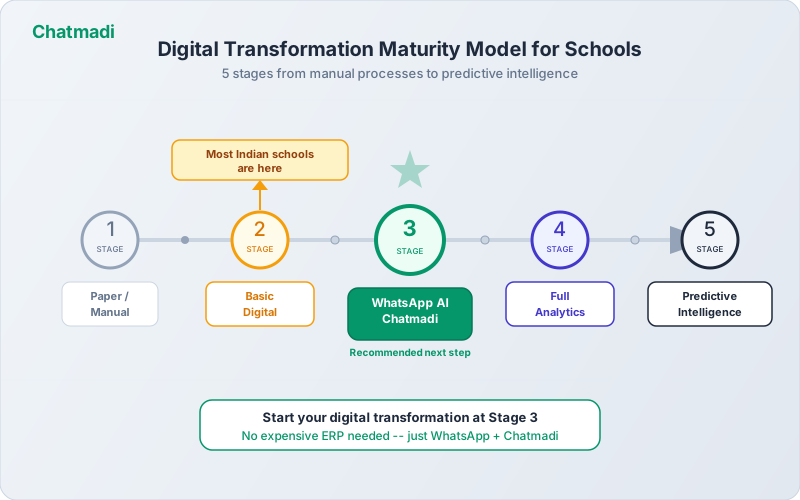
For most Indian schools, the starting point is not a complete technology overhaul. It is identifying the specific NEP 2020 requirements that are currently unmet and finding the minimum technology changes that address those gaps. Often, the highest-value change is implementing a systematic approach to WhatsApp communication that transforms what is currently a source of operational chaos into a genuine channel for the parent partnership NEP 2020 asks for.
Start free at chatmadi.com. The features most relevant to NEP 2020 implementation, including continuous student monitoring, welfare alert detection, and regular parent communication via WhatsApp, are available on the Growth plan and above. Schools can test the approach with a single class before rolling it out across the school.
Frequently Asked Questions
Does using Chatmadi mean a school is NEP 2020 compliant?
No software platform can make a school NEP 2020 compliant on its own. Compliance with NEP 2020 requires changes in curriculum design, pedagogy, teacher training, and assessment practices that go well beyond technology. Chatmadi addresses specific operational requirements of NEP 2020 implementation, including continuous parent communication, welfare monitoring from WhatsApp conversations, and multidimensional student tracking. It is a tool that supports implementation, not a substitute for it.
How does the AI weekly digest feature support NEP 2020's parent partnership requirement?
The AI weekly digest generates a natural-language summary of each class's activities, student progress highlights, attendance patterns, and upcoming events every week. This gives teachers a ready-made parent update that reflects continuous learning activity rather than periodic examination results. Sharing this digest with parents via WhatsApp creates the regular, substantive communication that NEP 2020's vision of parents as partners requires, without adding significant workload to teachers.
Does Chatmadi support the holistic assessment approach NEP 2020 requires?
The student dashboard in Chatmadi shows multiple dimensions of student data: attendance percentage, homework acknowledgement rates, welfare flag status, absence patterns, and academic performance across examinations. This multidimensional view supports the teacher's ability to conduct the holistic assessment NEP 2020 requires. It does not replace the qualitative teacher observation and peer assessment components, which remain the teacher's responsibility.
How should schools use the welfare monitoring features to meet NEP 2020 obligations?
NEP 2020 places explicit responsibility on schools for student welfare and social-emotional learning. The welfare monitoring features in Chatmadi detect welfare signals from WhatsApp conversations and route them to class teachers and principals. Schools should integrate this into their welfare response protocol: when a welfare alert is detected, there should be a defined process for who responds, how quickly, and how the response is documented. The technology surfaces the signal. The school's welfare policy determines what happens next.
Is Chatmadi suitable for government schools implementing NEP 2020?
Chatmadi is designed for any school where WhatsApp is the primary parent communication channel, including government and government-aided schools. The Starter plan is free, making it accessible for schools with limited technology budgets. Government schools implementing NEP 2020 have the same parent communication and welfare monitoring requirements as private schools, and many face these challenges with fewer resources, which makes the efficiency gains from AI-powered communication management particularly valuable.
TagsAI school management software IndiaNEP 2020 school technology IndiaNEP 2020 parent communication schoolsbest school management software NEPNEP 2020 assessment school softwareholistic education school technology India
C
Chatmadi Team
School Communication Intelligence
The Chatmadi team writes about AI-powered parent communication, school management best practices, and WhatsApp intelligence for Indian schools. Built by Eduloom Technologies OPC Pvt Ltd, Mysore.